
Lithuanian contemporary art has had a loud, well-deserved international run in recent years, from the Golden Lion forSun & Sea (Marina) at the Venice Biennale to the 2025 Performa Biennial Lithuanian Pavilion Without Walls. It would be easy to build yet another canon around the usual headline names, from Lina Lapelytė to Pakui Hardware, or to keep circling Robertas Narkus, Augustas Serapinas, Andrius Arutiunian, Emilija Škarnulytė, Eglė Budvytytė, and others who have already secured strong international visibility.
Yet the list below is deliberately personal – ten Lithuanian artists I’m following closely right now, not as a counter-canon to the obvious names, but as a map of where Lithuanian practice is currently thickening – at the level of research, material intelligence, and lived critique, where images, bodies, institutions, and everyday infrastructures are tested until they start to behave differently. Consider it an invitation to look closer, before the rest of the ecosystem catches up.
Gerda Paliušytė (b. 1987) lives and works in Vilnius. Her practice operates as a quiet resistance to the acceleration of neoliberal time, finding value in the “logistics of meaning” rather than its efficient delivery. Working primarily with photography, moving image, and installation, she investigates the cracks in commercial and biological systems – places where the “future” has not been successfully marketed. Her recent work focuses on the aftermath of consumption, such as macro giclée prints of white orchids that have outlived their artificially dyed blue phase, presenting them as accidental survivors of the floral industry.
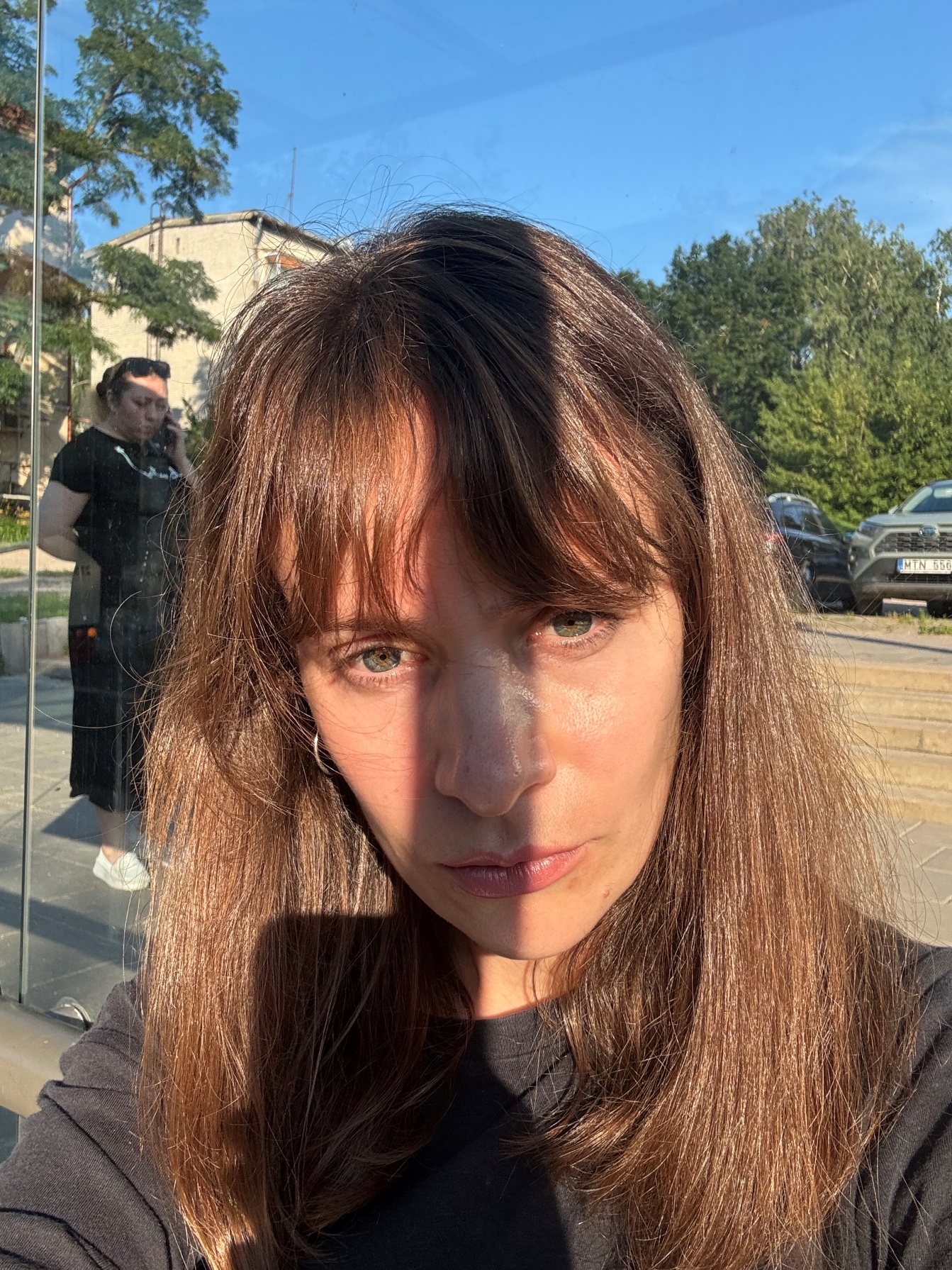
Gerda Paliušytė, self-portrait. Courtesy of the artist
She frequently engages with the aesthetics of transport and containment, transforming shipping boxes into autonomous sculptural spaces where the flow of images is deliberately suspended. By shifting focus from the centre to the periphery, her work suggests that true agency lies not in perfection, but in the stubborn persistence of the fragile; it acts less as a manifesto and more like a glitch in the natural selection of images.
While her professional background includes significant development through residencies such as the Berlinale Talents (2019) and the Sommerakademie im Zentrum Paul Klee in Bern (2014), she has established a robust international exhibition profile. Her recent solo presentations include Expectations at the Contemporary Art Centre (CAC), Vilnius (2025), and You Look At Me at the Jeu de Paume, Tours (2024). She has also exhibited at Editorial in Vilnius and the Lavender Opener Chair in Tokyo. Her group participation spans the 15th Kaunas Biennial, Survival Kit 15 in Riga, and the XII Baltic Triennial. She is a PhD candidate at the Vilnius Academy of Arts.
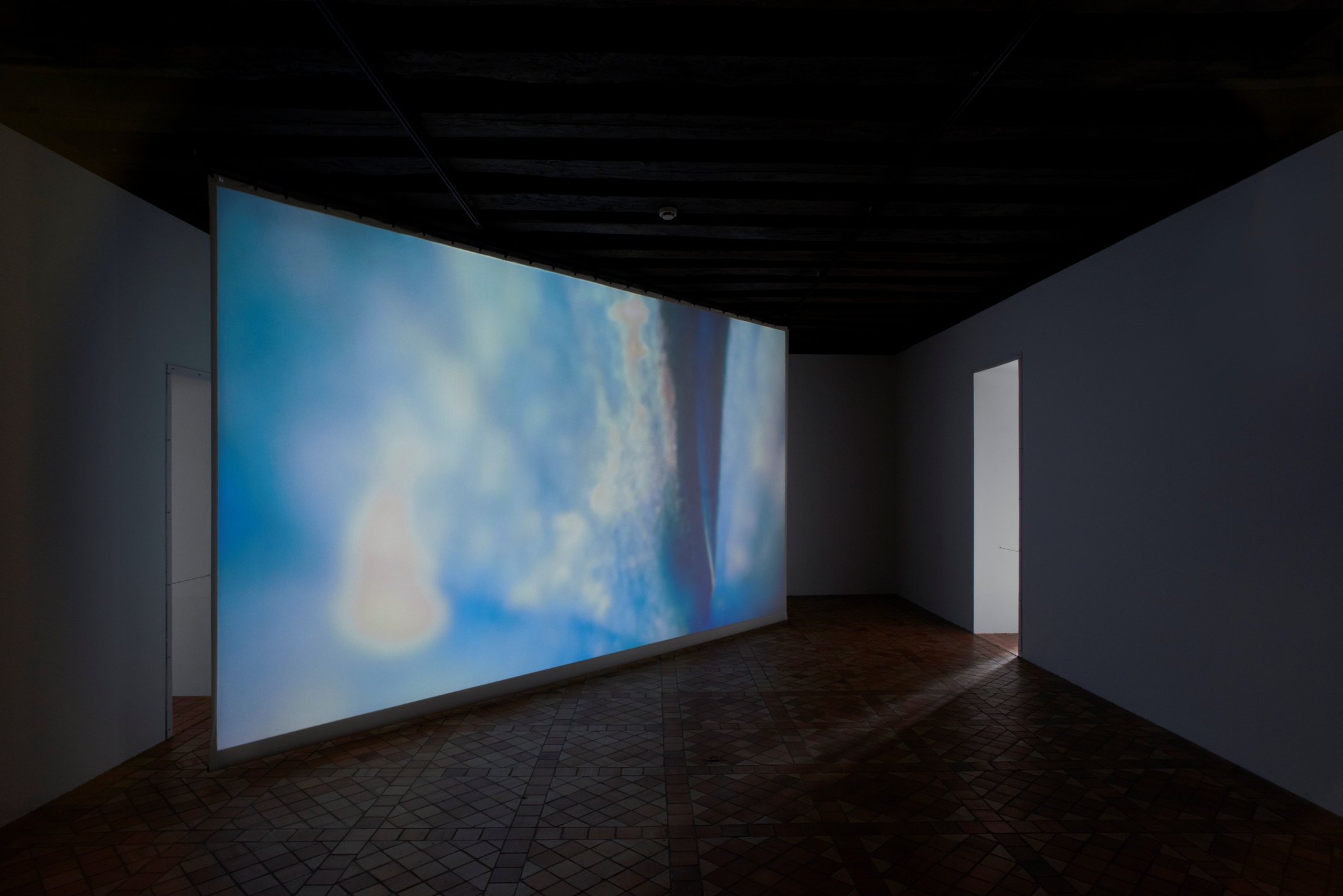
Gerda Paliušytė, Solo exhibition _You Look at Me_, Jeu de Paume-Tours, 2024. Curator Asta Vaičiulytė. Photo: Boris Camaca. Courtesy of the artist
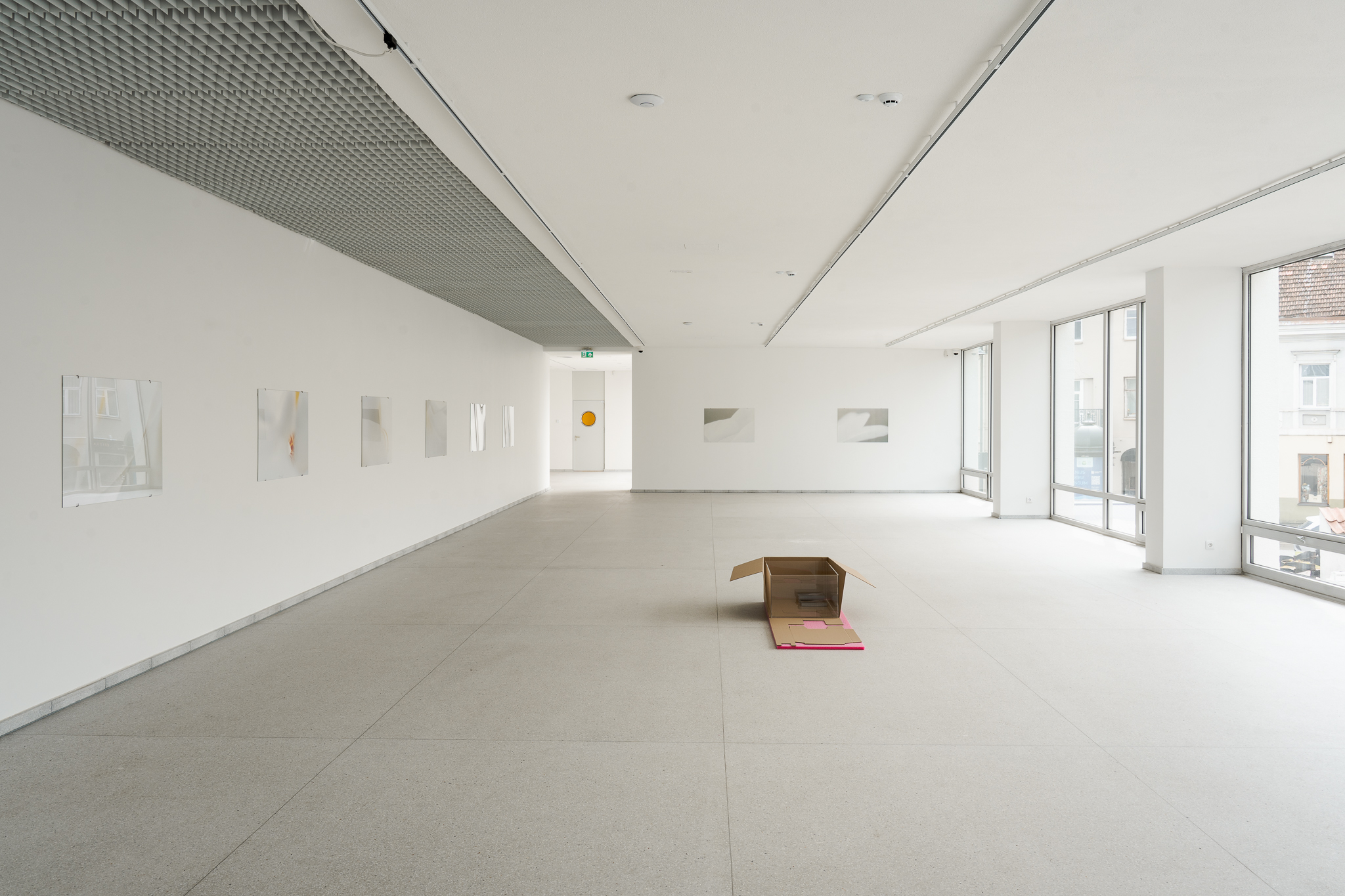
Gerda Paliušytė, Solo exhibition _Expectations_, CAC, 2025. Curator Asta Vaičiulyė. Photo: Andrej Vasilenko. Courtesy of the artist
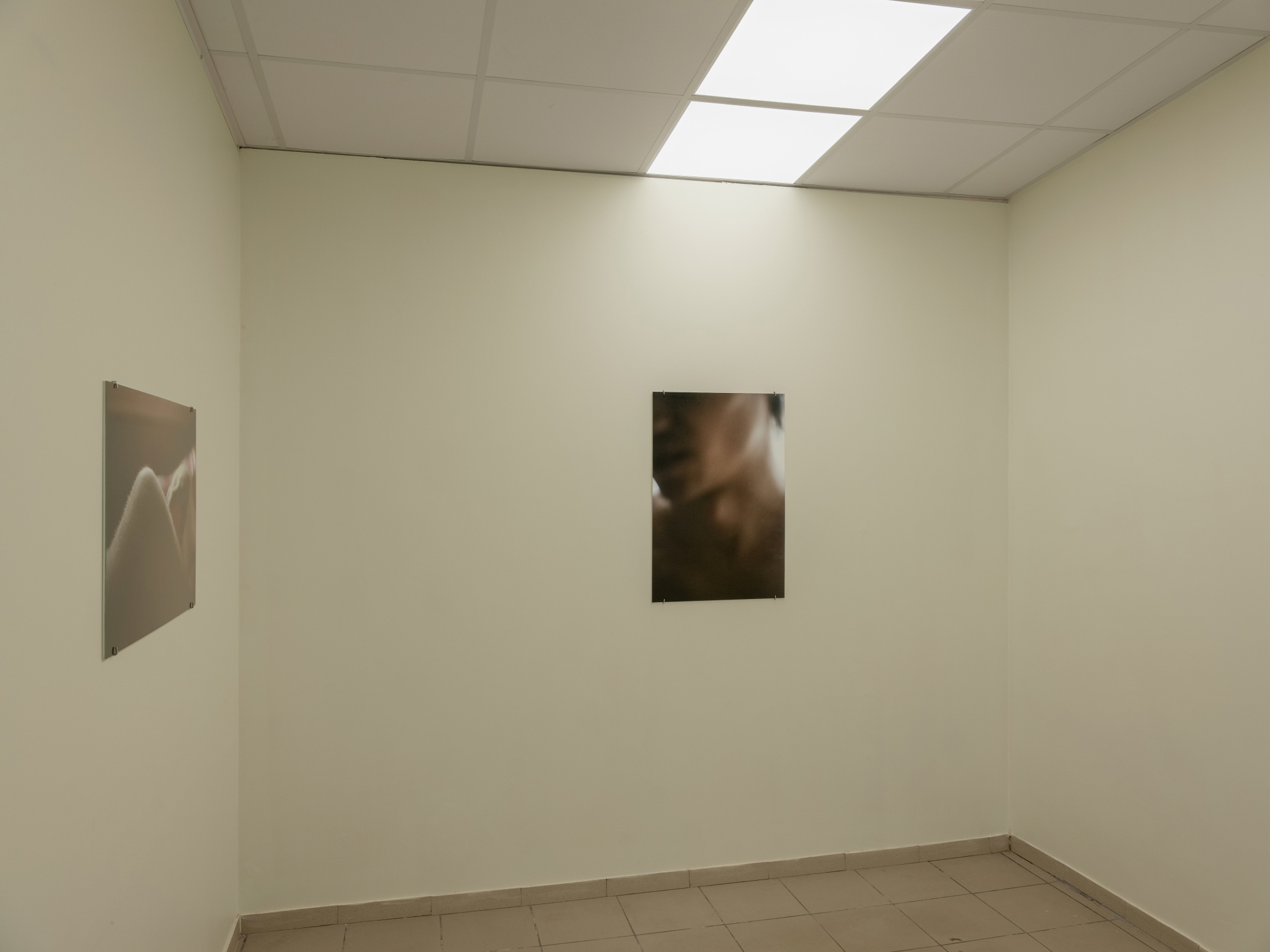
Gerda Paliušytė, “Lepus” exhibition (with Snieguolė Michelkevičiūtė), Avietė project space, 2025. Curator Agnė Bagdžiūnaitė. Photo: Lukas Mykolaitis. Courtesy of the artist
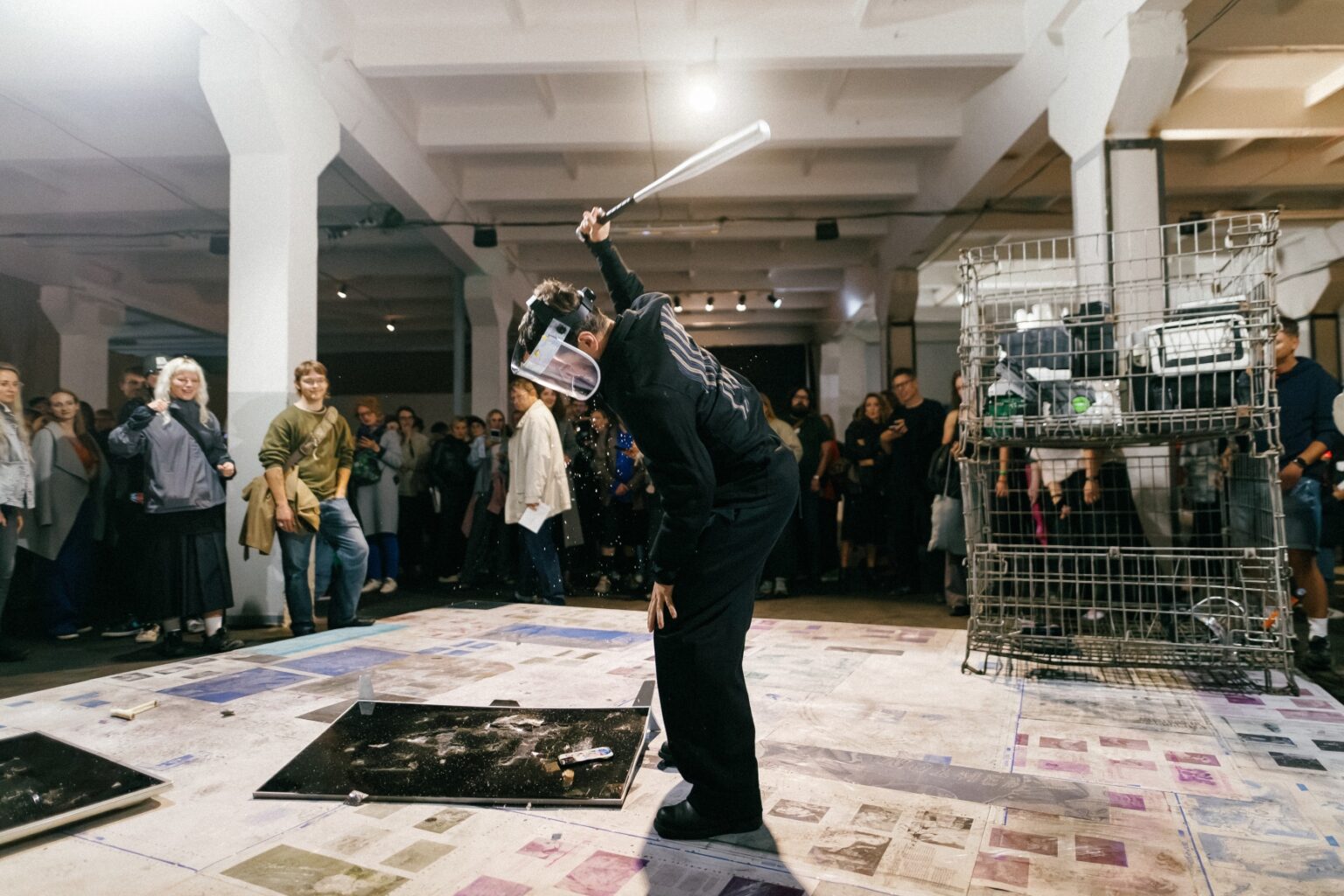
Anastasia Sosunova’s (b. 1993) multidisciplinary practice – spanning video, sculpture, installation, and printmaking – dissects the mechanisms of contemporary belief systems, from political populism to niche fandoms. Rooting her inquiry in the specific socio-political landscape of Eastern Europe and Lithuania, she analyses how collective myths are constructed and how “secular faiths” shape community behaviour. In recent works like the video Xover (2025), she juxtaposes the aesthetics of online fan culture with the architecture of authority, employing thermal imagery and “rage room” debris in her installations – smashable printers, modems, and screens – as the fossilised remains of the digital age.
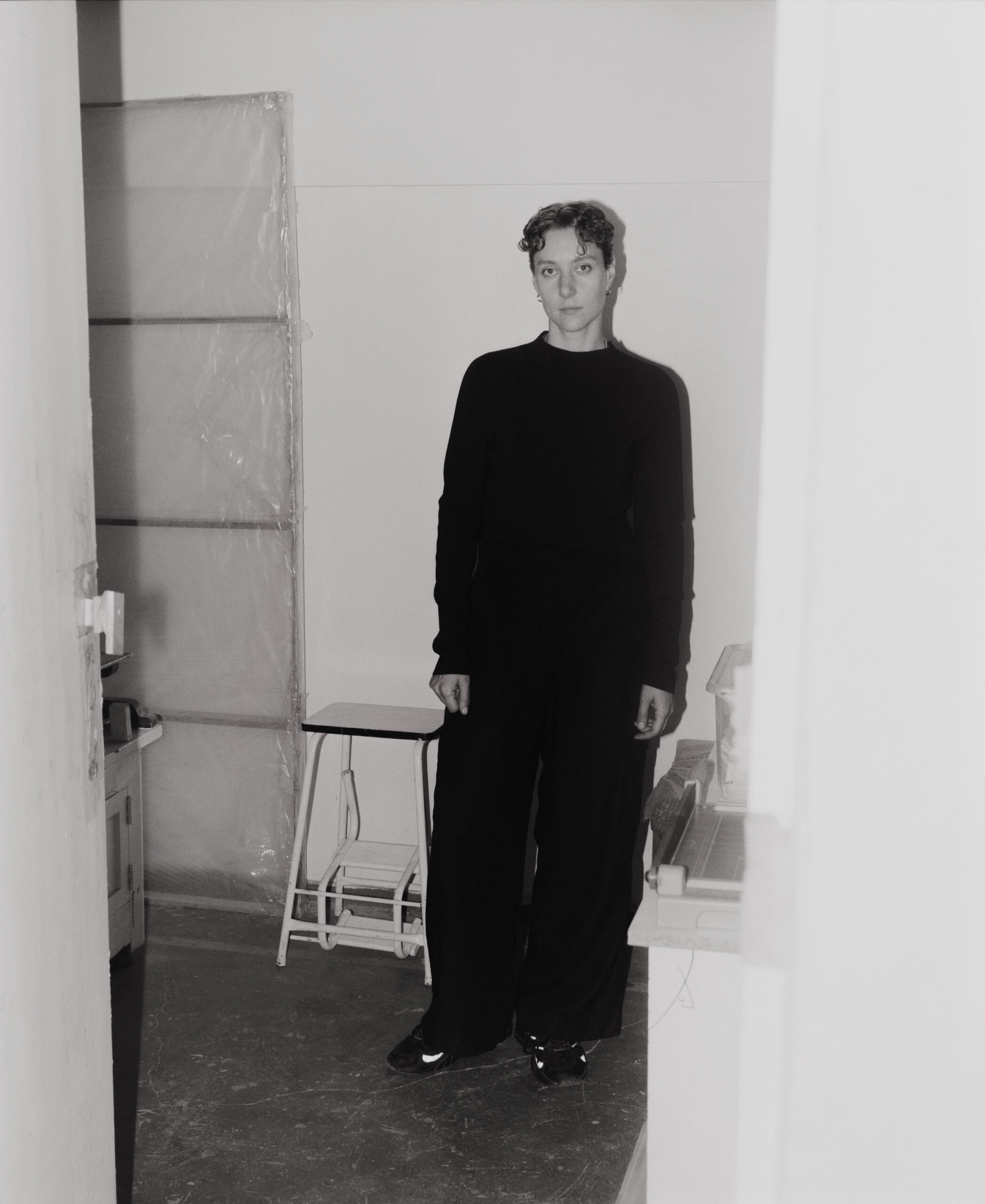
Anastasia Sosunova. Photo: Visvaldas Morkevičius. Courtesy of the artist
She is particularly interested in the friction between rational structures and the “messy” reality of human myth-making. By treating political narratives with the same anthropological curiosity as fan fiction, Sosunova suggests that today’s geopolitical reality is less a sequence of facts than a competing series of emotional crossovers, where the line between a devoted fan and a radicalised partisan is unsettlingly thin.
Sosunova holds a BA in Graphic Art (2015) and an MA in Sculpture (2017) from the Vilnius Academy of Arts, alongside participation in the Rupert Alternative Education programme (2016). A winner of the JCDecuax Prize (2018) and the Queer Art Prize at Viennacontemporary (2024), she has held solo exhibitions at the Contemporary Art Centre, Vilnius (2025), ICA Milano (2025), and Cell Project Space, London (2022). Her work has been featured in major international surveys, including the 17th Lyon Biennale, the 15th Gwangju Biennale, and the exhibition Contemporary art in Lithuania at the Centre Pompidou, Paris. In the first quarter of 2026, Anastasia was in residence at the prestigious Delfina Foundation in London. In 2026, she was also awarded the Lithuanian Government Prize for Culture and Art.
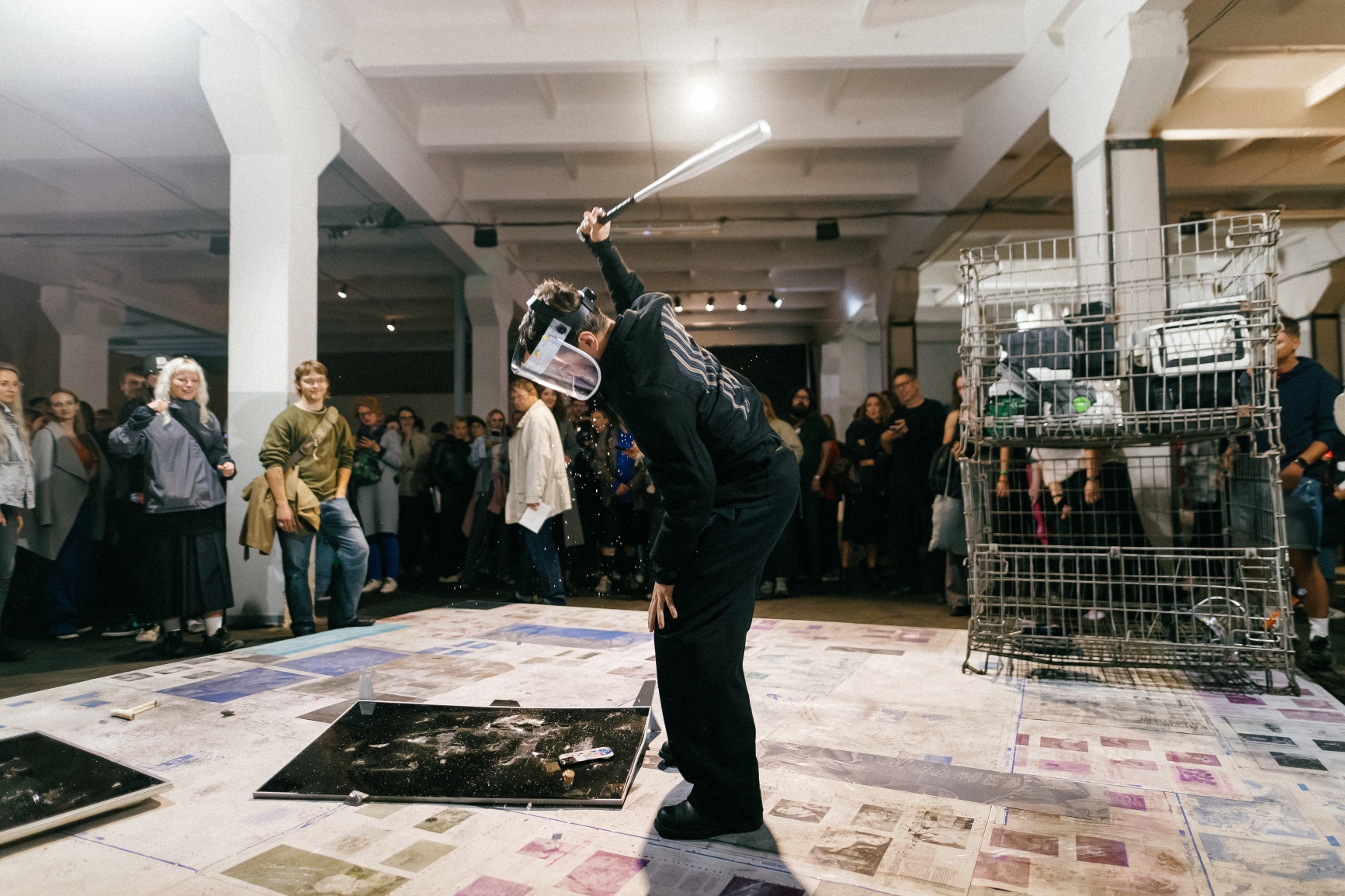
Destruction Park, Anastasia Sosunova in collaboration with Tomas Kažemėkas, 15th Kaunas Biennial: Life After Life, Kaunas 2025. Photo by Gražvydas Jovaiša. Courtesy of the artist
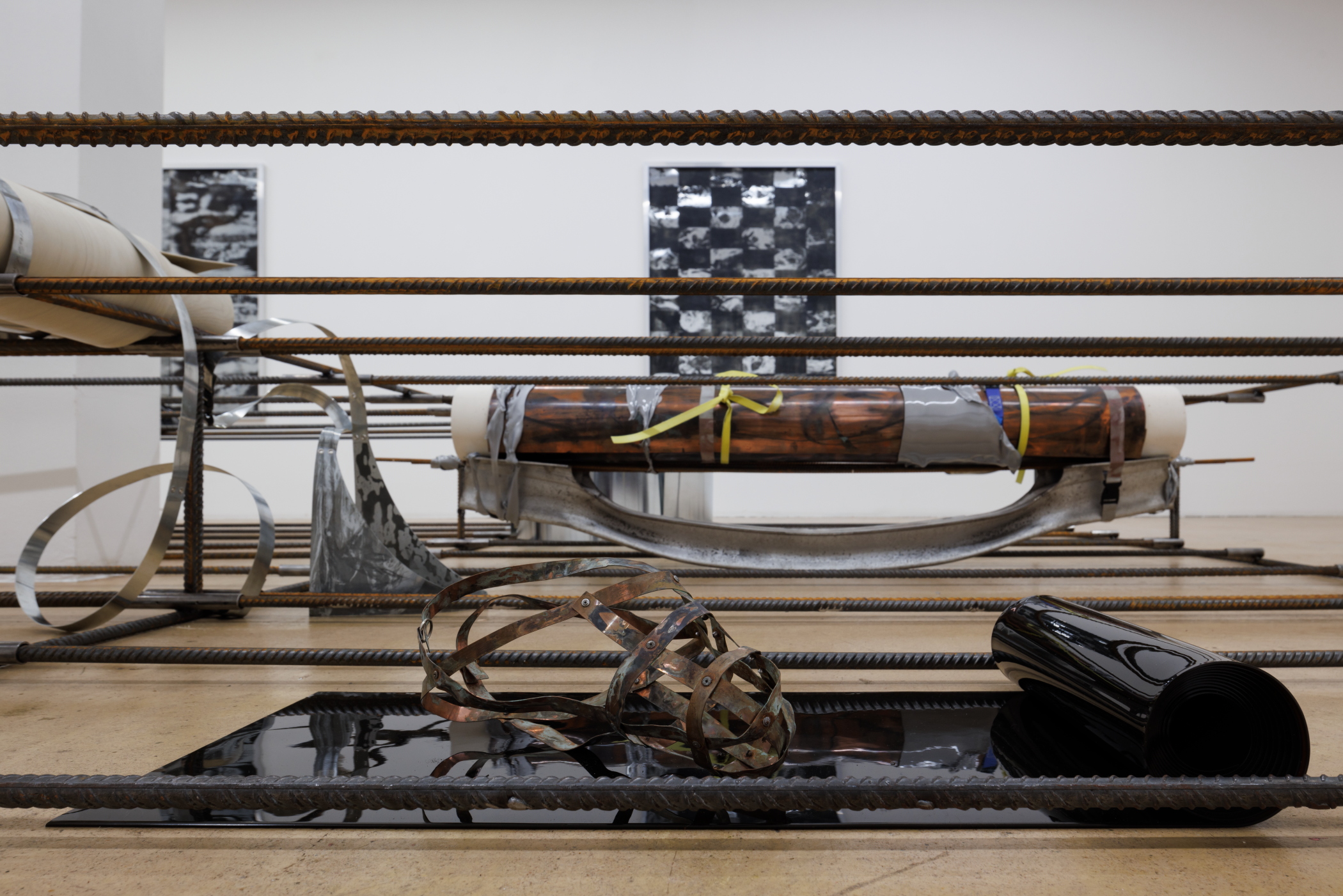
Anastasia Sosunova, Spit Bite, Kim: Contemporary Art Centre, Riga 2025. Photo by Ansis Starks. Courtesy of the artist
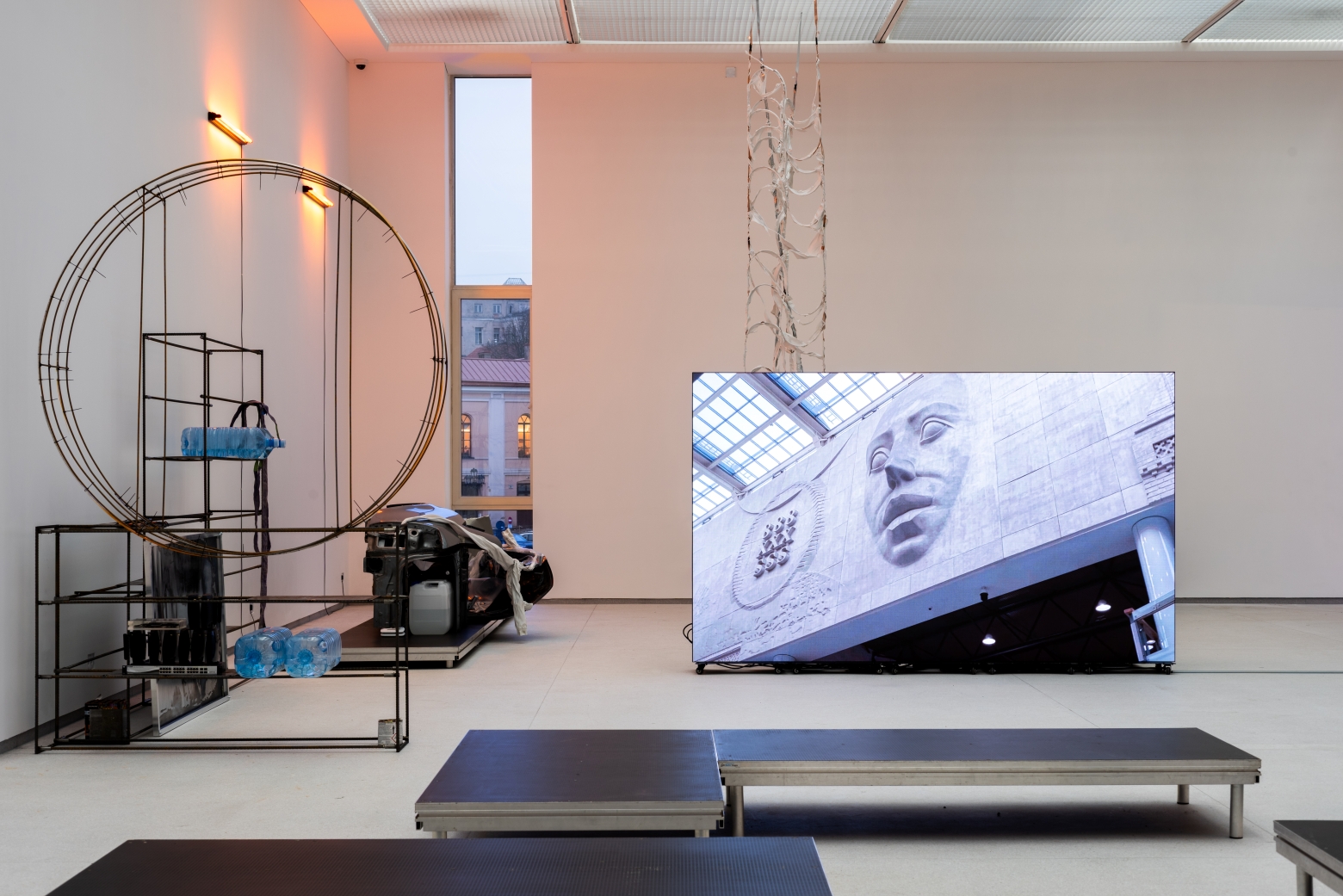
Anastasia Sosunova, Fandom, Contemporary Art Centre, Vilnius 2025. Photo by Jonas Balsevičius. Courtesy of the artist
The practice of Vilnius-based Ieva Rižė (b. 1988) operates at the exhausted intersection of late-stage capitalism and existential search, often employing humour as a sophisticated survival mechanism. Having transitioned from monumental painting to spatial installation and performance, she treats identity not as a fixed biological fact but as a malleable construct shaped by economic pressures and digital acceleration. Her recent cycle, imagine GOAT talking, wryly juxtaposes the pop-cultural acronym for “Greatest of All Time” with the sacrificial archetype of the scapegoat, questioning contemporary obsessions with status and optimisation.
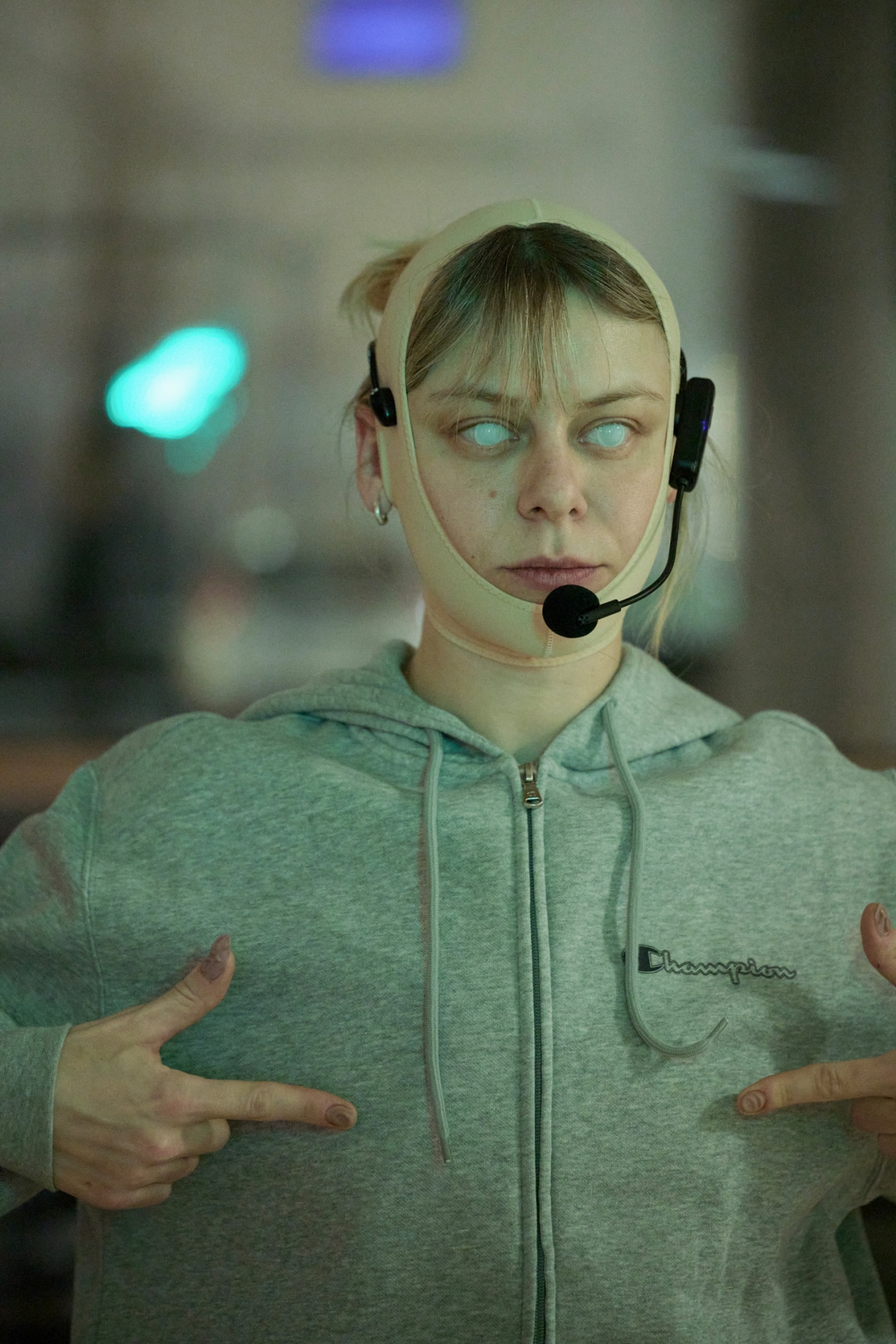
Ieva Rižė, “imagine GOAT talking VI”, 2025, text based performance, installation, Monika Jagunskytė, Vilnius Academy of Arts. Courtesy of the artist
She frequently utilises architectural logic to house fragile psychological states; for the piece “/ʃ t ɑː b i k ʌ s/”, she dismantled her own paintings to build a fortress-like sanctuary, while the installation Swallow transformed manicured fingernails into claw-like symbols of both glamour and predatory instinct. Rižė dissects the “sport” of burnout with a clinician’s eye, suggesting that in an era where happiness is marketed as a productivity hack, the only authentic response may be a well-timed, ironic collapse.
Currently a PhD candidate at the Vilnius Academy of Arts, she holds an MA in Sculpture and a BA in Monumental Painting from the same institution, alongside participation in the Rupert Alternative Education Program (2024). Her interdisciplinary background includes significant roles as a curator for the Yaga Gathering festival and producer for the Vilnius Biennial of Performance Art. Rižė has presented solo exhibitions and performances at Kaunas Artists’ House, Medūza Gallery, and the Vilnius Composers’ House. Her work has been featured in group shows at the Contemporary Art Centre (CAC), Editorial, Drifts, and the Radvila Palace Museum of Art.
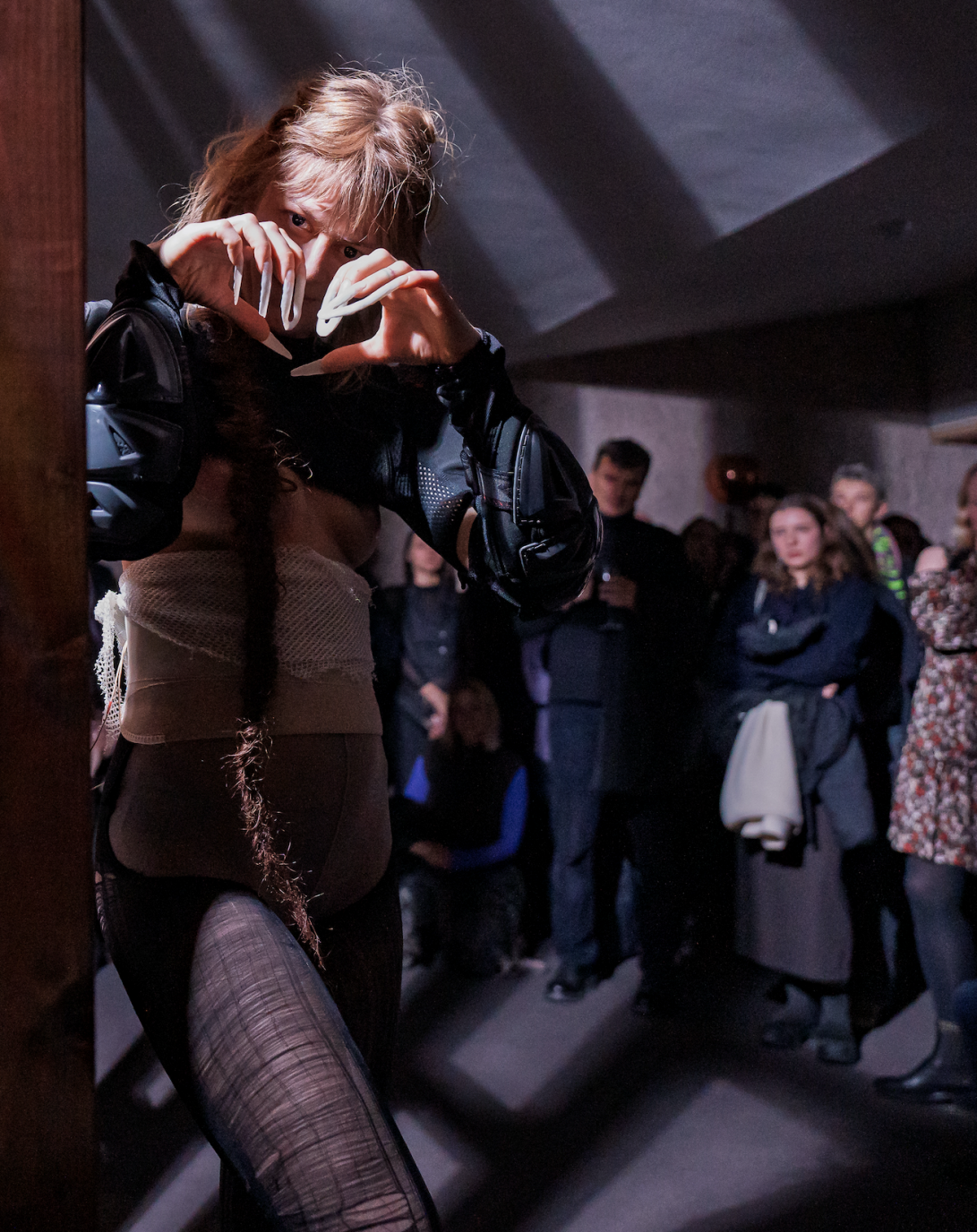
Ieva Rižė, “imagine GOAT talking I”, 2024, text based performance, Andrej Vasilenko, Kompozitorių Namai, Rupert AEP “Wherever We are We are What is Missing”. Courtesy of the artist
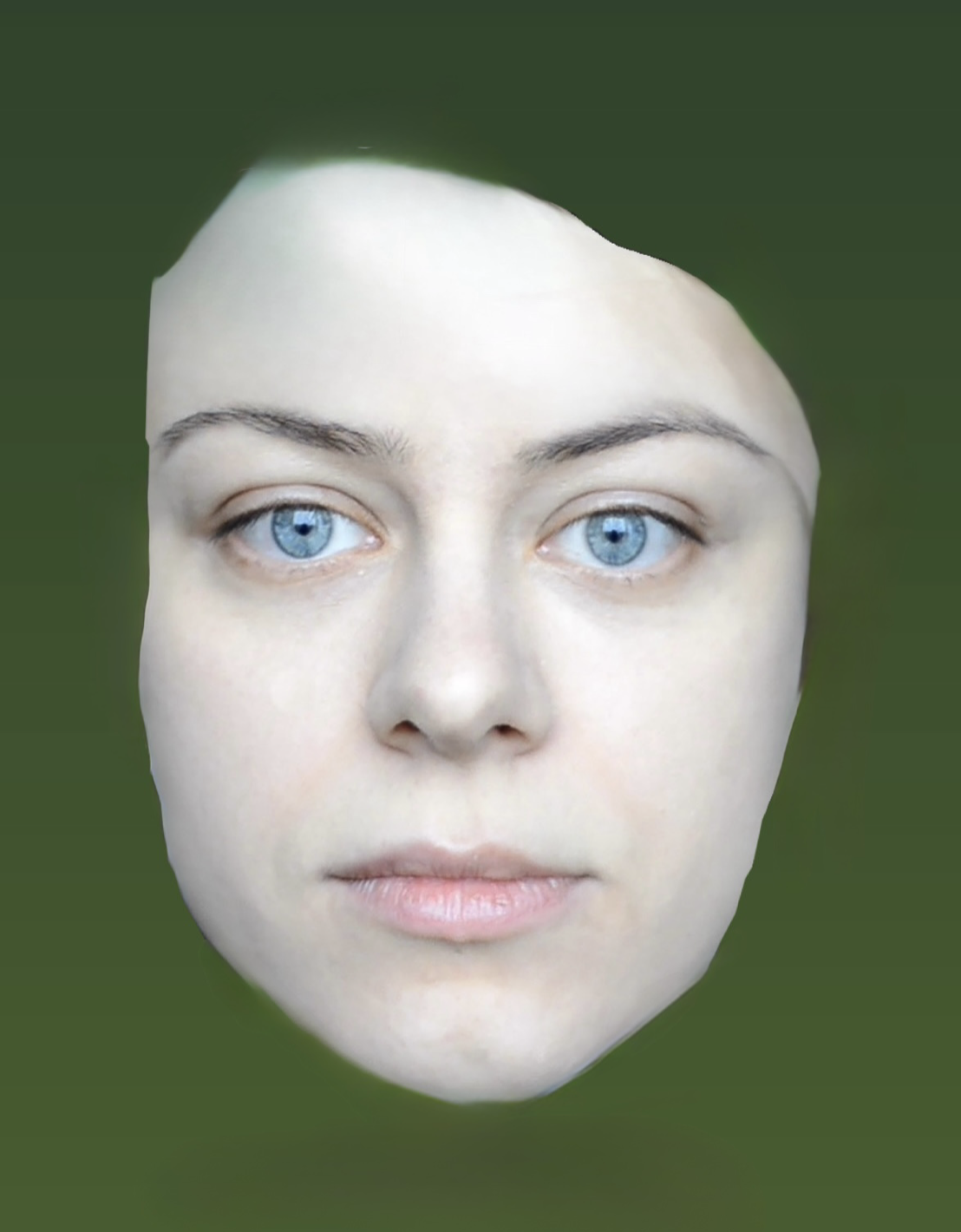
Ieva Rižė, portrait. Courtesy of the artist.
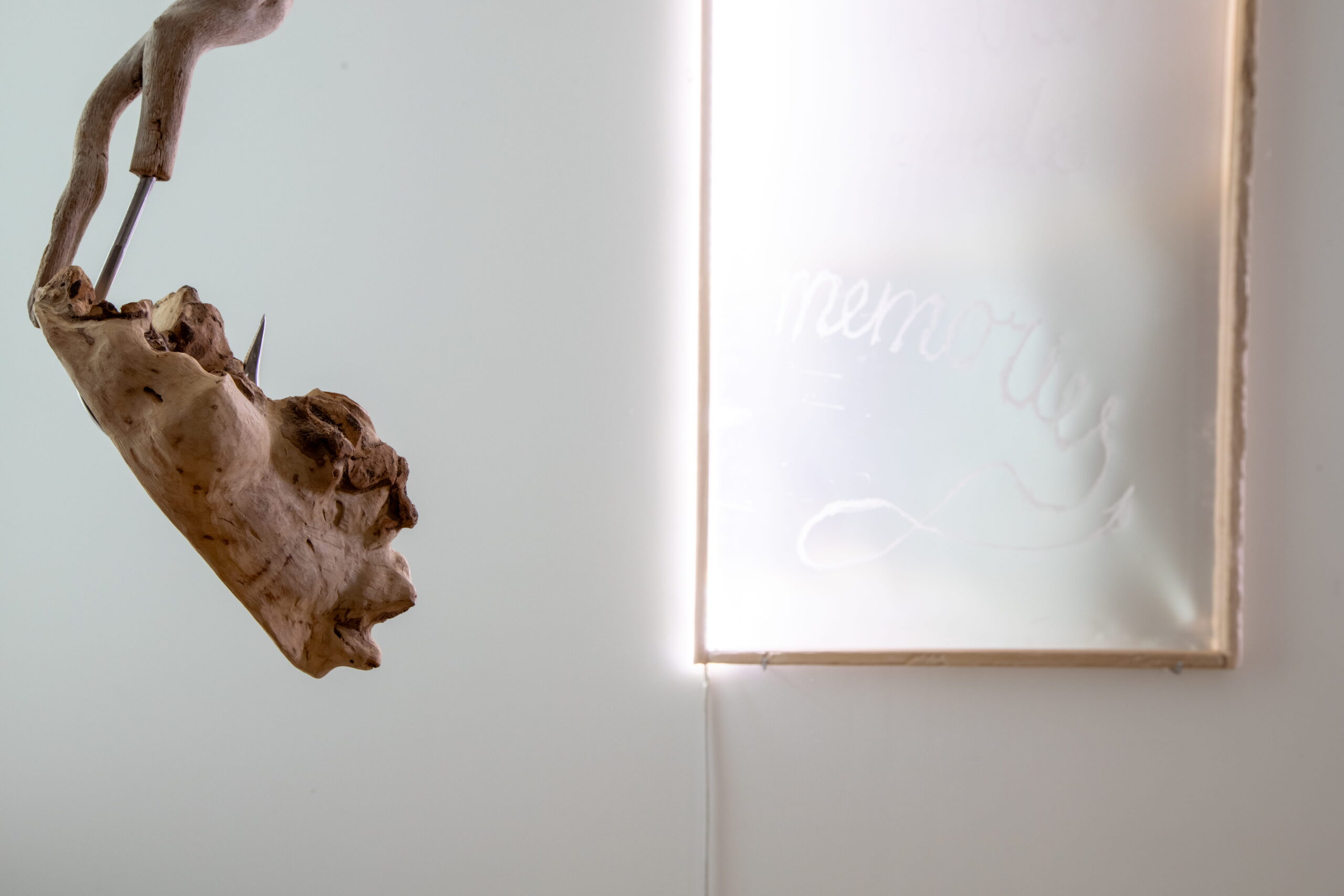
Ieva Rižė, “Swallow”, 2024, installation, multimedia (objects, video work), Darius Matonis, Kauno Menininkų Namai. Courtesy of the artist
An interdisciplinary artist, performer, and activist, Denisas Kolomyckis (b. 1992) focuses on choreographic intervention into social and institutional machinery, merging the discipline of a dancer with the raw directness of activism. Working across sculpture, painting, performance, and video, he frequently dismantles symbols of cultural elitism. A recent series, for instance, reconfigures the seating plans of prestige venues like La Scala and the Royal Opera House into casual games of Tetris or Battleship.
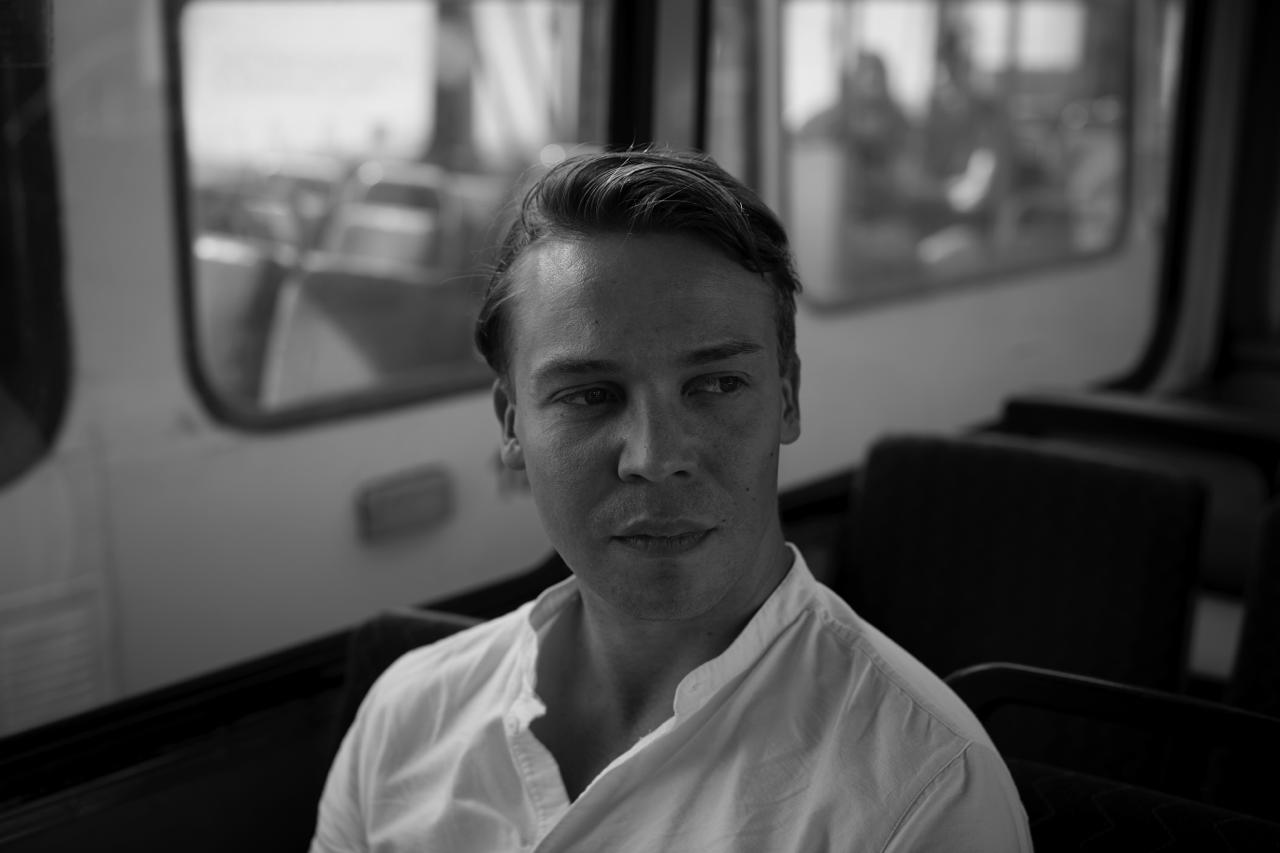
Denisas Kolomyckis, portrait. Photo: Dino Frittoli. Courtesy of the artist
His work is often driven by questions of labour, queer identity, and the distribution of power, utilising materials ranging from repurposed political advertising boards to his own body in endurance pieces. Influenced by the flux of institutional critique and the legacy of figures like Tadeusz Kantor, he treats public space as a stage for friction – a methodology best summarised by an early police report that once charged him with “regulating traffic with plastic movements” during an unauthorised street performance.
He is a graduate of the National M. K. Čiurlionis School of Art (Ballet Department) and holds an MA in Sculpture from the Vilnius Academy of Arts. A close associate of the late filmmaker Jonas Mekas, Kolomyckis spent two years working with him in New York. In 2021, he was awarded the Best Young Artist prize at the ArtVilnius contemporary art fair. His exhibitions and performances have been held in Lithuania, Italy, and Portugal. He is a co-founder of the Actors Guild of Lithuania.
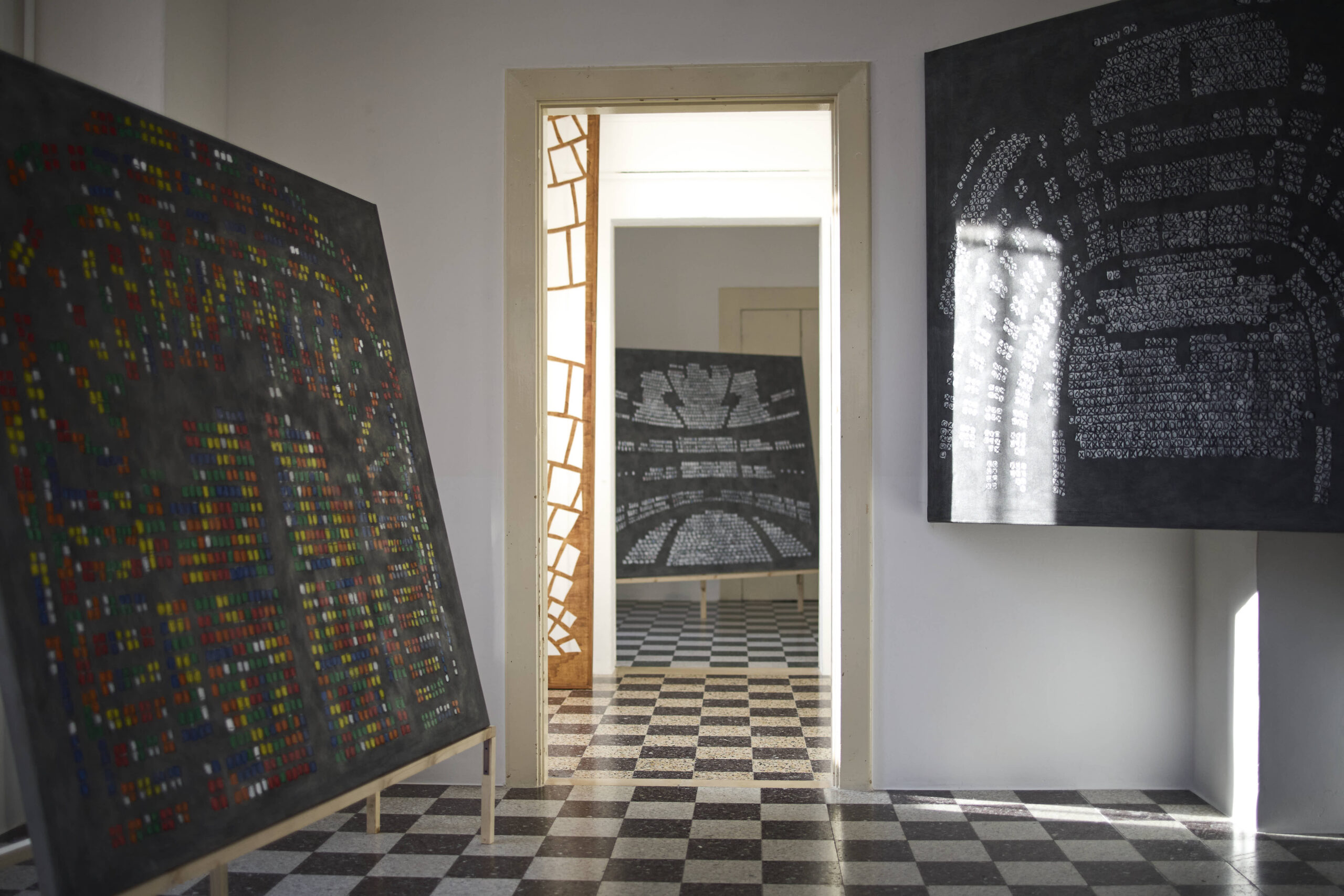
Exhibition “Pirate of the Capital” by Denisas Kolomyckis in Putignano, Italy. Photography: Dino Frittoli. Courtesy of the artist.
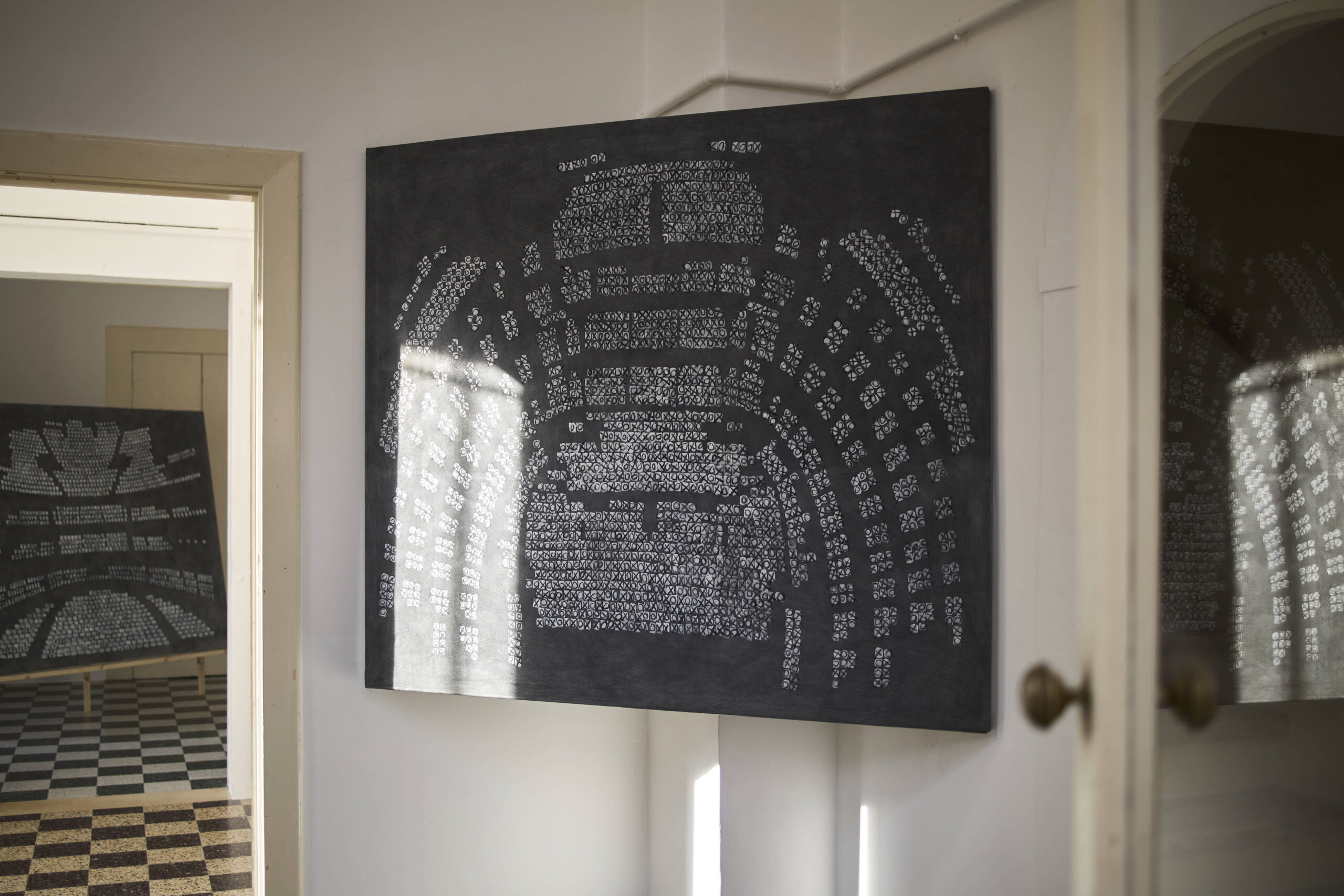
Exhibition “Pirate of the Capital” by Denisas Kolomyckis in Putignano, Italy. Photography: Dino Frittoli. Courtesy of the artist.
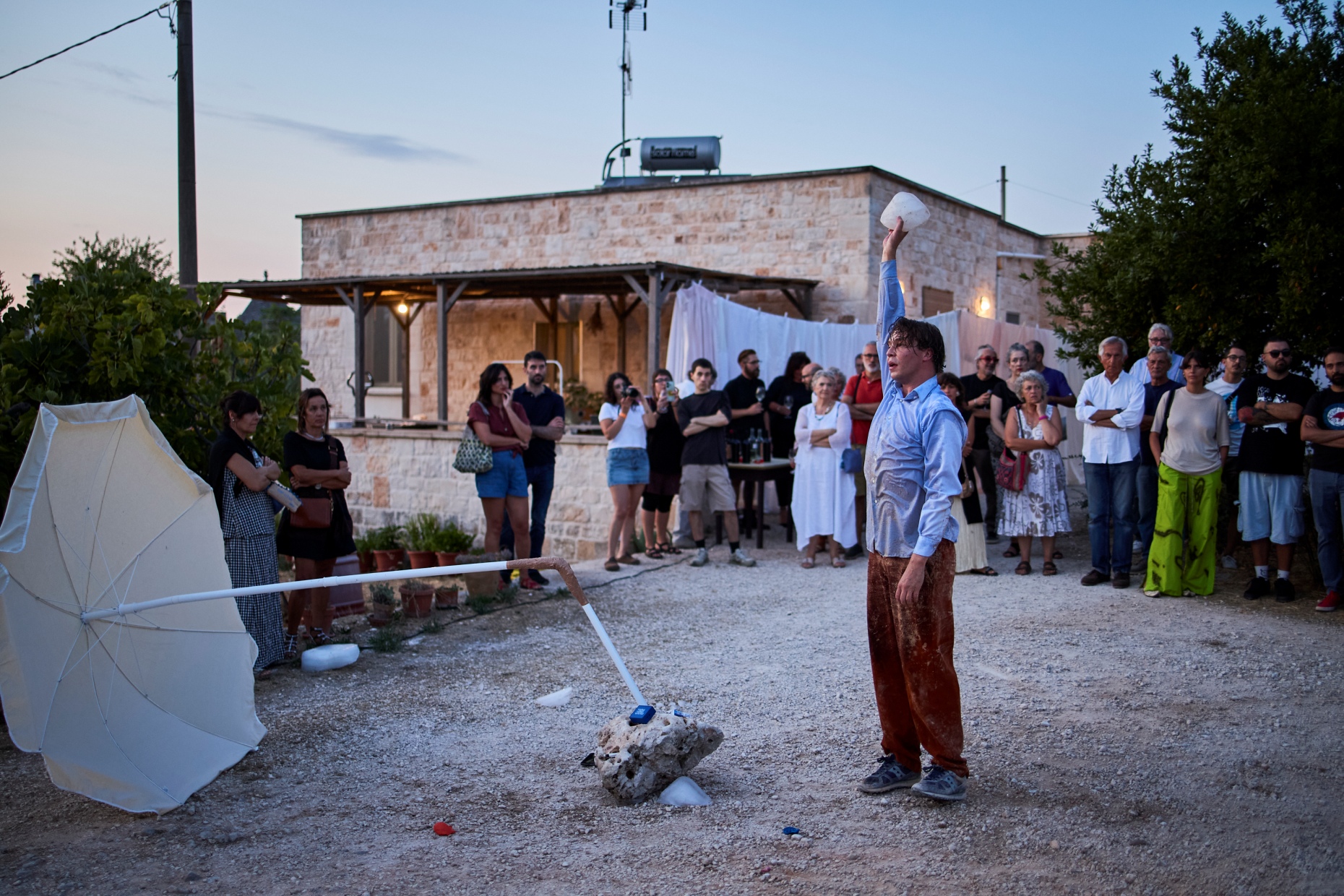
Denisas Kolomyckis, Performance “Per Diem”, 2025. Photo: Dino Frittoli. Courtesy of the artist
Kaunas-born and raised, Mantas Valentukonis (b. 1998) operates at the friction point between the “undying” tradition of oil painting and the glitchy nostalgia of early 2000s cyber culture. Describing his aesthetic as “digital romance”, he treats the canvas not merely as a surface but as a membrane comparable to a screen, often employing acrylic transfers to emulate the low-poly textures of vintage video game graphics. His practice oscillates between physical brushwork and digital construction. For the JCDecaux Award, he developed Quagmire, a video game built on the Unity engine, yet he persistently returns to oil paint to escape the coldness of the monitor.
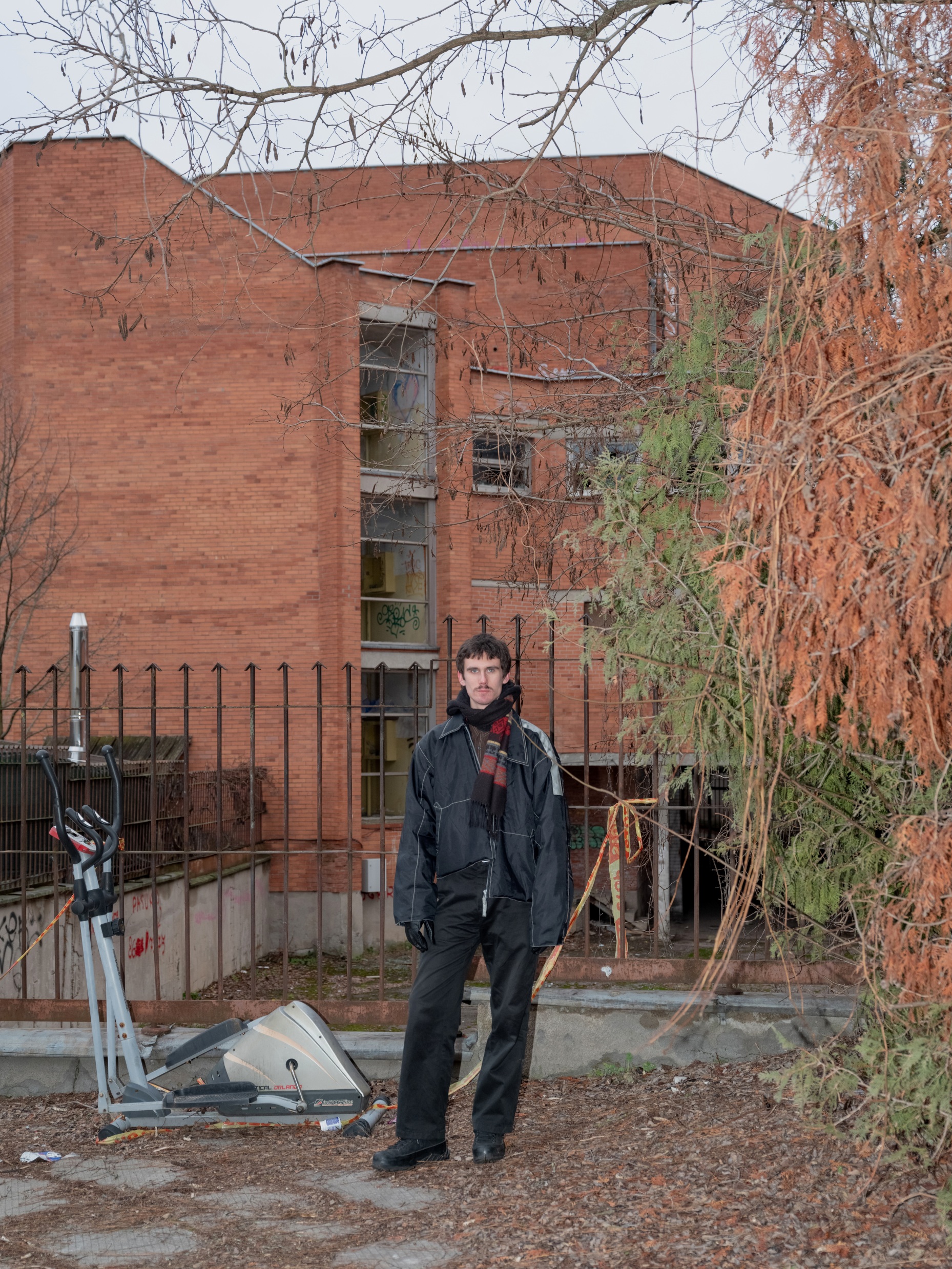
Mantas Valentukonis. Photo: Lukas Mykolaitis. Courtesy of the artist
He is fascinated by the “uncanny valley” and the artefacts of internet archaeology, seeking a lingering “soul factor” within synthetic imagery. Influenced by the conceptual rigour of old masters and his own curatorial strategies, he orchestrates spaces where messy organic reality and polished digital assets collide. Ultimately, his work suggests that in an era of AI perfection, the most human gesture remains the pixelated error.
Valentukonis holds a BA in Painting from the Vilnius Academy of Arts, Kaunas Faculty (2023), and also studied at the Warsaw Academy of Fine Arts. Active as both an artist and a curator, he has received an Honourable Mention at the Young Painter Prize (2025) and the Rotari Prize (2022). Recent solo presentations include Apparitions at Drifts Gallery (2024) and “Skins” at ArtVilnius’23. His work has been featured in major group shows such as the XVIII International Vilnius Painting Triennial, the JCDecaux Award 2024 exhibition at Sapieha Palace, and Intermediate Glooms, a project he also curated at Meno Parkas Gallery.
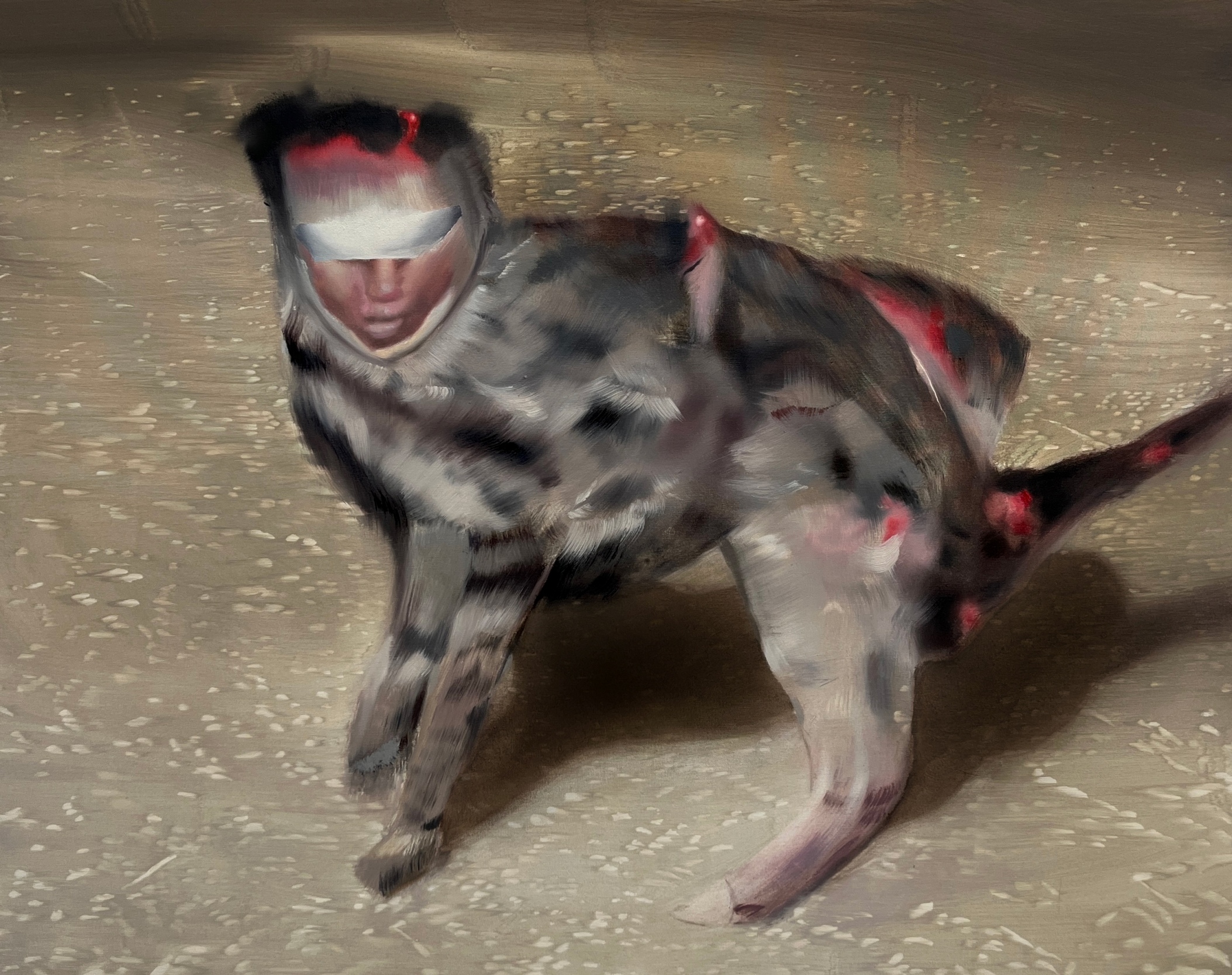
Mantas Valentukonis, Wild Cat, 2025, oil on canvas, 80 x 100 cm. Courtesy of the artist
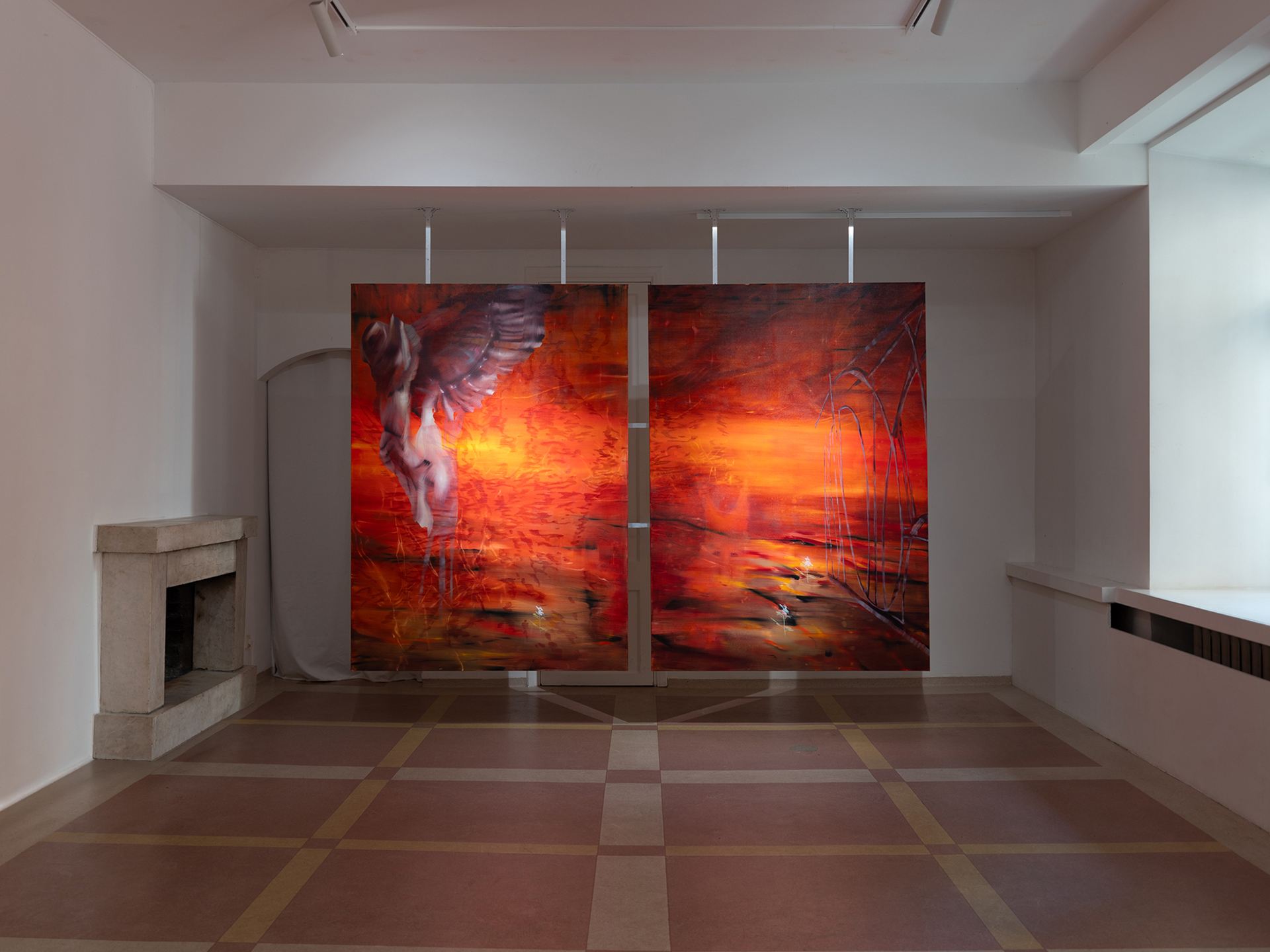
Mantas Valentukonis, “Gl(Azure) sky”, 2025, oil on canvas, 210 x 150 cm, diptych, Photo: Laurynas Skeisgiela. Courtesy of the artist
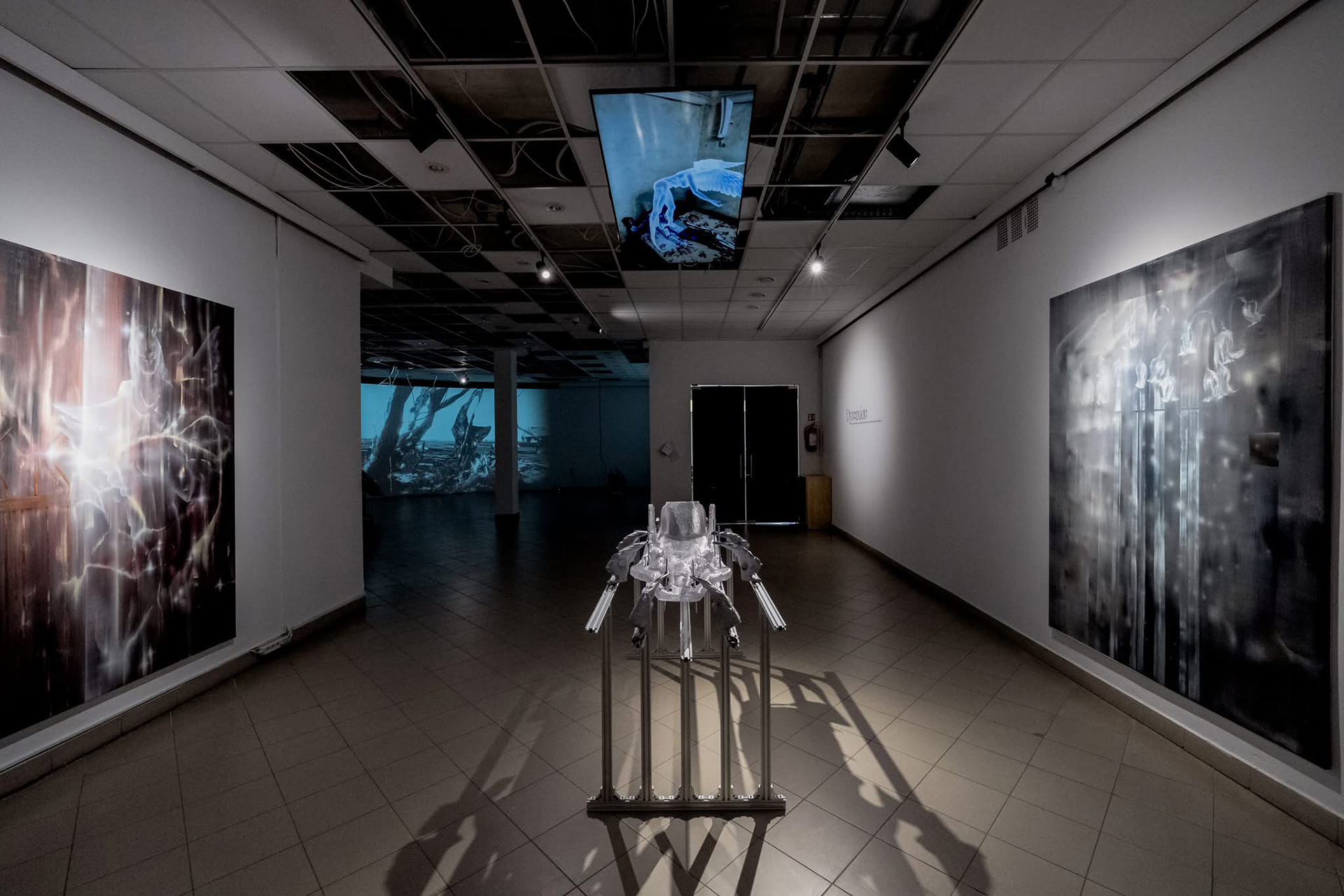
Mantas Valentukonis, “Lady died”, 2025, installation view, “Dymaxion” exhibition. Photo: Domas Rimeika. Courtesy of the artist
Neringa Poškutė-Jukumienė (b. 1981) is a visual artist, curator, and educator based in Lithuania, who interrogates the comfortable boundaries of contemporary jewellery, often discarding the wearable object entirely in favour of installation, video, and performance. Refusing the notion of the body as a passive display stand, she treats jewellery as a frictional agent – an entity that asserts its weight, sharpness, or political burden against the wearer.
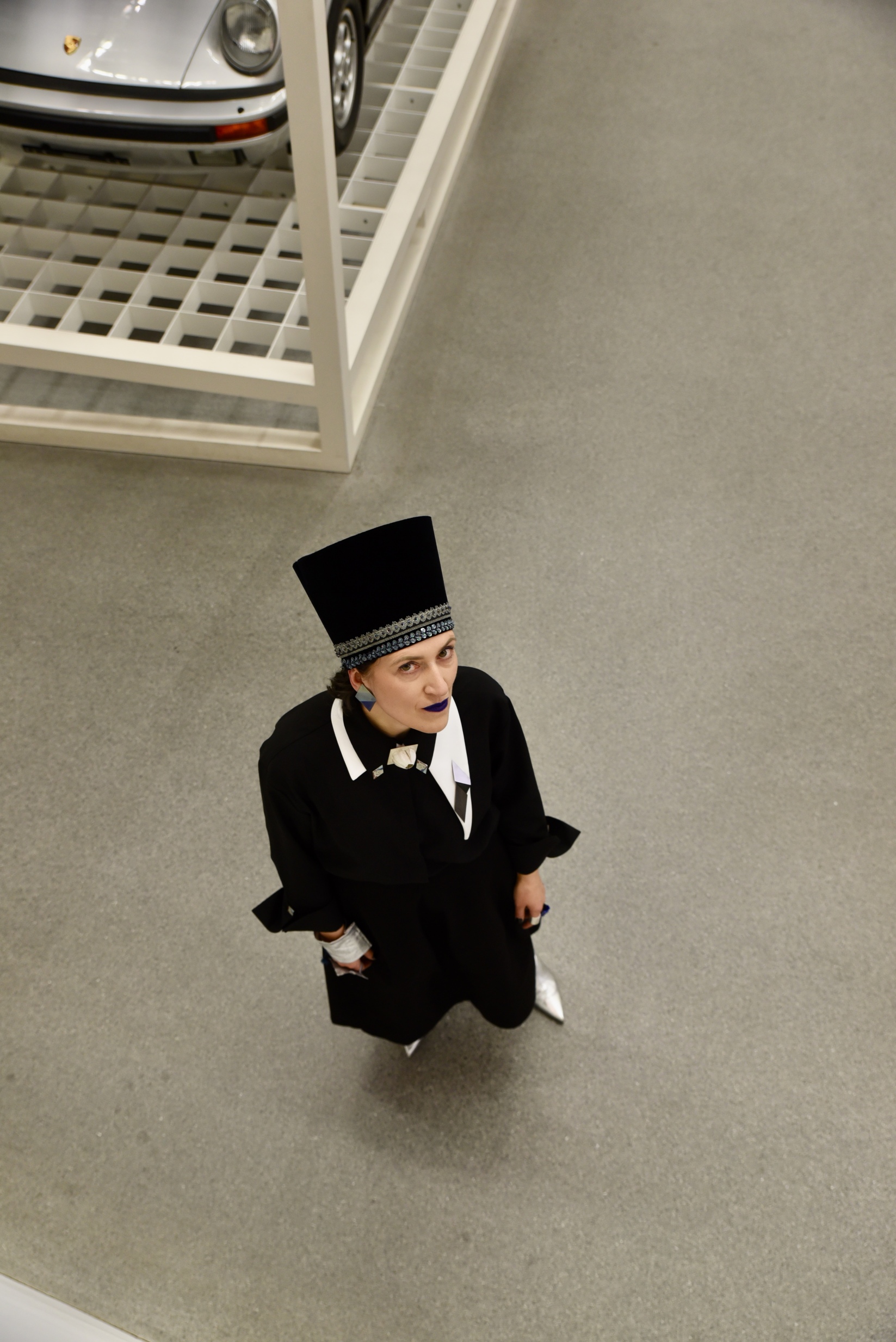
Neringa Poškutė-Jukumienė. Photo_ Ingrida Mockutė-Pocienė. Courtesy of the artist
Her recurring rhombus motif, derived from industrial scraps and pandemic warning tape, manifests in non-ergonomic iron rings that force the fingers into unnatural postures, prioritising the object’s autonomy over the user’s comfort. This critical stance extends to institutional power; her project, Mayor’s Ring, operated as a performative critique of authority that culminated in the public burial of the object itself. Whether inhabiting the persona of a female Pope or constructing narratives from the brick rubble of a decaying royal post office, she proves that the most impactful jewellery is often the kind you cannot – or dare not – wear.
She holds both a BA and an MA from the Vilnius Academy of Arts, where she is currently a PhD candidate and serves as an associate professor and head of the Metal Art and Jewellery programme at the Telšiai faculty. Her work has been exhibited at the International Biennial of Enamel Art (awarded diplomas in 2017 and 2020), the contemporary metal art biennial METALOfonas, and Munich Jewelry Week via the SMCK ON REEL video festival. Notable solo exhibitions include Prussian Blue at the Palanga Amber Museum and POV at the Klaipėda Cultural Communication Centre. She is also a selected member of the international Klimt02 platform.
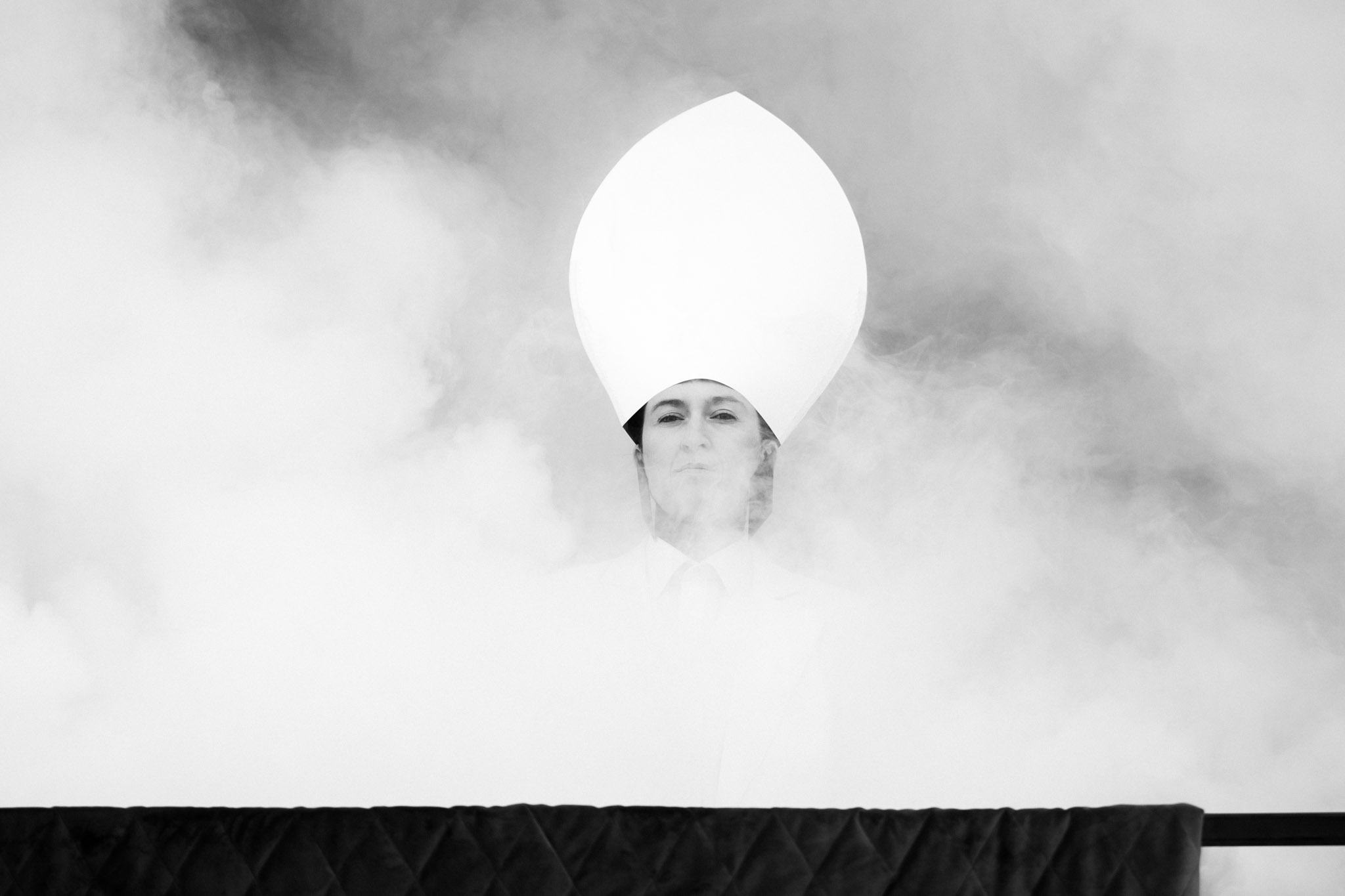
Neringa Poškutė-Jukumienė, Installation and performance “Brilliant Green Vine”, 2023, video by Gintautas Beržinskas. Photo: Domas Rimeika. Courtesy of the artist
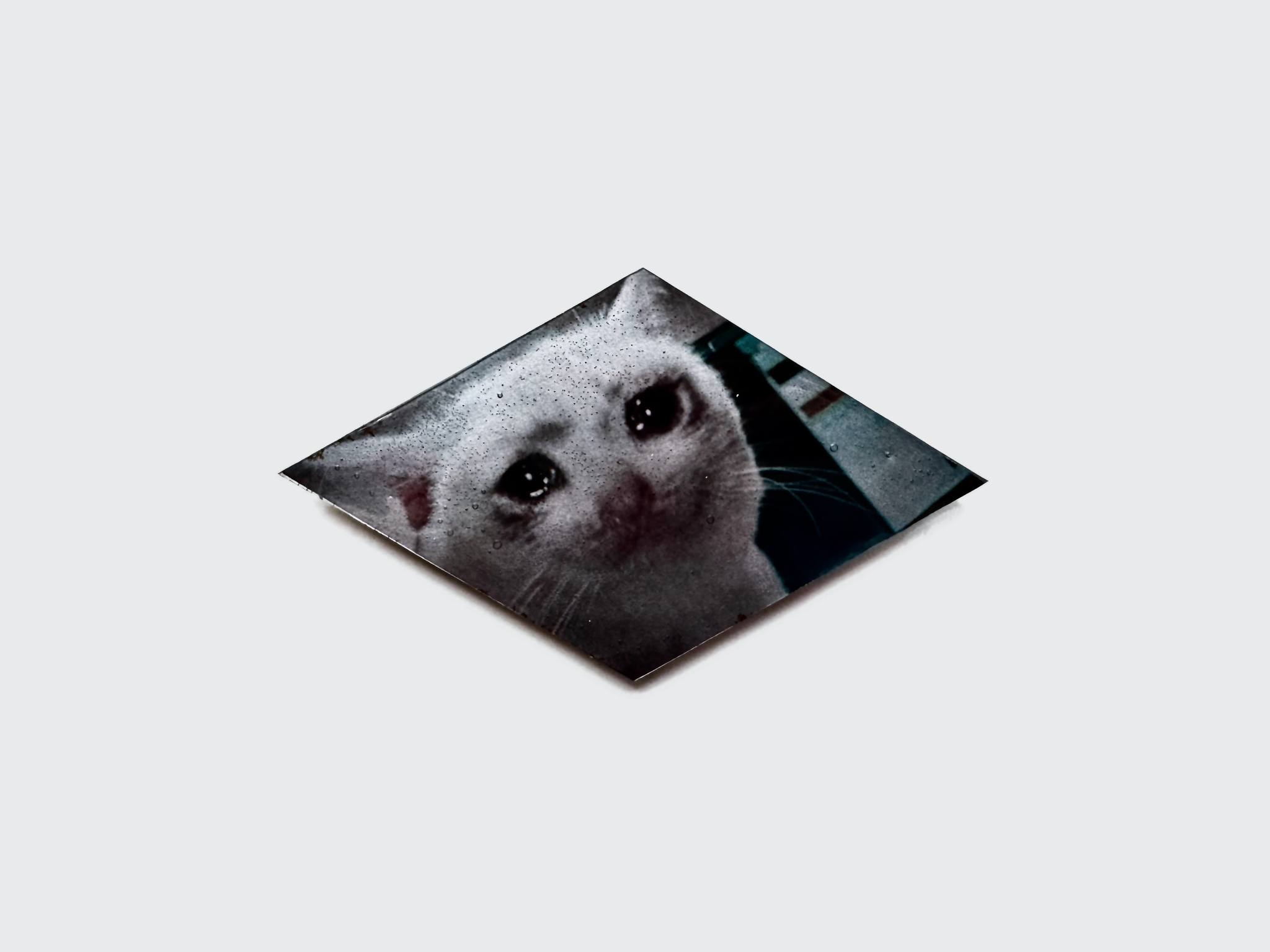
Neringa Poškutė-Jukumienė, Piece of jewellery/brooch “POV: you came to a jewellery show and you’re like – where’s the jewellery?”, 2025, steel, epoxy resin. Exhibition POV, Klaipėda culture communication center, Klaipėda. Photo: Neringa Poškutė-Jukumienė. Courtesy of the artist
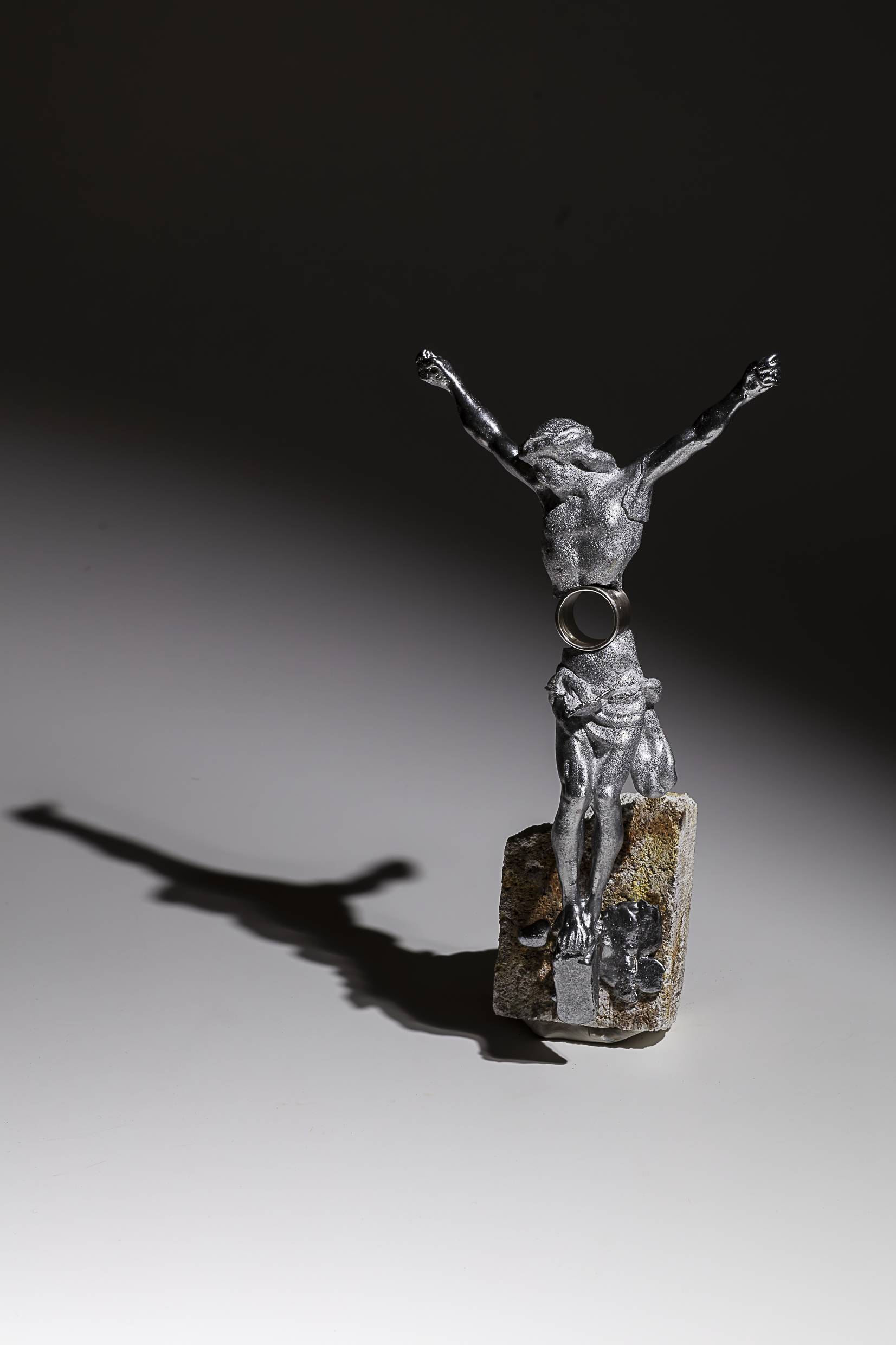
Neringa Poškutė-Jukumienė, Piece of jewellery/ring. ”The Pope’s Ring”, 2025, silver, aluminium, steel. Exhibit in International art fair “ArtVilnius’25” and exhibition “POV”, Klaipėda culture communication center, Klaipėda. Photo: Gintautas Beržinskas. Courtesy of the artist
Beatričė Mockevičiūtė (b. 1994) lives and works in Vilnius. She treats perception less as a theme and more as a raw material, constructing objects that act as architectural interventions within the viewer’s field of vision. Her practice investigates the city not as a static collection of concrete and steel, but as an unstable optical weather system defined by light, reflection, and moisture. Working primarily with industrial materials such as stainless steel, glass, and LEDs, she creates structures that fold the environment back onto itself; a steel surface might make the sky appear where a wall should be, or a light installation might liquefy a solid room into a wavering atmosphere.
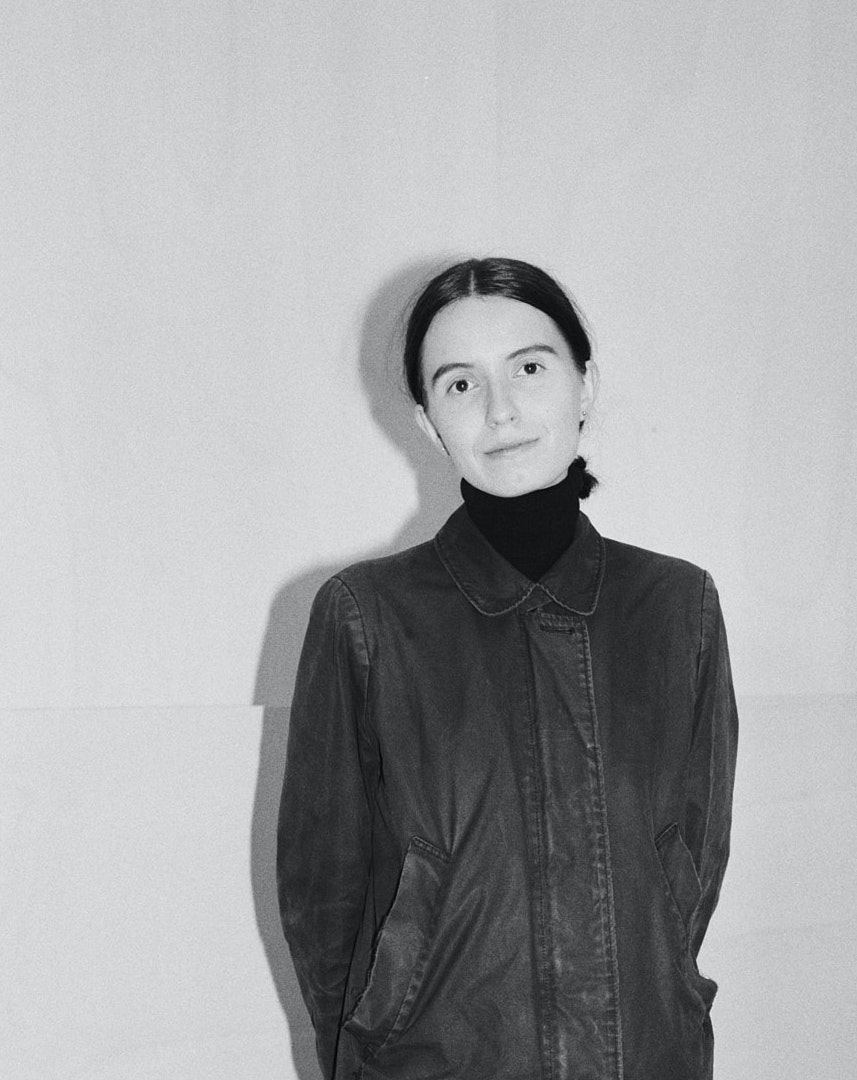
Beatričė Mockevičiūtė. Photo: Visvaldas Morkevičius. Courtesy of the artist
These works render the everyday “membrane” of reality temporarily legible, turning the incidental glare of a window or the dampness of a street into a sculptural event. Whether through modest interior objects or large-scale public commissions, she isolates the ephemeral moments we usually ignore because we are too busy looking at “things” rather than the space between them. It is an art of high-definition noticing, where clarity is always conditional, and the urban architecture feels strangely intimate.
She holds both a BA and MA in Sculpture from the Vilnius Academy of Arts and is an alumna of the Rupert Alternative Education Program (2016–2017). Her work has been presented at major Lithuanian institutions, including the Contemporary Art Centre (CAC), MO Museum, and the National Gallery of Art, as well as internationally at Fondation Fiminco in Paris, Project Space Hawerkamp 31 in Münster, and the Vejle Art Museum in Denmark. Notable recent projects include the solo exhibition Shallow streets at Drifts Gallery (2025) and the public sculpture Asukas in the Vilnius Paupys district (2021). Mockevičiūtė received a Special Mention at the 2017 JCDecaux Prize competition and was named Best Young Artist at ArtVilnius’16. Beyond her studio practice, she works as an exhibition architect and curator of educational programs.
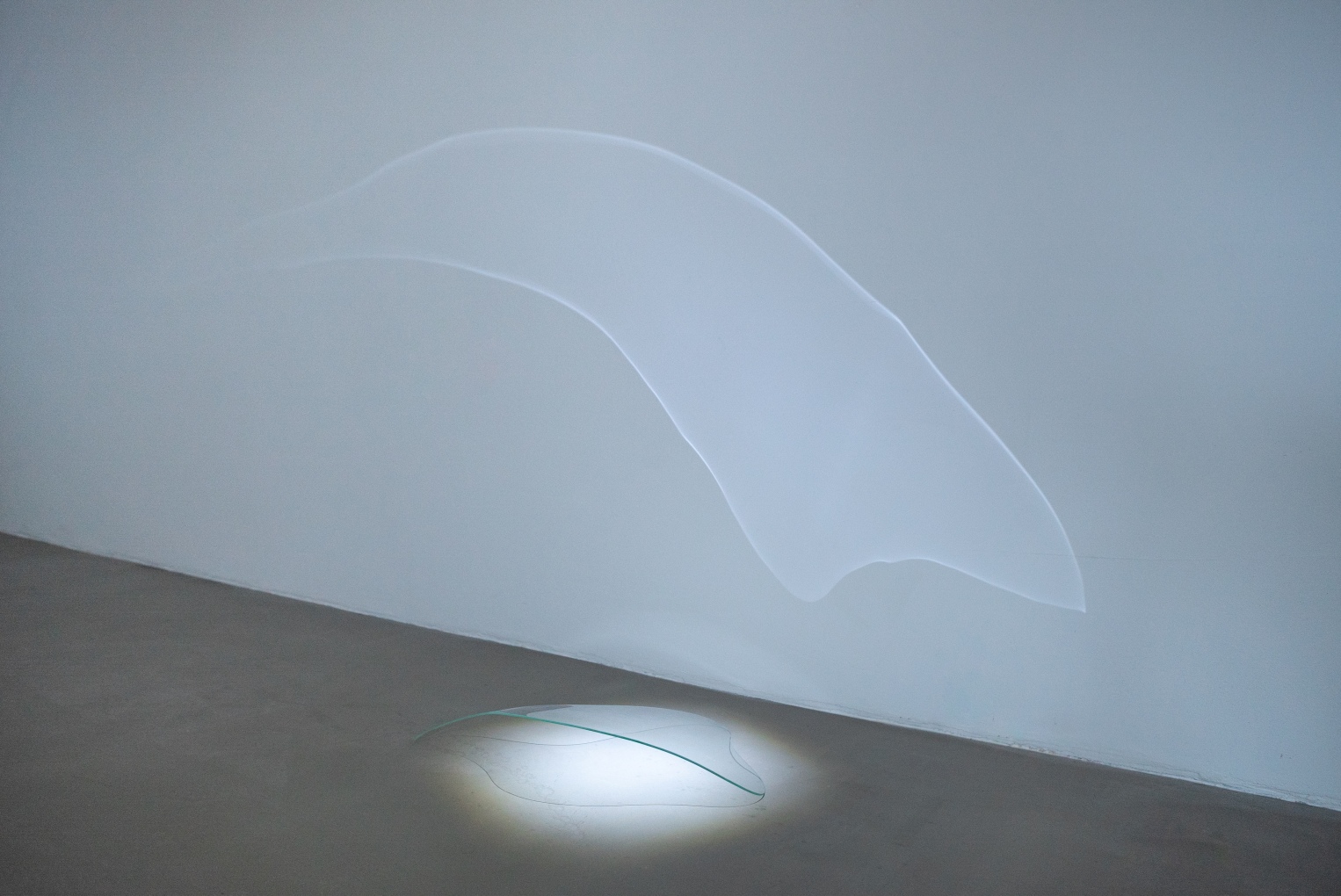
Beatričė Mockevičiūtė, “Blueish”, 2020 (Glass, LED light), “Swallow” gallery, Vilnius. Photo: Laurynas Skeisgiela. Courtesy of the artist
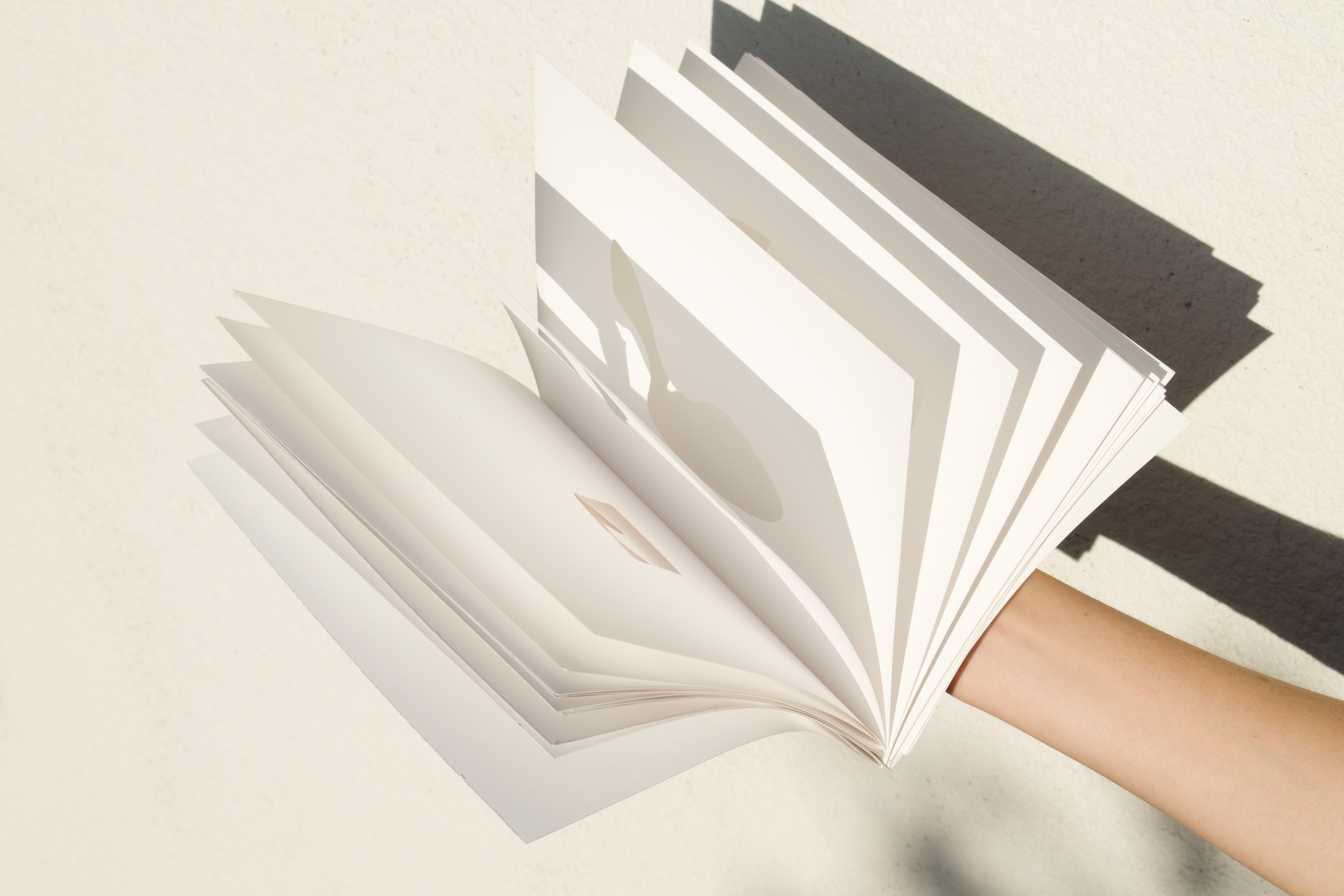
Beatričė Mockevičiūtė, “Asukas”, 2018, (book). Photo: Ignė Narbutaitė. Courtesy of the artist
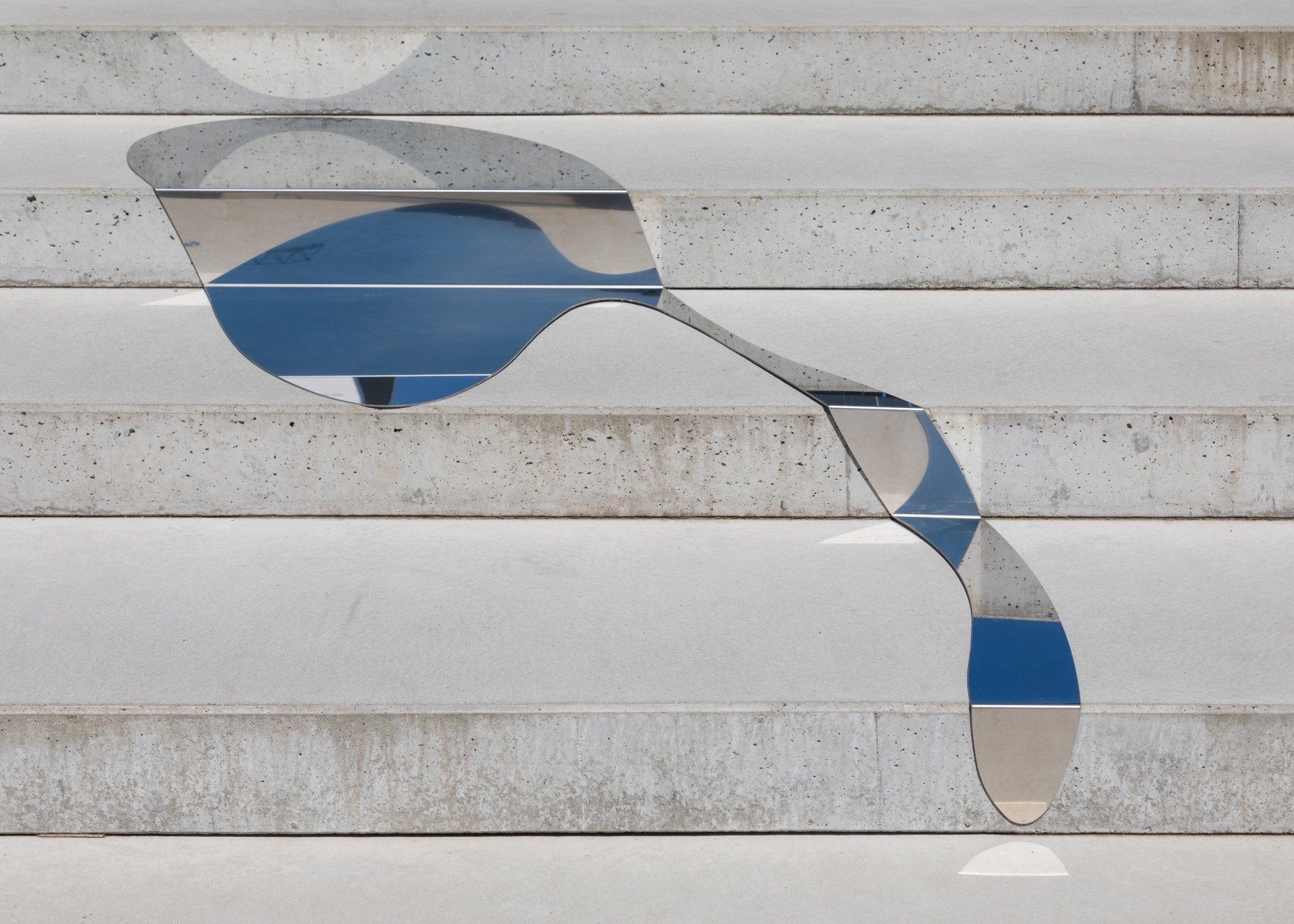
Beatričė Mockevičiūtė, “Seabird”, 2019, (Stainless steel), Floating Art Exhibition “Cry Me A River” curated by Mette Woller, Vejle. Photo: David Stjernholm. Courtesy of the artist
Agata Orlovska’s (b. 1998) practice operates as a calculated sabotage of recognition, where the “known” image – often a fragmented gesture redolent of art history – is dragged into the present and forced to misbehave. While technically grounded in painting, she treats the artwork less as a window and more as a physical organism subject to structural intervention; surfaces are perforated, layered, or dulled until the motif speaks primarily through its own damage.
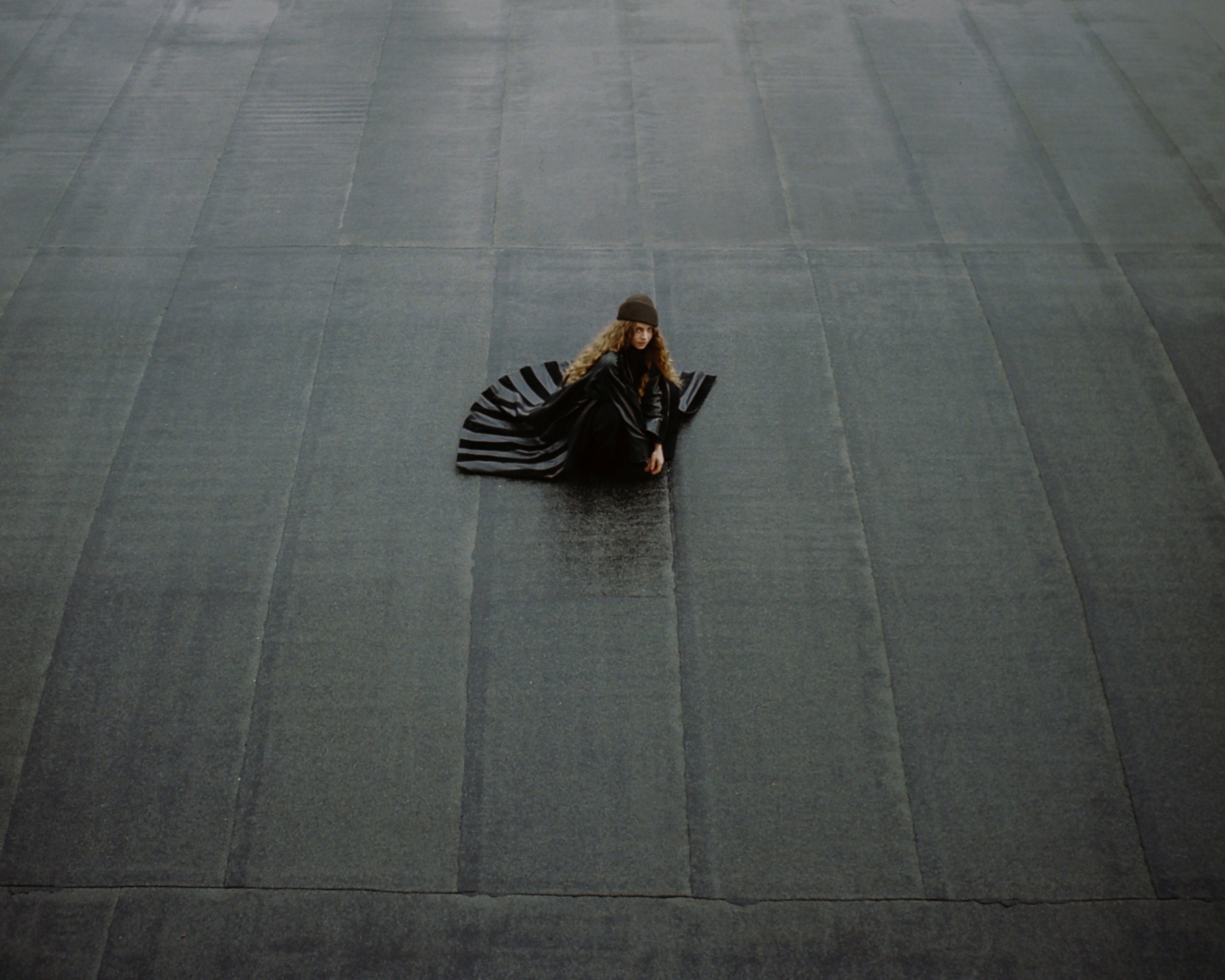
Agata Orlovska. Photo: Monika Penkutė. Courtesy of the artist
This approach transforms concealment into a high-stakes emphasis: the eye is drawn not to the image itself, but to the blank cut-out, the overlaid grid, or the industrial sheen that refuses painterly intimacy. She investigates the anatomy of the artwork by focusing on what is missing, creating a tension where meaning is not delivered by representation alone, but by the specific way matter interrupts it. Whether through the “unseen” operating within contemporary visuality or the tangible obstruction of light, Orlovska compels the viewer into a forensic mode of seeing – hunting for the original image beneath layers of deliberate occlusion. It is a sophisticated game of visual hide-and-seek where the act of hiding is the main event.
While being a painter, she is also a doctoral candidate at the Vilnius Academy of Arts, where she obtained her MA in Painting in 2023. She has rapidly established a significant profile, winning the prestigious Young Painter’s Prize, the Nordic and Baltic Young Artist Award, and the M. K. Čiurlionis incentive scholarship in a single year (2023). Her work is held in the collection of the Lithuanian National Museum of Art. Recent solo and duo presentations include Dymaxion at KKKC (Klaipėda, 2025), Ša naqba īmuru at Pamėnkalnio Gallery (Vilnius, 2024), and Per speculum et in aenigmate at Vartai Gallery (Vilnius, 2023).
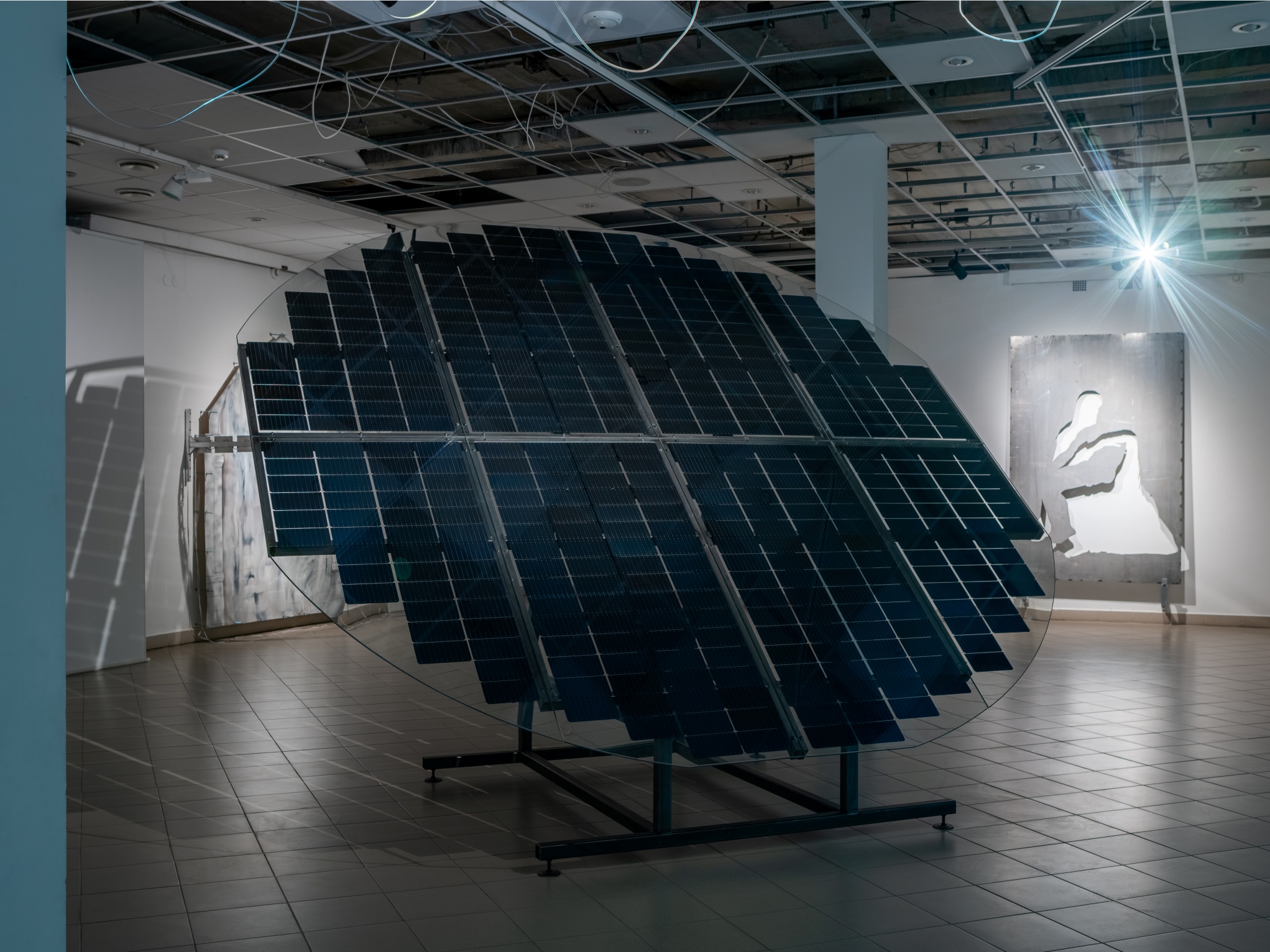
Agata Orlovska, “Do Not Go Gentle Into That Good Night”, 2024, solar panels, tempered glass, steel. Exhibition view_ “Dymaxion”, KKKC, Klaipėda, Lithuania. Photo by Laurynas Skiesgaila. Courtesy of the artist
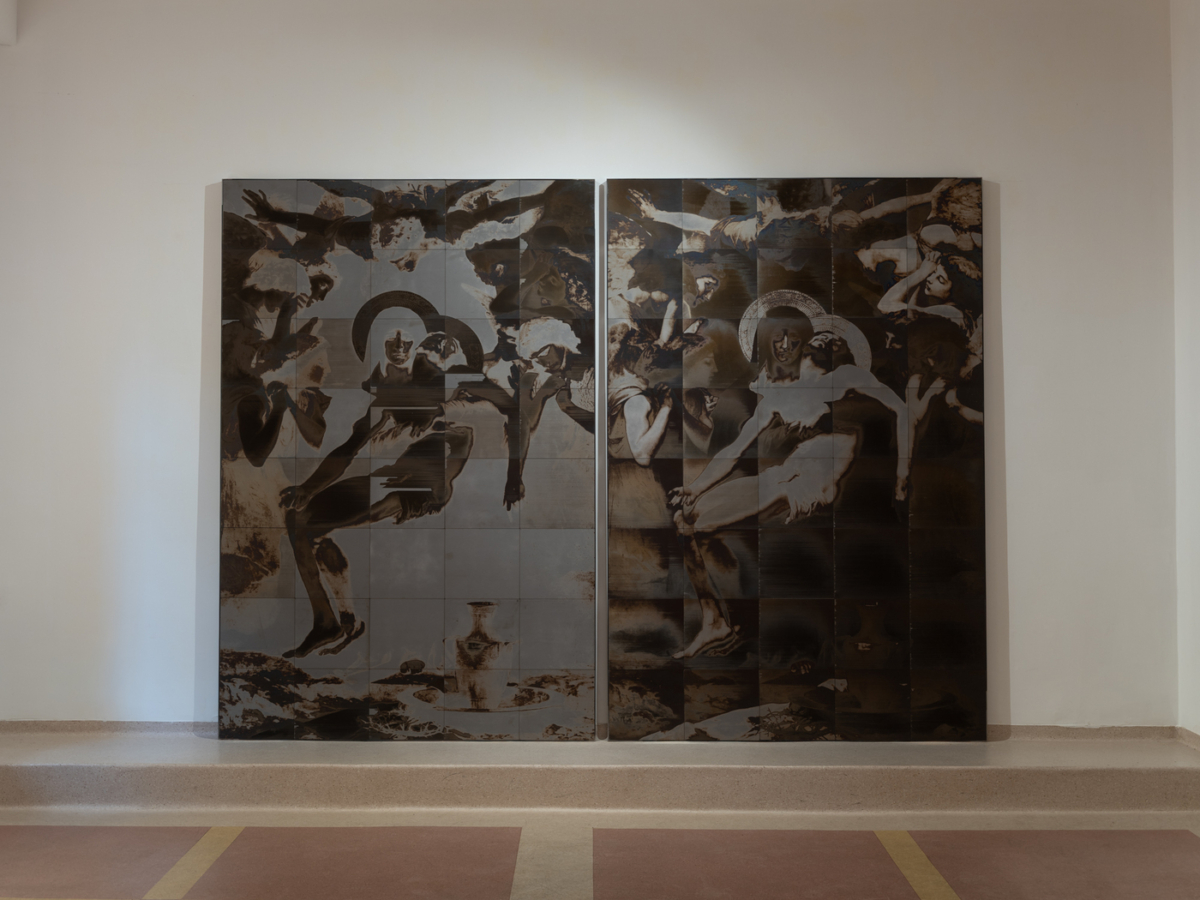
Agata Orlovska, “Pictura Lacrimosa _ William-Adolphe Bouguereau Pieta”, 2025, steel, laser cutting, laser engraving. Exhibition view_ “Perforation”. Photo by Laurynas Skiesgaila. Courtesty of the artist
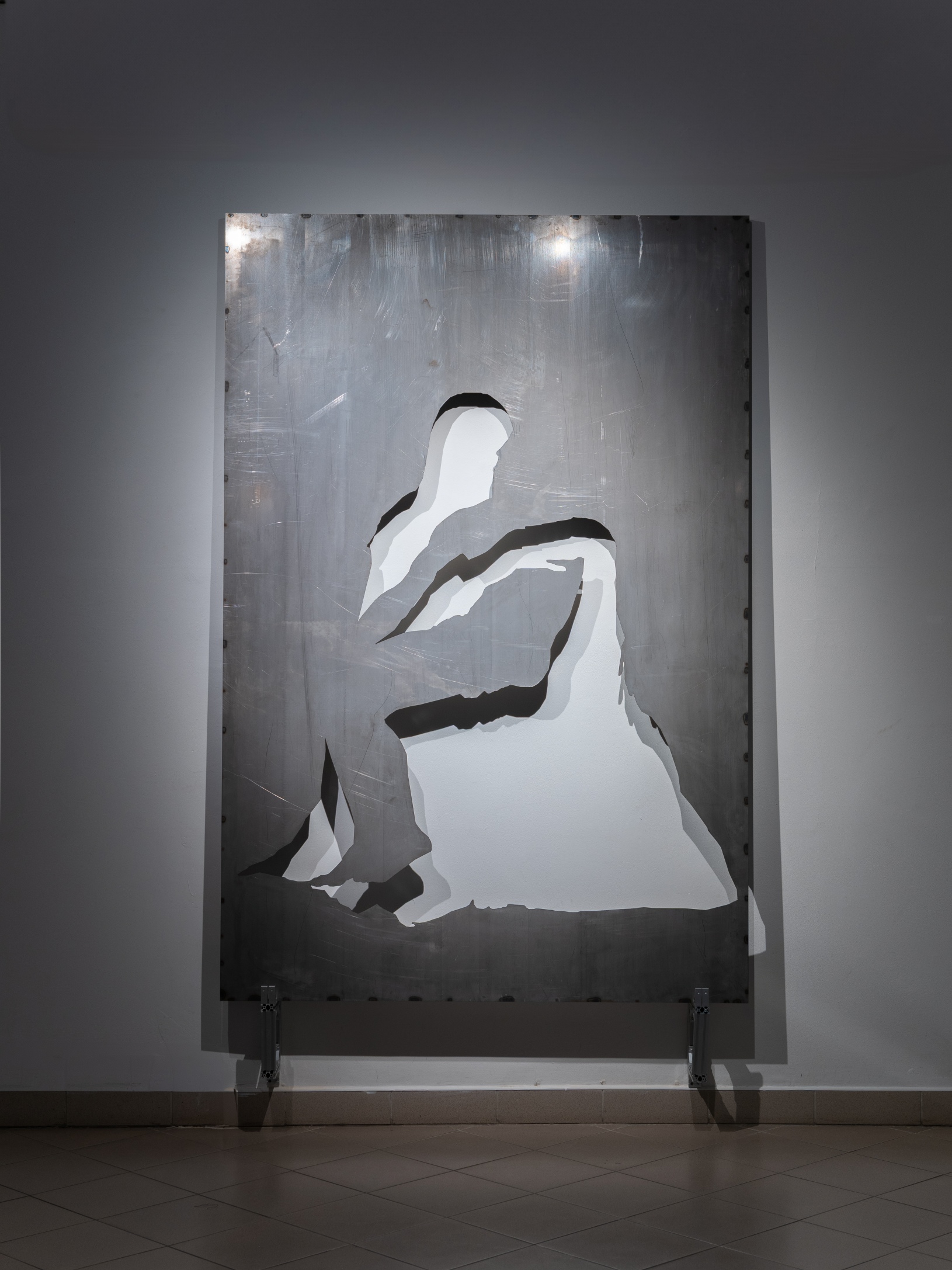
Agata Orlovska, “The Armour of Pieta”, 2025, steel, laser cutting. Exhibition view_ “Dymaxion”, KKKC, Klaipėda, Lithuania. Photo by Laurynas Skiesgaila. Courtesy of the artist
An artist and curator, Ona Barbora Šlapšinskaitė (b. 1999), constructs installations and videos that function as stubborn “memory machines,” assembling improvised scenography and everyday matter to probe the uncomfortable intimacy of inherited history. Treating the past as an active agent rather than a static backdrop, she allows family lore and ideological residue to leak into the present, negotiating the fragile gap between verifiable fact and the distortions of memory.
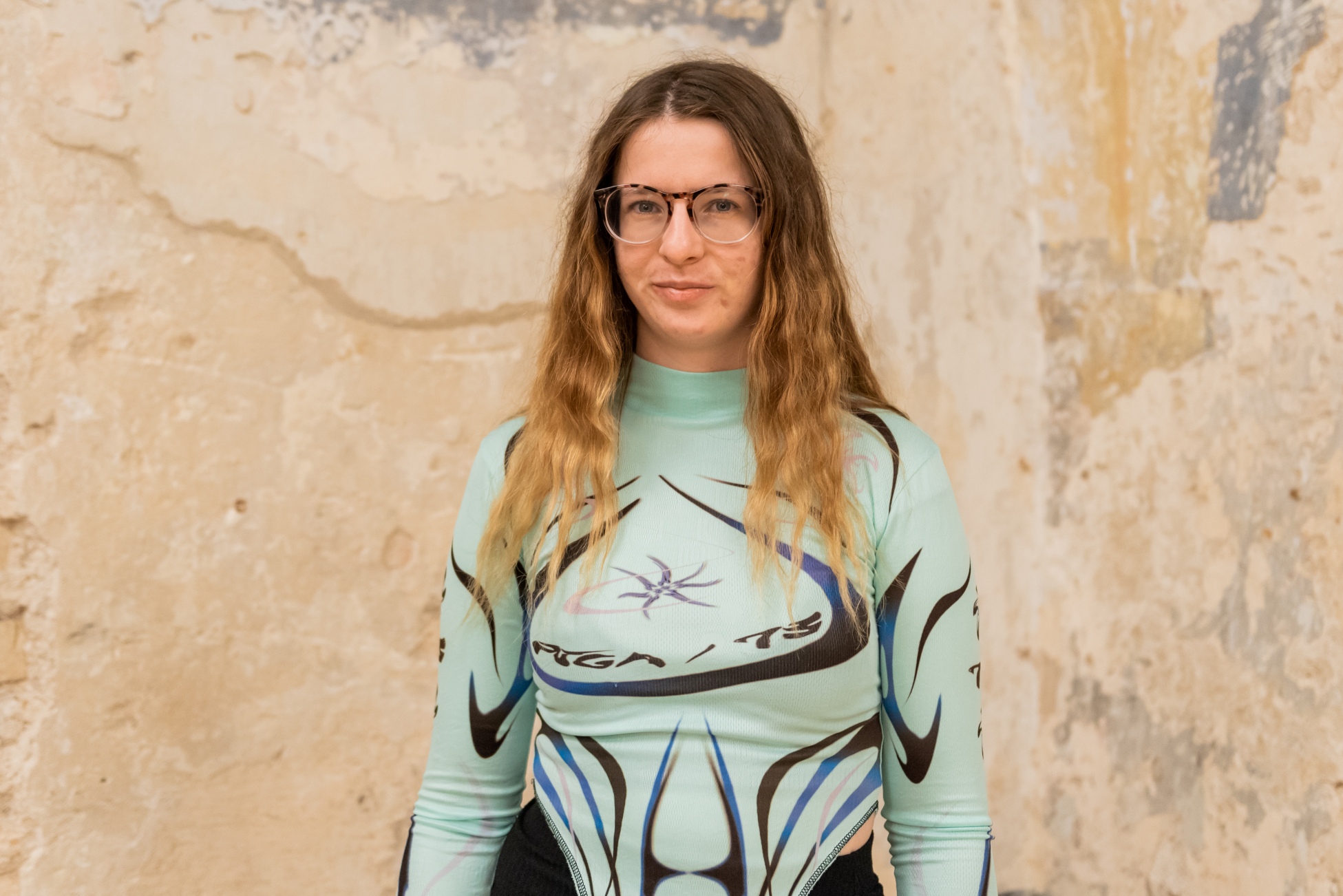
Ona Barbora Šlapšinskaitė. Photo: Remigija Vilniūtė. Courtesy of the artist
Her material vocabulary is deliberately eclectic yet tactile – utilising polyethene film, beeswax, orange peels, and spray-painted clay to give physical form to ephemeral hauntings. In works like Don’t get me wrong, this is not a simple possession (2024), she navigates post-colonial trajectories through the spectral figure of a great-grandfather, while projects like Druzhba (2023) translate segregated urban routes into a fictional alphabet. By intertwining the clinical with the tender, her practice questions who authors memory and who is written out of it, suggesting that even a humble oyster shell or a makeshift defensive structure can act as a hinge between private recollection and collective trauma.
She is currently completing an MA in Sculpture at the Vilnius Academy of Arts, following studies at the Hochschule für Grafik und Buchkunst Leipzig. She is the winner of the main prize at the JCDecaux Award 2024 and has received individual grants from the Lithuanian Council for Culture. Her work has been exhibited at Sapieha Palace (Vilnius), IKZP (Germany), Camberwell Space (London), and the Martynas Mažvydas National Library of Lithuania. In addition to her studio practice, she has curated exhibitions, including the recent miela, gražu, žavu/ Cuuuute!!! (2025).
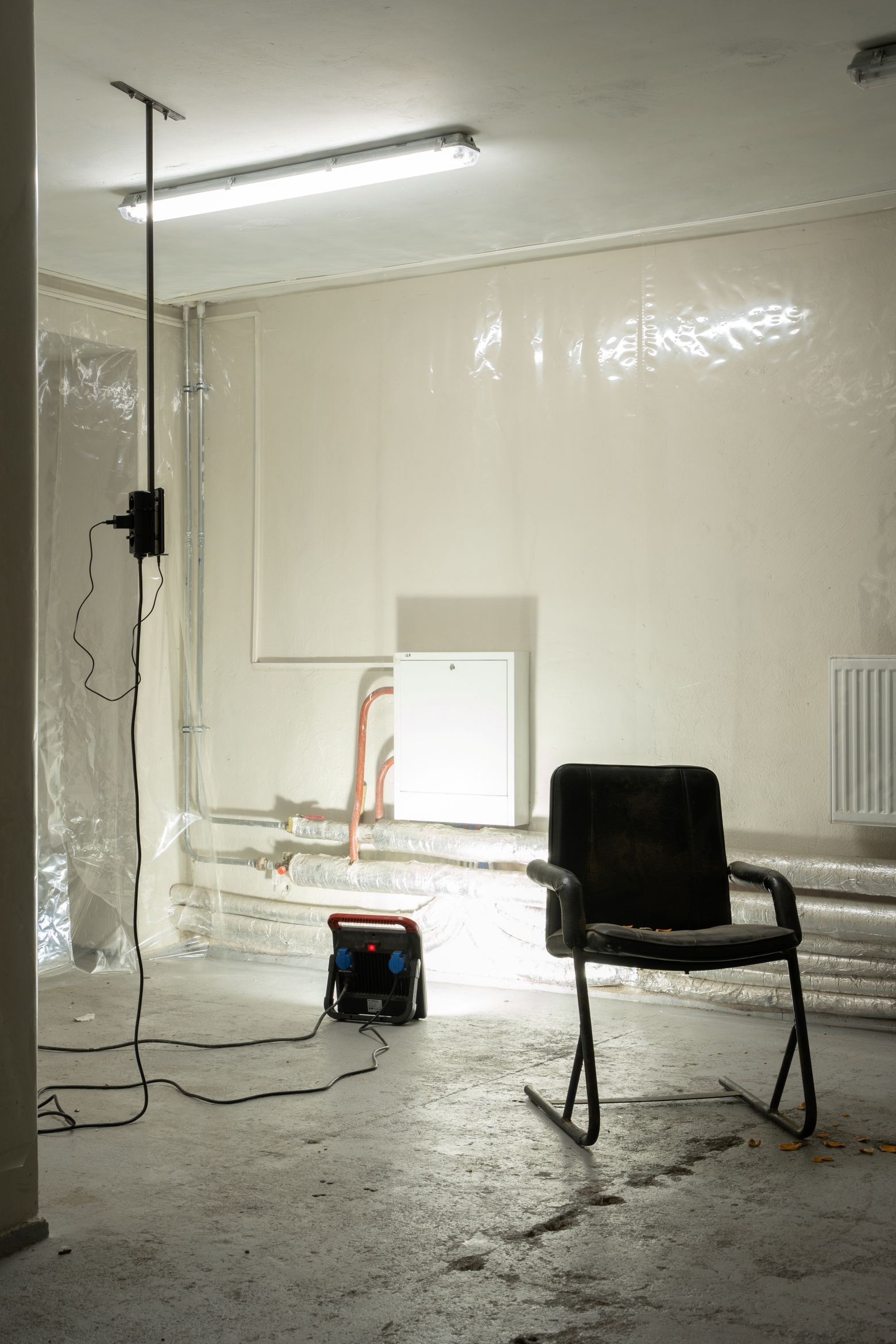
Ona Barbora Šlapšinskaitė, “The intruders are leaving, but others will come”, 2023, photography Jurga Sako. Courtesy of the artist
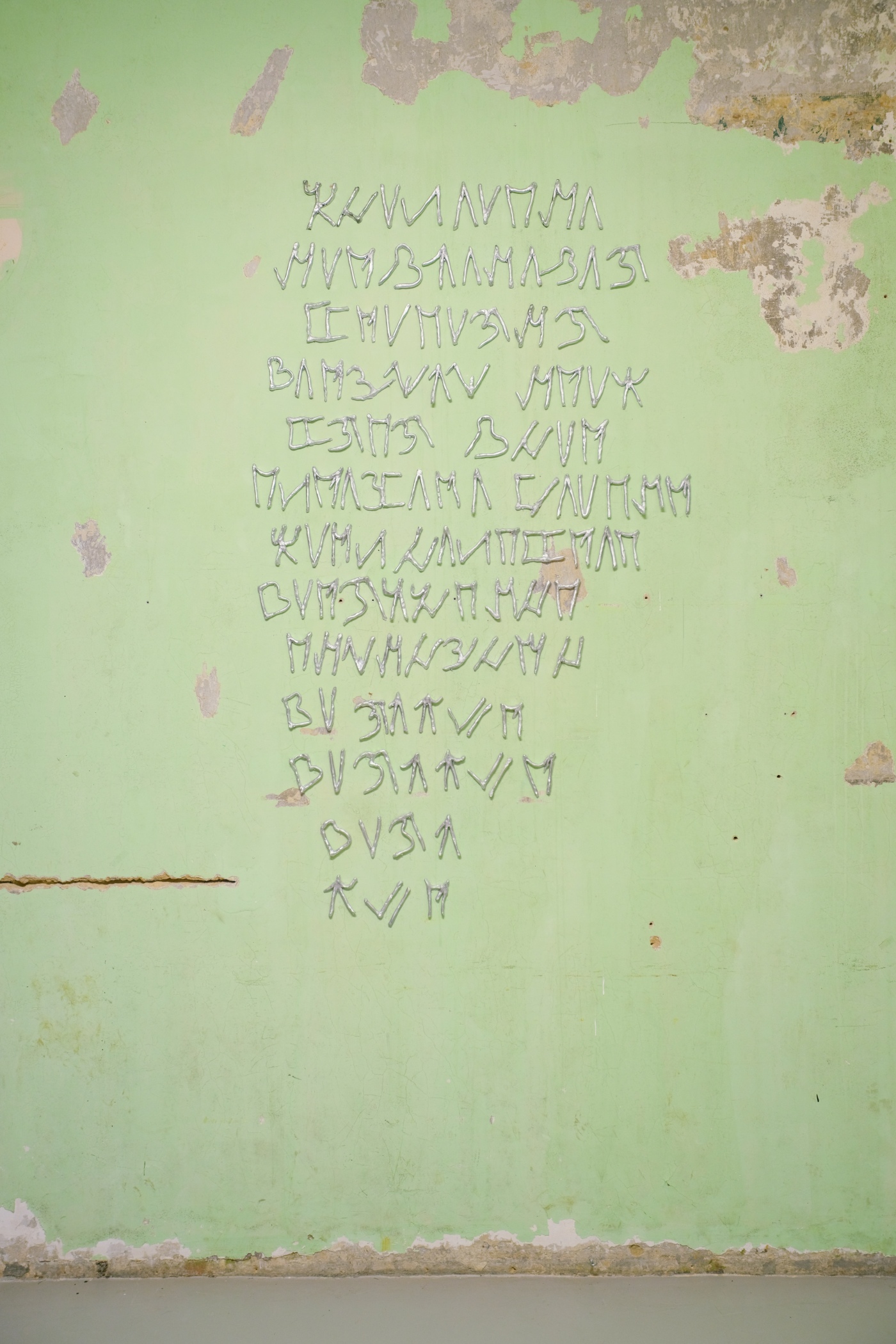
Ona Barbora Šlapšinskaitė, “Druzhba”, 2023, photography Laurynas Skeisgiela. Courtesy of the artist
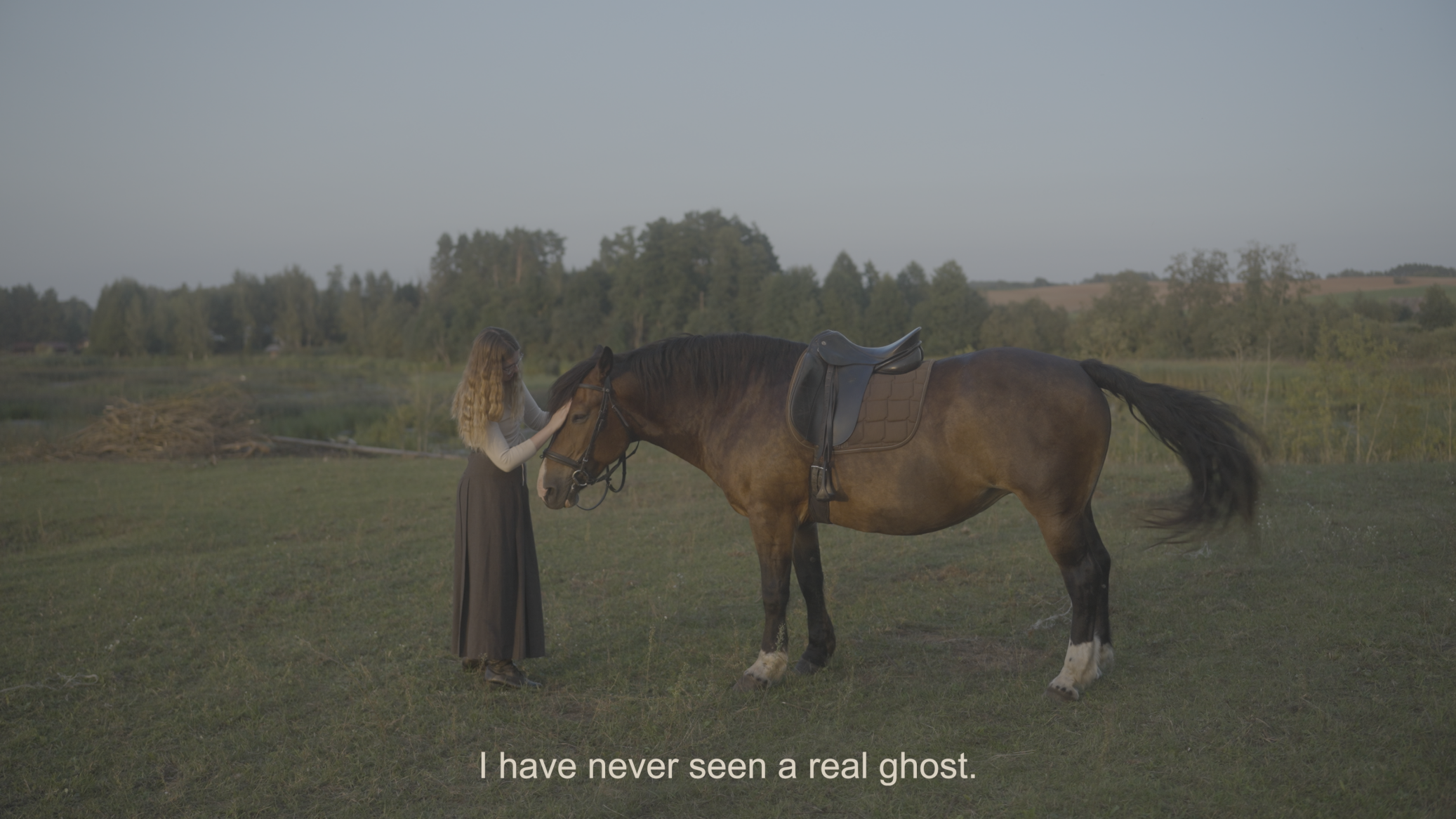
Ona Barbora Šlapšinskaitė, “Don’t get me wrong, this is not a simple possession”, video, 13’37 min, credits – camera operator: Alanas Gurinas; assistant: Matas Šatūnas; dubbing: Barbora Matonytė; soundtrack: Tata Frenkel. Exhibition photography Alanas Gurinas. Courtesy of the artist
Eglė Tamulytė(b. 1988), also known professionally as Aglaja Ray, is an interdisciplinary artist who describes her practice as “visual philosophy,” a research-based inquiry spanning installation, performance, and painting. Her trajectory is defined by distinct phases: an early Dark Period rooted in black-and-white underground aesthetics, followed by a Neon Period (2019–2024) that engaged with transhumanism, artificial eternity, and theological structures through vibrant colour palettes. Her work frequently occupies the intersection of science and belief, engaging physicists and philosophers to produce installations that question the ethical limits of human evolution – most notably in her Technoteology cycle.
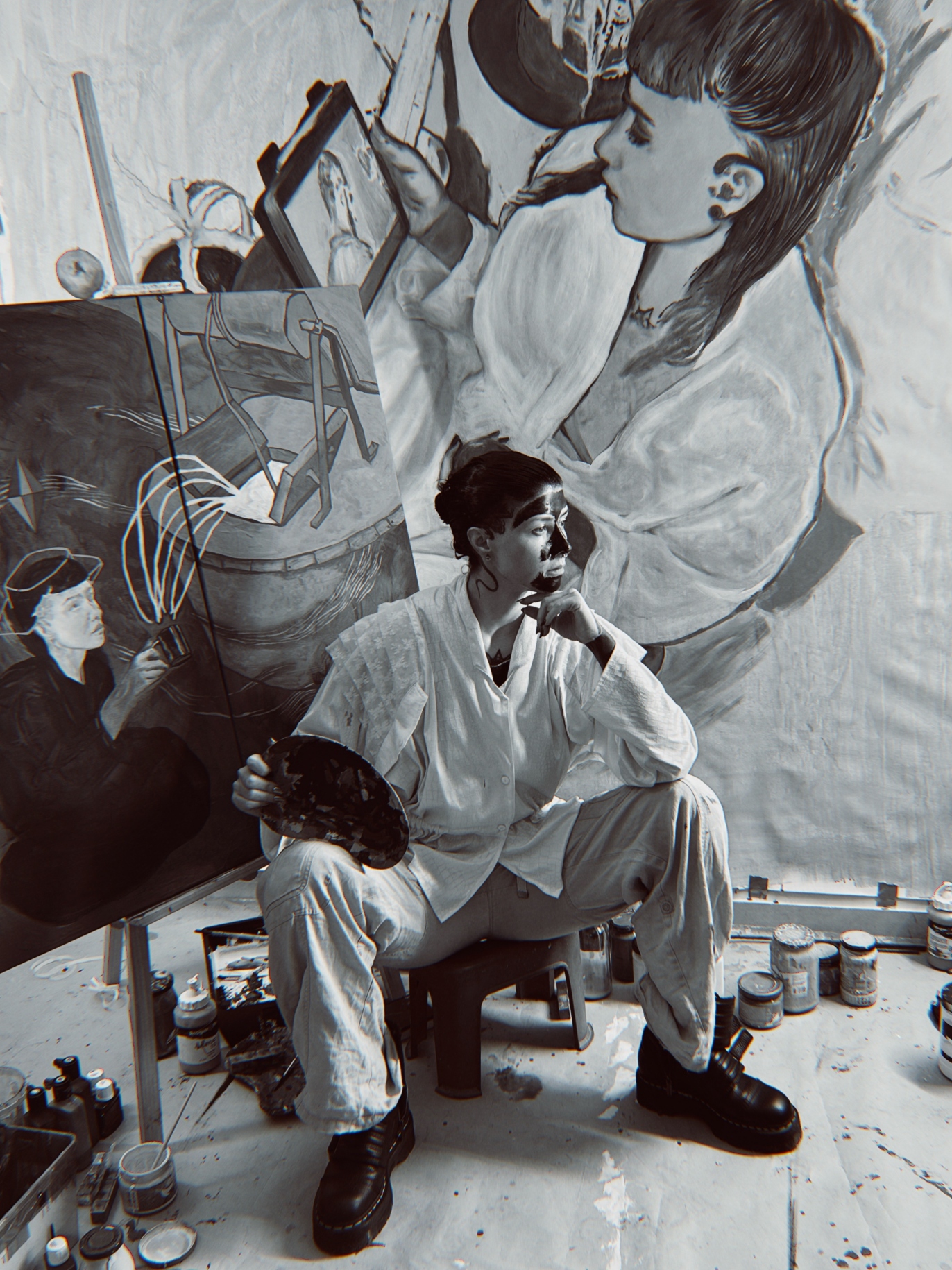
Aglaja Ray in her studio in Kazlų Rūda, 2025. Courtesy of the artist
A strategic withdrawal to the rural town of Griškabūdis reshaped her methodology, utilising isolation to ground these lofty metaphysical queries in community engagement and site-specific intervention. Recently, her focus has pivoted toward figurative oil painting and autobiography, softening the cold edge of cyborg theory with the vulnerability of personal memory. Ultimately, she treats art less as a static production and more as a spiritual survival mechanism for the post-human age.
She holds an MA in Graphic Arts from the Vilnius Academy of Arts (2020). Her practice has been consistently supported by the Lithuanian Council for Culture, receiving multiple State Scholarships for Artists between 2016 and 2026, as well as the Ary Stillman Scholarship. Tamulytė has exhibited internationally, with presentations at the Supermarket Art Fair in Stockholm and a solo show at Casa Colorada in Marseille. In parallel to her studio work, she directs the artist-run initiative Šaltmiros gyvenimo mokykla in Griškabūdis.
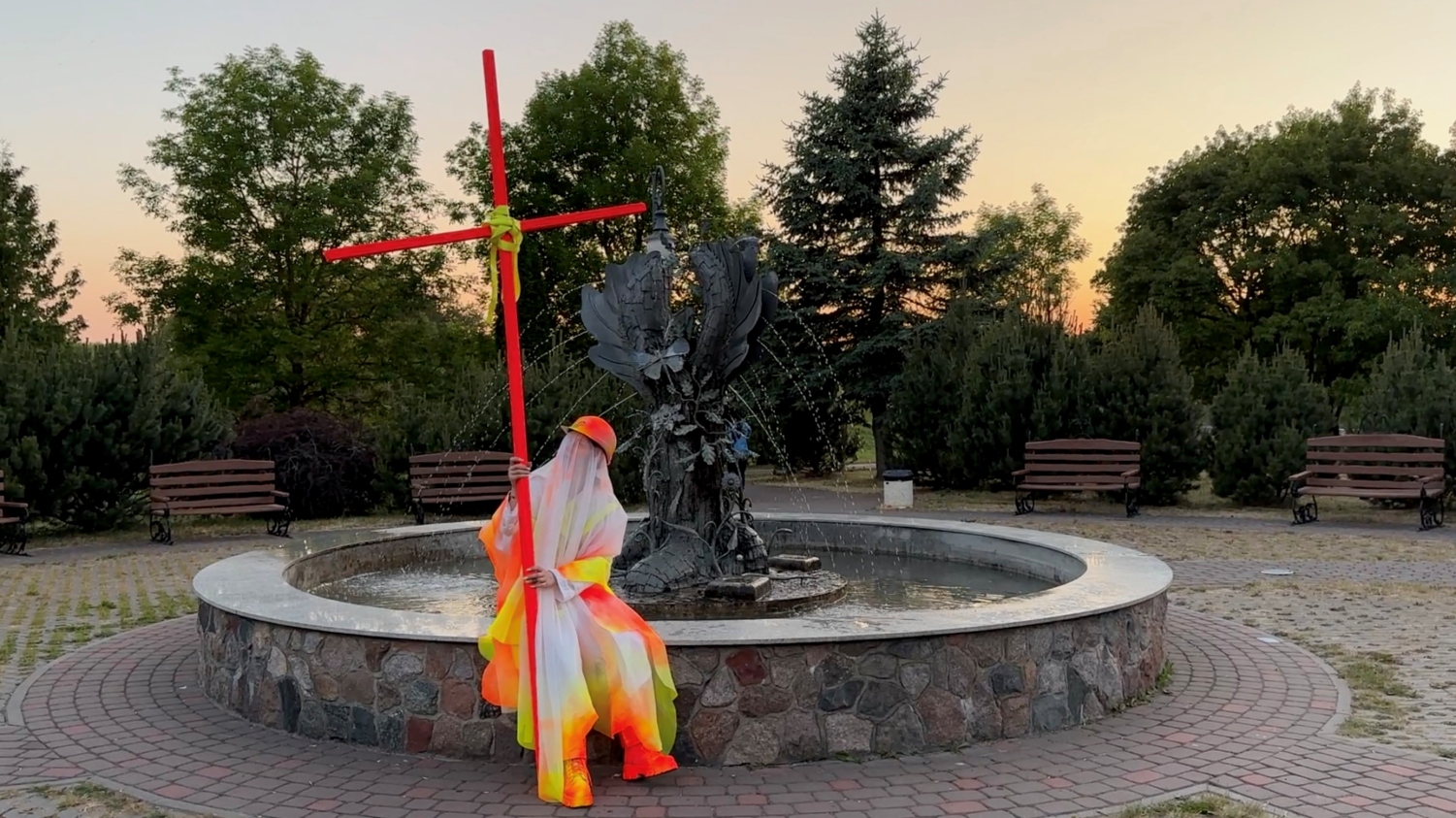
Aglaja Ray, Still from the performance video “The walk in Silence”, 2023. Tauragė, Lithuania. Contemporary Art Festival “KVADRATU”. Courtesy of the artist
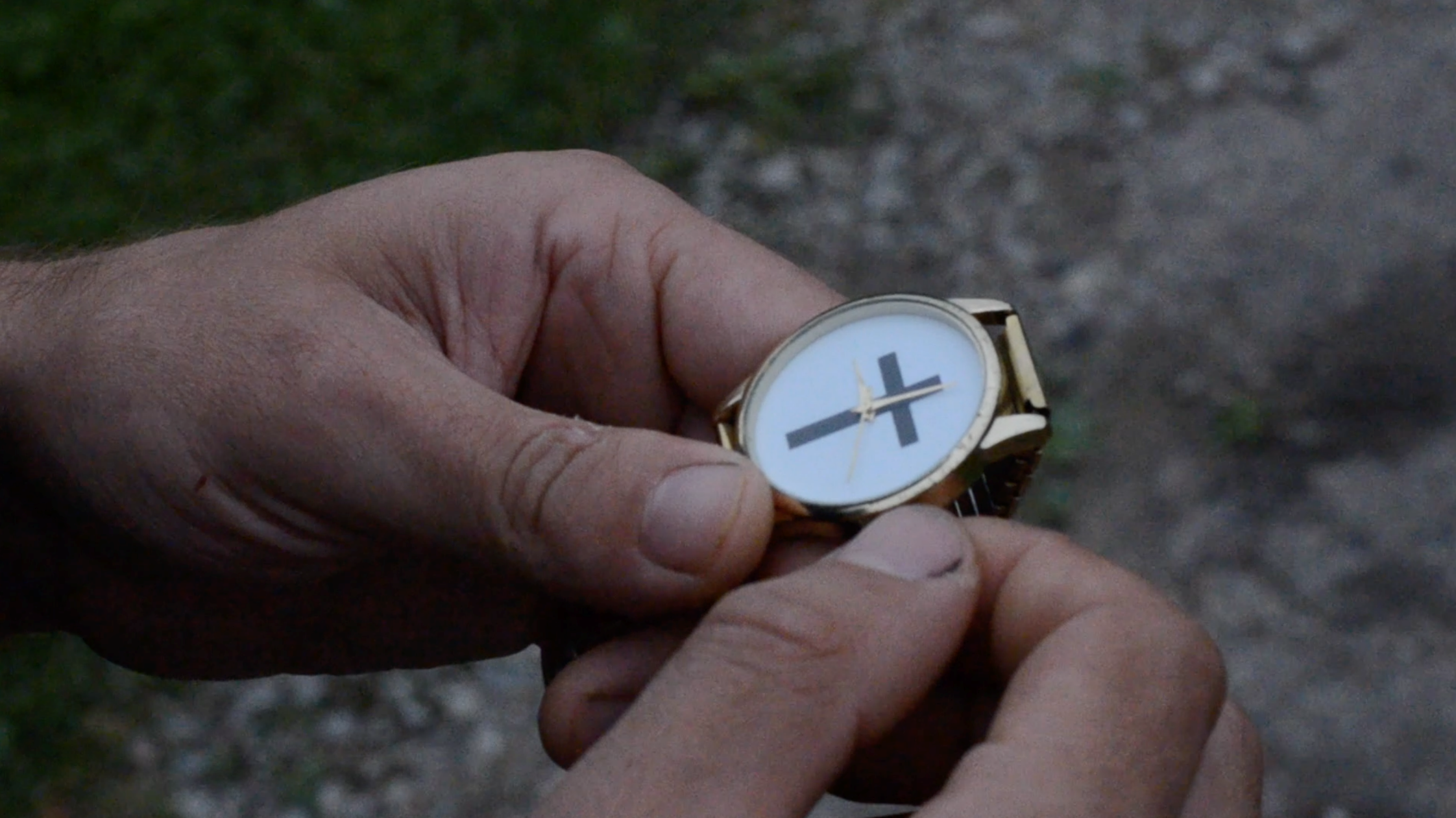
Aglaja Ray, Still from short film “The Clock”, 2026. Courtesy of the artist
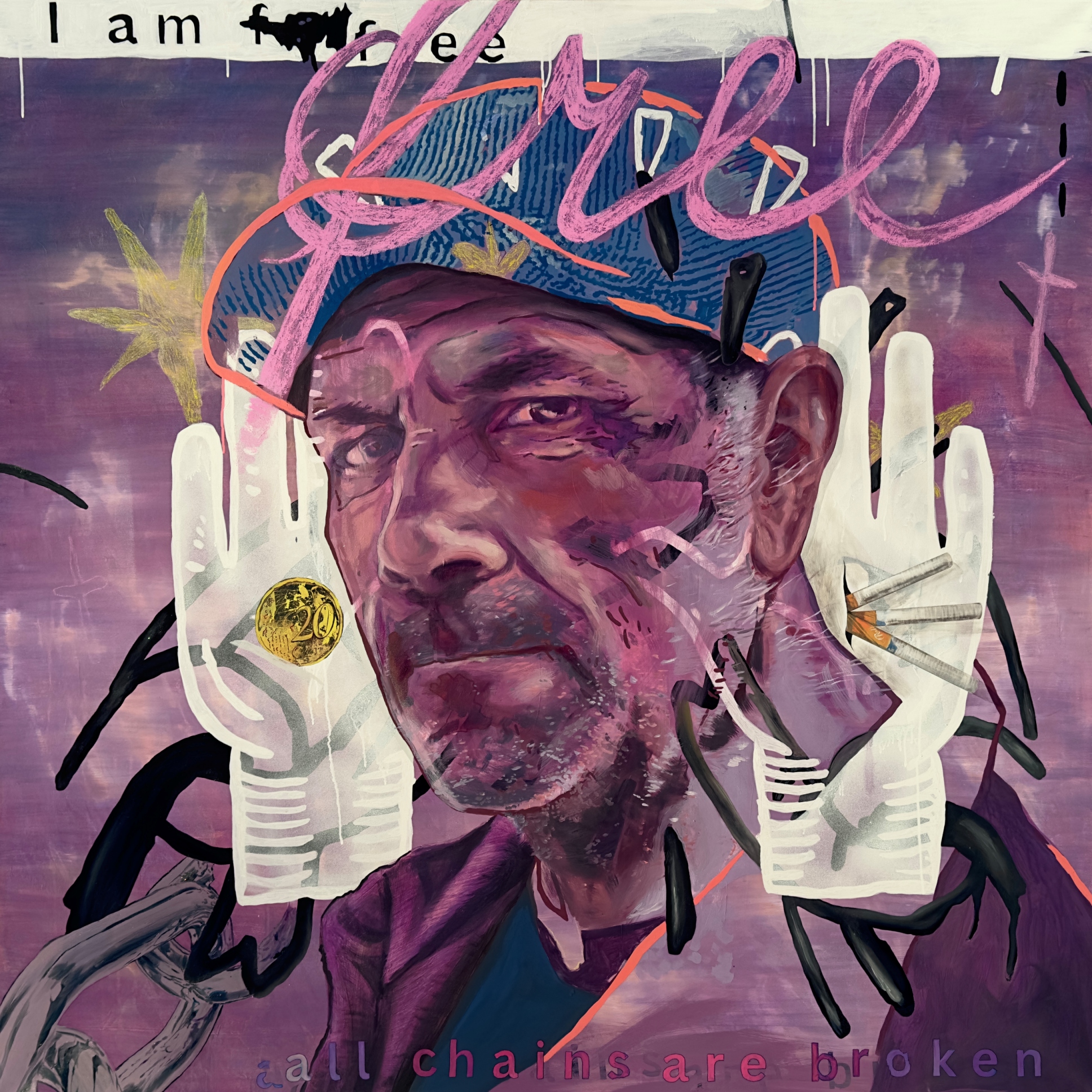
Aglaja Ray, “Our Algirdas. Nothing is missing anymore”, canvas, acrylic, oil paint, oil and pastel crayons, 150 cm x 150 cm, 2026. Courtesy of the artist
Written by Rosana Lukauskaitė