
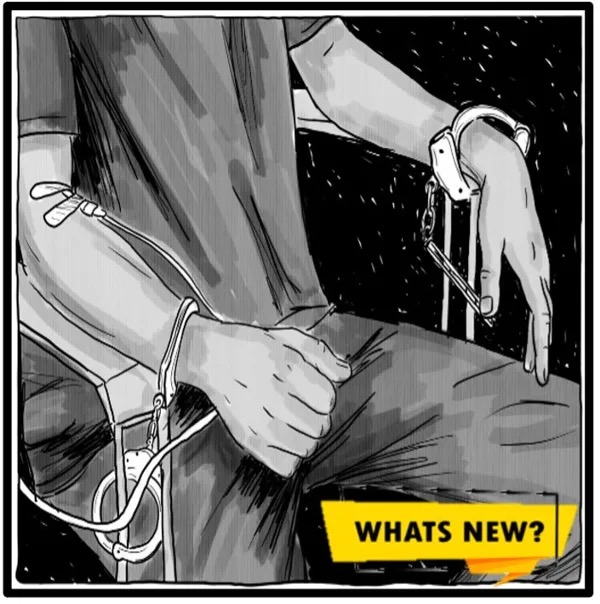
Following are selected articles, reports, etc., from the latest (March) posting on the End-of-Life Care Behind Bars website. Access the monthly postings at: https://bit.ly/47sVCRU
Untapped Potential: The Power of Peer Support Programs in Prisons
JOHN HOWARD ASSOCIATION (U.S.) | Online – 4 March 2026 – At the time this report was drafted, there were more than 70 Peer Support Programs in U.S. carceral facilities identified in operation with a focus on improving health outcomes for incarcerated people with more new programs regularly coming to our attention, in addition to international programs. This project focused on 15 programs across 12 jurisdictions addressing a range of health and well-being areas including … palliative care. John Howard Association set out to examine how these kinds of programs could fill gaps in care inside Illinois’ prisons. The dysfunctional state of medical and mental health care inside facilities has been an ongoing issue of deep concern as well as the subject of litigation. People inside often report that they cannot access medical and mental health treatment, and staff shortages are creating an untenable and worsening situation. Access report at: https://bit.ly/3OMytV2
N.B. Word search report for multiple discussion/mentions of “hospice” and “palliative care,” e.g., Louisiana State Penitentiary Hospice Program (p.16) and Nebraska Hospice Care Volunteer Program (p.17). BRA
Before my time in hospice, I never considered dying alone
PRISON JOURNALISM PROJECT (U.S.) | Online – 3 March 2026 – The incarcerated care workers of No One Dies Alone (NODA) changed how I thought about dying in prison. These were women working with NODA, a peer support initiative that trains and supports incarcerated individuals as companions for other incarcerated people at the end of their lives. Within West Pod, there are three specially trained NODA care workers. These women work on shifts to assure the people in hospice care receive their daily dose of comfort. The compassion they exhibited was amazing. Watching them interact with patients brought to mind a mother and infant: the gentle talks, feeding, wiping mouths, combing hair. They chopped food in small pieces to prevent choking and helped patients dress and undress. I was awestruck by how unambiguously the care workers loved Frances. I felt like an outsider looking through a telescope at another planet. Full text: https://bit.ly/4rbkBAR
Inmate-founded hospice program reshapes culture at Illinois prison
CORRECTIONS1 (U.S.) | Online – 21 February 2026 – Finis Leonard has helped 13 men die. That’s not why the 48-year-old Rock Island native has been in Illinois prisons since 2007. Handed concurrent sentences of 30 years for being an armed habitual criminal and 10 years for the unlawful possession of a firearm by a felon, Leonard made a decision in 2016 that he says changed his life. He decided to study palliative care (PC) and started a hospice care program at Danville Correctional Center. Leonard said working with dying men and helping others learn PC has made him a better person. He has petitioned Rock Island County State’s Attorney Dora Villarreal for early release from his prison sentence, which is expected to last another six years. “Helping people transition from life to death with some kind of dignity and comfort has made me a better person,” he said… Full text:https://bit.ly/4aKlEBN
‘This place is love’: A prison unit for the dying – in pictures
PRISON JOURNALISM PROJECT (U.S.) | Online – 11 February 2026 – In 1996, a 17-bed, state-licensed hospice began caring for dying incarcerated men at California Medical Facility (CMF) … At that time, the hospice unit mainly took care of patients dying of AIDS. Today, many of the patients housed there are dying of cancer, the leading cause of death in U.S. prisons. All of the patients at CMF had ceased treatment; the main objective of their care was comfort. Since CMF’s hospice program typically only houses patients who have six months or less to live, I expected the mood to be somber – like the kind you might encounter at an underfunded senior living facility. But what we found was something brighter and more alive. The hospice unit more closely resembled a hospital ward than a prison. Medical staff, social workers, psychologists and a chaplain buzzed about. If I hadn’t handed over all my belongings, passed through a metal detector, and walked through a line of people dressed in state-issued blues, I might not have guessed I was in a prison at all. Full text: https://bit.ly/4qvIcfk
Equitable palliative care in prisons: Integrating advanced care planning
BRITISH JOURNAL OF GENERAL PRACTICE (U.K.) | Online – 14 February 2026 – The authors cite an existing definition of “critical illness” requiring reversibility, distinguishing from illness-related deterioration at the end of life. Whilst analytically useful, this distinction may be less clear in ageing prison populations – where frailty and advanced multimorbidity coexist with episodes of acute deterioration. Notably, 16% of reported incidents resulted in avoidable hospital admissions. In community settings, advanced care planning and early palliative involvement reduce admissions. More consistent integration of these approaches within custodial healthcare could support clearer treatment-escalation decisions and reduce unnecessary transfers. Barriers to palliative care include limited hospice access (often superseded by security constraints) and logistical challenges with opioid prescribing. Short staffing … further restrict timely symptom control and anticipatory prescribing, particularly out of hours. Full text:https://bit.ly/4qKs6Pd
N.B. See ‘Care Planning in Correctional Healthcare: In Defence of Prison Inmates’ Autonomy,’ posted on the ‘Spotlight’ page of the End-of-Life Care behind Bars website: https://bit.ly/3Ph3JLM
Grieving in prison: What it means to mourn when no one can hold you
NORTHWESTERN PRISON EDUCATION PROGRAM: NORTHWESTERN INSIDER (U.S.) | Online – Accessed 9 February 2026 – How does one truly grieve while in prison? One doesn’t – not fully, not completely. You may be eligible for a funeral furlough, but that only works if you anticipate the passing well in advance, and if you can afford the fees. The approval process takes a minimum of 30 days. And if it’s granted, the individual in custody is required to pay for mileage, gas, and the day wages of the accompanying officers, all in advance. Most applications don’t get approved. And even if you are granted a furlough, let’s be honest: Who wants to wear shackles, waist chains, and cuffs for hours just to spend 15 minutes with the deceased? You’re not allowed to speak with other family or friends. It’s just you, your loved one, and two armed correctional officers who may or may not have compassion. Grieving in prison is a challenge most people will never understand. Full text: https://bit.ly/4rEGxVI
Caring for formerly incarcerated patients in hospice and palliative care: Dignity, safety, and restorative compassion
REWRITING THE LAST CHAPTER (U.S.) | Online – 9 February 2026 – As the hospice community deepens its commitment to equity and trauma-informed care, clinicians are increasingly caring for individuals who have experienced incarceration. These patients bring with them a lifetime of medical, psychological, and existential burdens shaped not only by disease, but by the enduring imprint of trauma, stigma, and institutionalization. Providing end-of-life care to those once imprisoned challenges us to embody the core philosophy of hospice – that every human being deserves compassion, dignity, and relief from suffering, regardless of their past. Incarceration leaves an unmistakable mark on the body and mind. Research shows that formerly incarcerated individuals experience accelerated biological aging… By the time many reach hospice, they carry decades of unaddressed health inequities and deep mistrust of the healthcare system. Full text: https://bit.ly/4rHgddz
N.B. See ‘Engaging the Hospice Community in End-of-Life Care in Prisons’ (Parts 1 & 2) posted on the ‘Spotlight’ page of the End-of-Life Care Behind Bars website: https://bit.ly/4mfBPL9
How has this resource benefited you. Let us know: https://bit.ly/4cdWVFD
____________________________________________________________________________________
Barry R. Ashpole, Ontario, CANADA Biosketch: https://bit.ly/3XMTRs4
Cover photo Source:Prison Journalism Project https://bit.ly/4aJQhs8
BARRY R. ASHPOLE is an educator and communications consultant living in Ontario, Canada. Now semi-retired, he has been involved in palliative and end-of-life care since 1985. He established the End of-Life Care Behind Bars website (https://bit.ly/4dU4qmi), an advocacy, teaching and research “tool” to inform and, hopefully, affect a seismic shift in society’s attitudes towards the health and well-being of the incarcerated. Regular postings include annotated listings of current articles, reports, and so on, culled from the professional literature, the news media and other sources.
Republish This Article
The author believes in the free flow of information. Republish this article for free, online or in print, under Creative Commons licence, with due credit to the author and source. https://bit.ly/3B9EK6n