
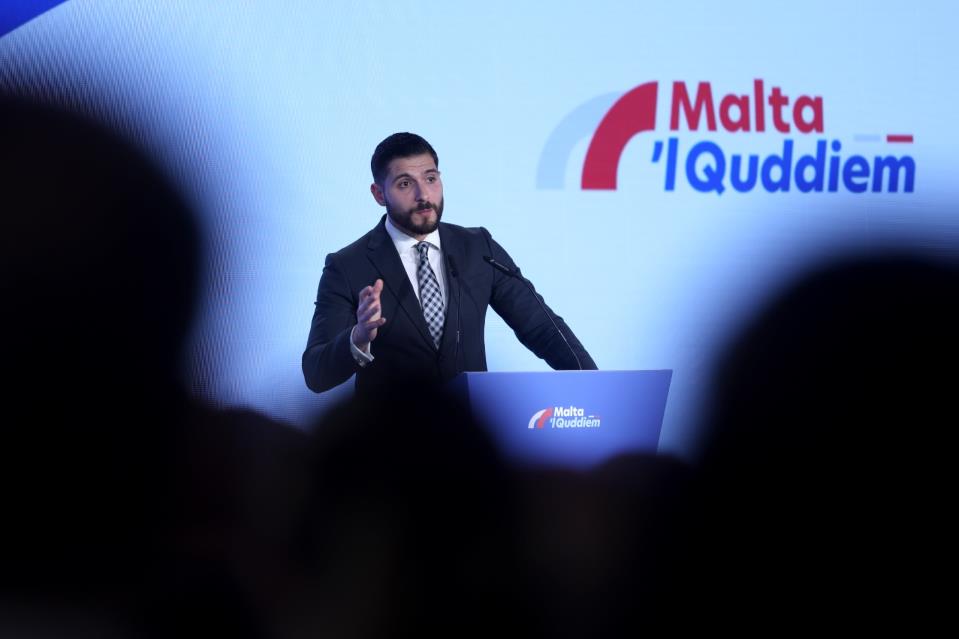

Leader of the Opposition Alex Borg has outlined a series of policy priorities ranging from financial support for families to labour reform and long-term transport investment during an interview on NET Television.
Speaking about Malta’s demographic challenges, Borg highlighted the country’s persistently low fertility rate, warning that it poses serious social and economic implications for the future. He pointed out that while lifestyle choices and societal changes play a role, financial pressures remain one of the most significant barriers preventing couples from having children.
In response, Borg detailed the Opposition’s proposal for a “child trust fund,” through which parents would receive €5,000 for every newborn. He explained that the measure is intended to provide immediate financial support to families while also serving as a long-term investment in Malta’s population sustainability.
Borg stressed that the proposal is part of a wider strategy aimed at making family life more affordable and secure, arguing that government policy should actively support those who wish to have children. He added that such initiatives are essential if Malta is to address demographic decline in a meaningful and sustainable way.
On employment reform, Borg addressed the idea of a four-day work week, clarifying that the proposal is not being presented as an immediate policy change. Instead, he said, it is meant to open a nationwide discussion on the future of work.
He emphasised the importance of consulting all stakeholders, including businesses, employees, unions, and economists, to fully understand the potential impact of such a shift. Borg noted that while a shorter work week could improve work-life balance and productivity, it also raises questions about economic competitiveness and implementation across different sectors.
Turning to infrastructure and long-term planning, Borg criticised the government’s handling of major projects, particularly in relation to Vision 2050. He argued that despite millions of euros being spent, there has been little tangible progress in addressing critical issues such as traffic congestion and efficient public transport.
He also referenced the government’s now shelved plan to implement a metro system, describing it as an idea that had been heavily promoted in the past but ultimately failed to materialise. Borg accused the government of using the project as a form of political propaganda without delivering concrete results.
Looking ahead, Borg pledged that a government led by the Nationalist Party would prioritise mass transport reform from the outset. He stated that within the first 100 days in office, work would begin on implementing a new transport system aimed at reducing congestion and improving connectivity across the islands.
Borg said that the party has already conducted studies into various mass transport options, and these findings will form the basis of a comprehensive plan to be unveiled during the electoral campaign. He added that transport will be one of the central pillars of the party’s policy platform.
Further details on these proposals, particularly in relation to mass transport, are expected to be announced in the coming months.