
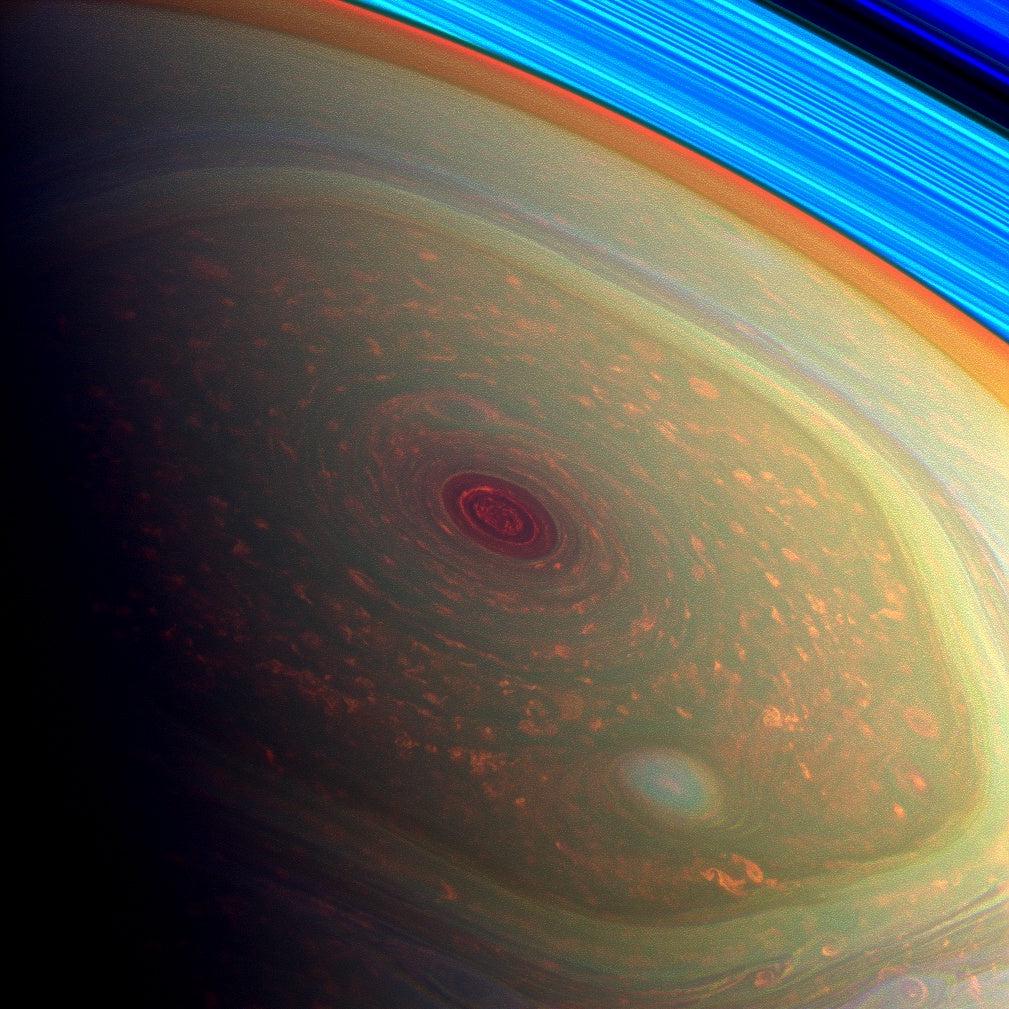
You’re looking at a massive storm spinning at Saturn’s north pole. That red “eye” is part of a long-lived polar vortex, basically a hurricane that doesn’t die.
The bright blue rings aren’t actually blue. It’s a false-color effect showing areas with little to no methane, which helps scientists see structure in Saturn’s atmosphere more clearly.
Images like this help researchers understand how extreme storms form and behave in gas giants and insight that could apply to planets far beyond our solar system.
Captured from ~419,000 km away with a resolution of about 22 km per pixel.
https://i.redd.it/6nijdxwrrxrg1.jpeg
18 Comments
You can tell it’s a CCD camera they had on Cassini just by looking at this image. The noise profile is the exact same as a CCD haha. Love how I can see that.
E: Not sure why I’m being downvoted when Cassini actually had a CCD camera on it, here is the link if you don’t believe me, right form the [NASA ](https://science.nasa.gov/mission/cassini/spacecraft/cassini-orbiter/imaging-science-subsystem/)website.
The fact that its hexagonal astonishes me everytime
Is the red and orange real colour, if it is then is it hot or cold
Did you know the first god in earth was saturn? Some ancient religions tough saturn was the first sun.
Everything ends. It’s still pretty cool though.
Hexagons are the Bestagons.
“Everything reminds me of her”
Hey. I heard you liked storms so I put a storm inside your storm.
I can’t wait until we get super close footage of places like this. Like similar to drone footage zipping around mountains and canyons. All the gas giants and their moons have incredible features.
Thought this was someone’s leg with a sore on it at first.
That’s a nipple mate. Sorry.
Is it a storm if it never ends?
my ideal version of an afterlife would be to exist as some sort of observer. unable to be damaged or hurt by anything, and able to go observe anything, anywhere. i’d love to go see what it’s like on saturn, and frankly all the planets in our solar system.
Saturn losing it’s hexagon would make for a good sci-fi film. Train a team of meterologists and geomotry teachers to be astronauts and launch them into fatal gravitational force. Before anyone tells me that sounds dumb, thank you.
Yah, that looks real…. psssh
Grabbed this from the machine because I’m the idiot in the room. Thought I’d share it in case I’m not the only one…
It’s a permanent feature, roughly 5,000 miles wide, with winds raging up to 330 miles per hour, making it one of the largest and most intense storms in our solar system. What’s truly fascinating is that it’s embedded within a hexagonal jet stream, a unique six-sided atmospheric pattern that’s still a mystery to scientists.
I used to live there, but now I moved back
🎶This is the storm that never ends…🎶