
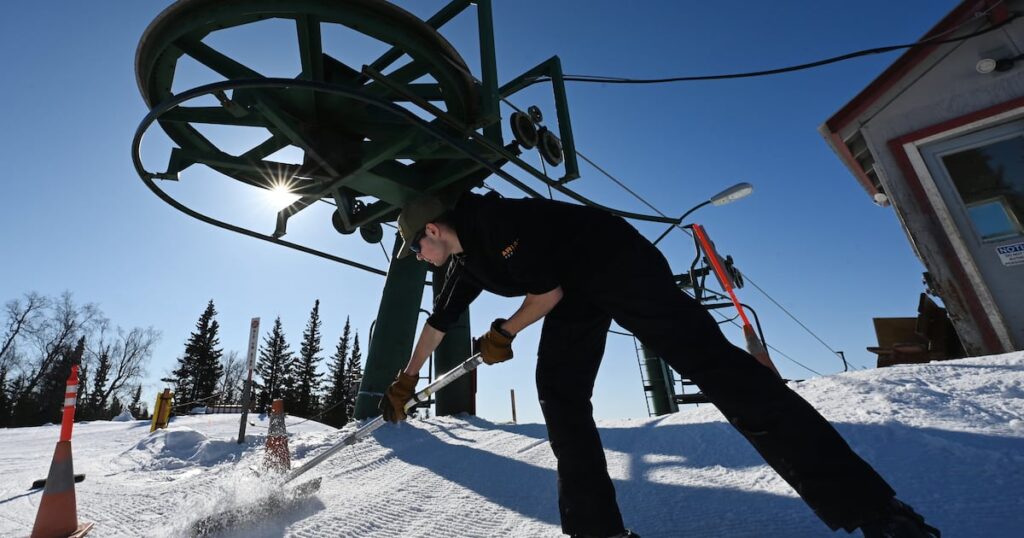
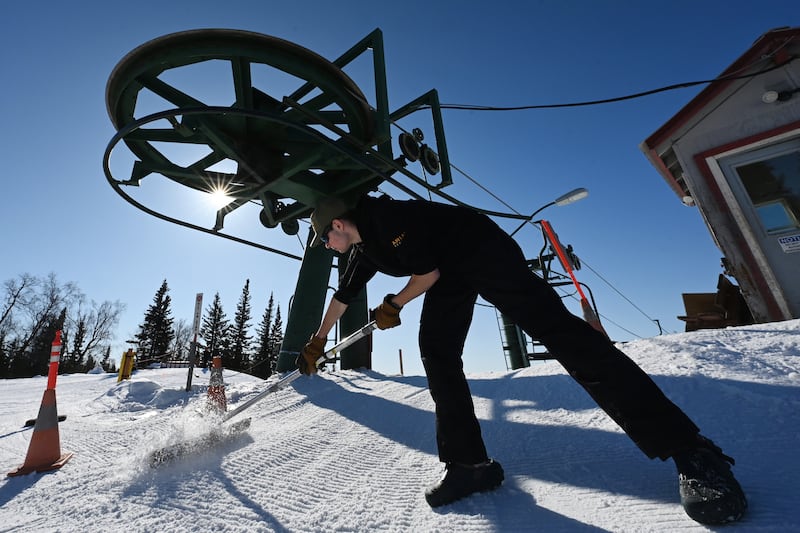
 Lift operator Judah Sturm rakes the chairlift off-ramp at Hilltop Ski Area on Tuesday, March 24, in Anchorage. (Bill Roth / ADN)
As the Hilltop Ski Area chairlift trundled 800 feet to the top, snowboard instructor Kurt Meehleis began Tuesday’s lesson. His student, Ryan Kernodle, 9, stared as Meehleis demonstrated carving turns with a tilt of his feet.
By the third lap, two more small snowboarders joined the “Hot Doggers” class, adding to the list of hundreds of students Meehleis has taught the fundamentals of snow sports.
“I don’t tell a person how to snowboard, I help them become a snowboarder,” said Meehleis, 47.
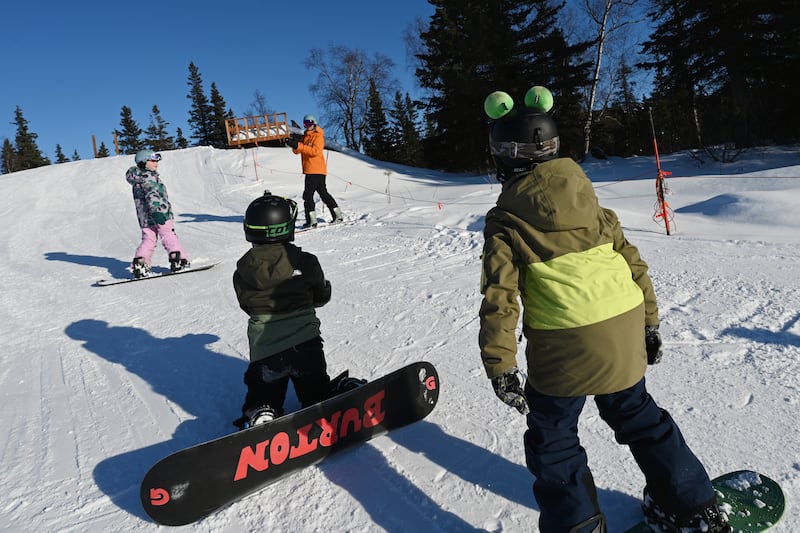 Snowboard instructor Kurt Meehleis works with youth snowboarders during a lesson at Hilltop Ski Area on Tuesday, March 24. (Bill Roth / ADN)
Meehleis left behind a career in engineering to join the team at the ski area on the Anchorage Hillside full-time in 2019. Last season, he was the most-requested snowboard instructor and celebrated his 30th year teaching.
“Every lesson should be unique,” said Meehleis, who learned to ski at Hilltop as a kid. ”It’s like a puzzle every time you get a new student.”
Each winter, a mixture of staff and volunteers at Hilltop, Arctic Valley and Skeetawk work in tandem as ski hill stewards. It’s a task that requires a desire to preserve access to an ever-more-expensive sport. With lift tickets costing less than $100, this group of small, not-for-profit ski areas in Southcentral Alaska ensures cost is not a barrier. And for Anchorage residents, the distance from home to the slopes — and down the hill — is short, but sweet.
“We’re here because we love it,” said Robert DeBerry, a community development manager at Hilltop. “We work in an industry that is all about fun and giving people that community, camaraderie (and) glue that holds us all together.”
In late March, resident golden retriever Finn, for which the on-site restaurant Finn’s Kitchen is named, wandered through a mostly empty lodge. By the time school let out and 5 p.m. neared, families crowded around most of the available tables and a lift line formed outside.
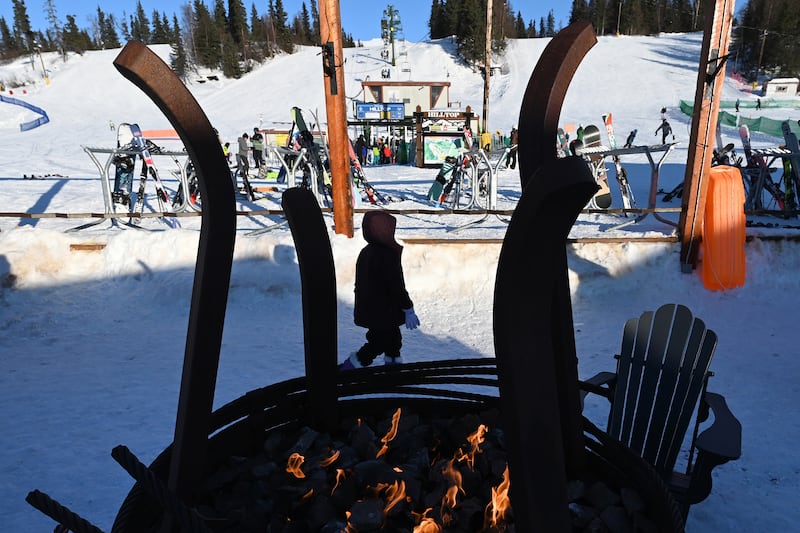 A warming fire at the base of Hilltop Ski Area on Tuesday, March 24. (Bill Roth / ADN)
 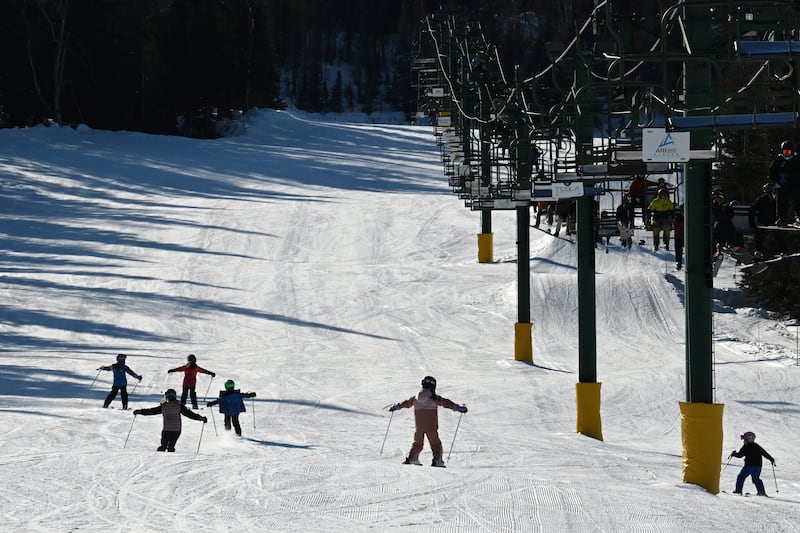 A group of skiers cruise down a groomed trail at Hilltop Ski Area on Tuesday, March 24. (Bill Roth / ADN)
For many Anchorage residents, skiing at Hilltop runs in the family, DeBerry said. His wife learned to ski there, as well as his nieces and nephews.
“You can go almost anywhere in Anchorage, throw a rock in a crowd and hit somebody that has a Hilltop story,” he said.
Meehleis said he finds great joy in seeing his students succeed. They learn lifelong skills that can be used to weather Alaska’s dark, trying winters, he said. And unlike larger “destination” resorts where visitors ceaselessly cycle through, he said, Hilltop skiers tend to stick around. Some of his former students have joined the instructor team.
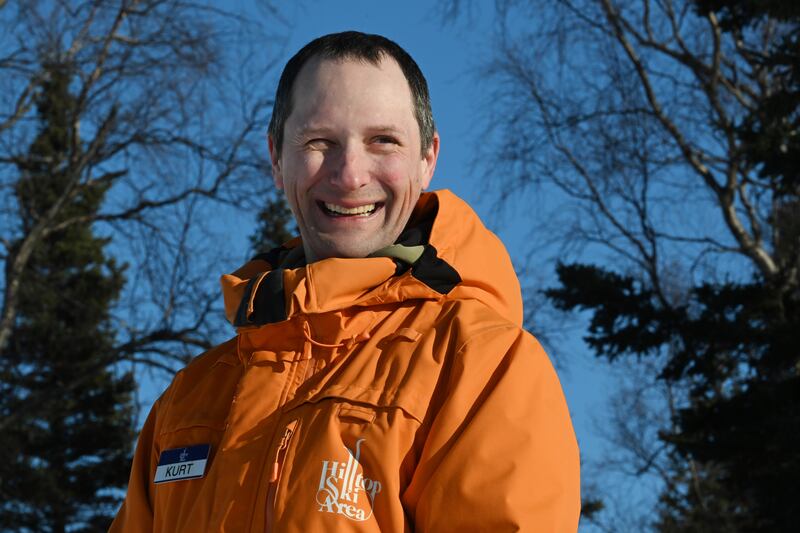 Snowboard instructor Kurt Meehleis during a lesson at Hilltop Ski Area. (Bill Roth / ADN)
“A lot of the people that come to Hilltop — the customers — do feel (like they are) part of the ownership and a desire to make it a better place,” Meehleis said.
Mom and pop
Tucked into the windy foothills of the Chugach Front Range just north of Anchorage, generations of volunteers have carried Arctic Valley Ski Area through the 2008 financial crash and a possible sale in the late ‘90s.
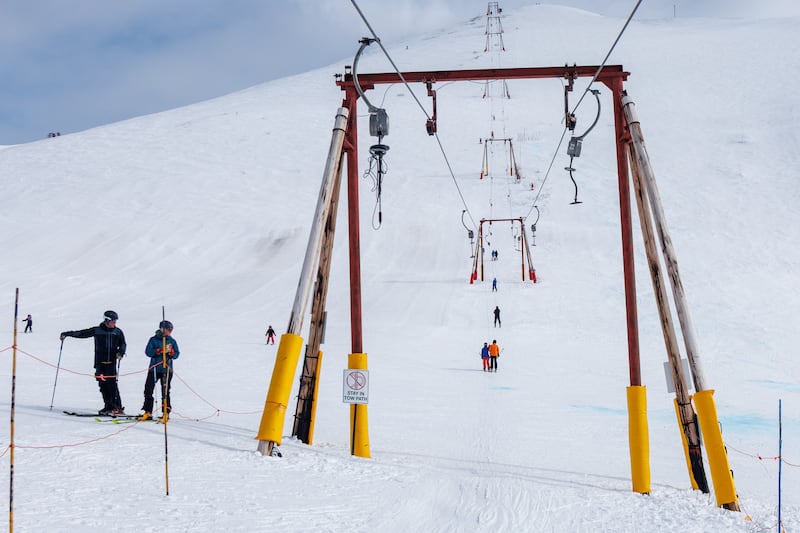 Skiers trundle up the T-bar for a late afternoon lap at Arctic Valley Ski Area on Sunday, March 22. (Bella Biondini / ADN)
The Anchorage Ski Club, the nonprofit that runs the ski area, will celebrate its 90th anniversary next winter.
The milestone will mark the end of Beverly Luedke-Chan’s almost lifelong tenure at Arctic Valley, one that started when she was too short to reach the rope tow and hitchhiked to the top by holding onto the knees of friends.
Her parents managed the ski area through much of the 1960s and 1980s, a time when “skiing was just about skiing,” said Luedke-Chan, 58. She suspects the old leather, lace-up boots she used to wear, paired with wooden skis, may have contributed to a few of her ankle and knee problems.
After 25 years, Luedke-Chan plans to retire from the board of directors. While it has become too painful for her to ski more than a few times a season, she takes pride in building a board that understands what it takes to keep a small ski area intact for multiple generations.
“There aren’t that many small, independent ski areas left,” Luedke-Chan said. “We’re kind of a dying breed, and it is important to me to leave the area (and) the club in a state it could continue on. It is so hard to afford to be able to learn to ski nowadays with all of the costs it entails.”
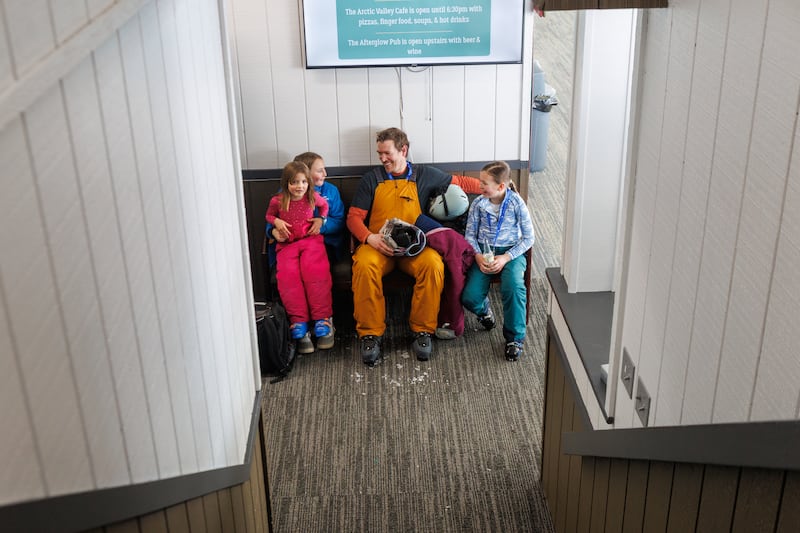 Nora and Elena Heffernan and Will and Rowan Tompkins take a snack break in the Alpenglow Lodge at Arctic Valley Ski Area on Sunday, March 22. (Bella Biondini / ADN)
Today, she imagines people visiting large ski resorts expect an amusement park-type adventure that comes with a variety of bells and whistles, such as fancy hotels and spas, and five-star restaurants. These high expectations, paired with large companies’ desire to maximize revenue, have contributed to an incredibly expensive industry, she said.
At major resorts in the Lower 48, walk-up rates often exceed $250, a price that does not include rental gear. The price of daily lift tickets has also crept up at Girdwood’s Alyeska Resort, which joined the Ikon Pass collective of ski resorts in 2023. In 1999, a lift ticket cost $37. Today, a full-day weekend ticket costs about $150, with higher prices on holidays.
Inside Arctic Valley’s Alpenglow Lodge, an array of discarded mittens and helmets, awaiting their owner’s return to the lifts, lay on the foldout tables in the main room. From behind the cafe counter, Rich Todd distributed hot dogs — with themed names for Super Bowl Sunday — and paper trays of mac and cheese to visitors on their lunch break.
 Anchorage Ski Club volunteers Desiree’ LaMonde and Rich Todd greet customers at the Arctic Valley Cafe on Sunday, March 22. (Bella Biondini / ADN)
During the week, he shuttles cheese, pretzels and pizza crusts from town to the lodge since the delivery company refuses to drive the winding and often icy 6-mile road leading up to the ski area. It’s not unusual for Todd, a volunteer, to put in 40 to 50 hours a week during the height of ski season.
Todd joined the Anchorage Ski Club in 2007, because every two hours volunteering earned him a free ski day.
Two years later, amid “fear and panic” that Arctic Valley might not open, Todd said, the board asked for extra help. The nonprofit didn’t have enough cash left in the bank to make its insurance payment, he said.
The Anchorage Ski Club ran the entire operation with volunteers that year. Todd stepped in and, over the years, served as a ski lift operator, snowcat groomer and mechanic. He’s a familiar face for frequent Arctic Valley skiers 16 years later.
“If you grow up skiing here, you develop this love for a small mom-and-pop place,” he said. “It’s your community.”
Close to home
Near Hatcher Pass, Joe Rucker used the chairlift as a lookout tower, surveying the small hillside.
He could easily spot the gaggle of roughly 45 homeschool students he was responsible for by their orange armbands, but he knew many by helmet or coat color, or the runs they frequent on their regular Thursday outings.
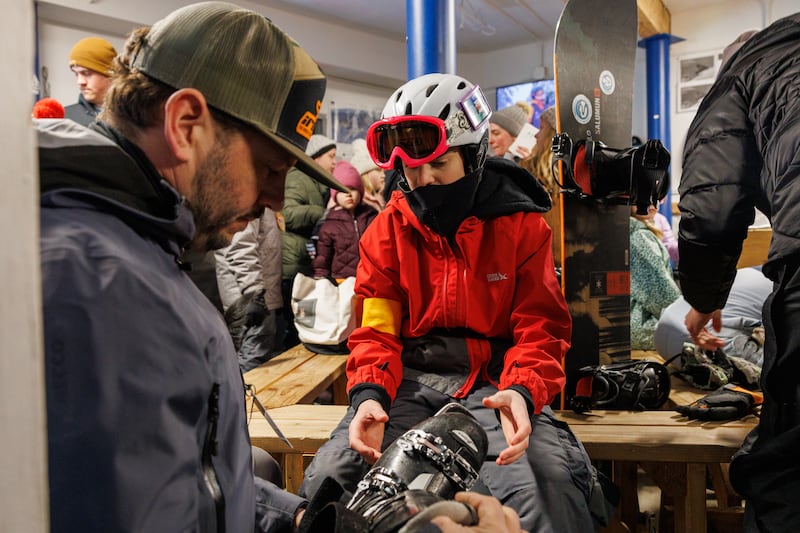 Mat-Su Central School adviser and teacher Joe Rucker helps seventh grader Jaxx DuToit find rental boots that fit at Skeetawk Ski Area on March 19 at Hatcher Pass. (Bella Biondini / ADN)
Rucker, a teacher and student adviser at Mat-Su Central School, chaperoned several students new to snow sports. For many Palmer families, it’s an opportunity that’s possible through a low-cost partnership program launched this year between the school and Skeetawk Ski Area.
The small ski area, operated by nonprofit Hatcher Alpine Xperience, is still very much in its infancy. After years of doubt that it could be done, a determined group of volunteers from nearby communities kickstarted the modest operation in 2020 with the installation of a single chairlift.
“When I was a kid, I can recall all the conversations about a ski resort getting built up there, and it took a long time for it to happen,” Rucker said. “But it is awesome to see the fruition of that dream by a lot of people come true.”
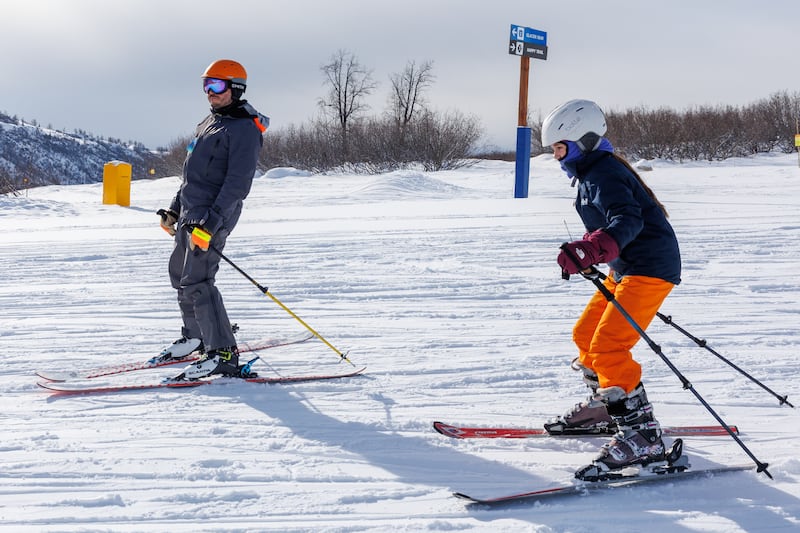 Mat-Su Central School fourth grader Lydia Boothe follows Mat-Su Central School adviser and teacher Joe Rucker down the Glacier Bear run at Skeetawk Ski Area on March 19. (Bella Biondini / ADN)
General manager Megan Justice estimated Skeetawk receives approximately 30,000 skier visits per year, a number that is growing.
Managers say community support has allowed the nonprofit ski area to pursue an expansion. Skeetawk’s long-term plans include a $25 million gondola that would more than double the skiable acreage and tap into summer tourism.
When homeschool parent Jamie LeCount returned home to Colorado for Christmas to visit family and ski, she said the trip reminded her of the industry’s growing tendency to cater to the wealthy. At the height of the ski season, a single weekend lift ticket at Colorado’s Vail Ski Resort can cost as much as $350.
From the costly equipment to the day tickets or season passes needed to access lift-serviced skiing, most families can’t afford the whole package, she said.
Regardless of the day of the week, lift tickets are always less than $50 at Skeetawk. LeCount said the partnership program covers a large chunk of the cost for her five children to ski. A school bus is typically available to shuttle kids, in elementary through high school grade levels, to and from the ski area.
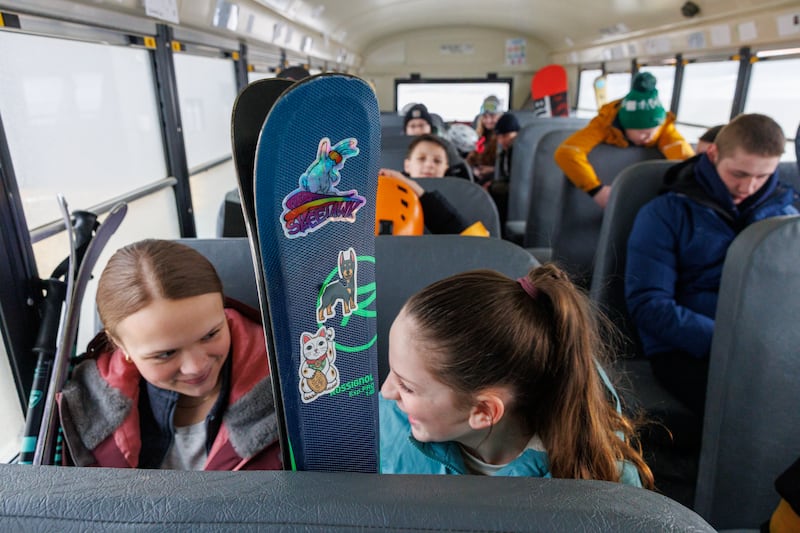 Mat-Su Central School 10th grader Kali Guy and seventh grader Hailey Pence whisper on the bus before it departs for Skeetawk Ski Area on March 19 at Hatcher Pass. (Bella Biondini / ADN)
 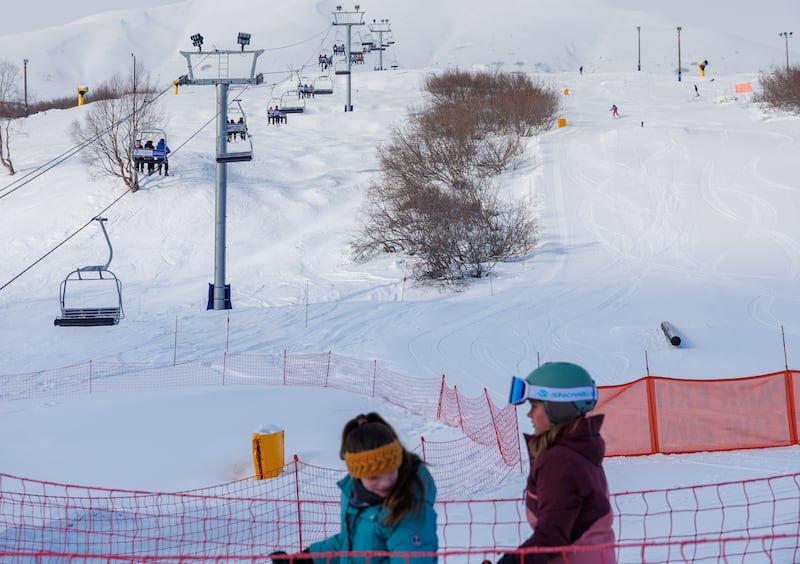 Mat-Su Central School seventh grader Hailey Pence and tenth grader Kali Guy slide into the lift line at Skeetawk Ski Area on March 19. (Bella Biondini / ADN)
It’s an 18-minute ride from the Mat-Su Central School lobby to the chairlift, where the average height of the people waiting in line is well below 5 feet.
Outfits are mismatched, and in mid-March, with temperatures hovering around 2 degrees, the cold was no bother for students scrambling off the bus to the slopes. After a quick lap, they’ll hop right back in line.
“It doesn’t matter what gear you have, grab whatever gear you can get and go. … Having it right in our backyard is a huge blessing,” LeCount said.