
Hi,
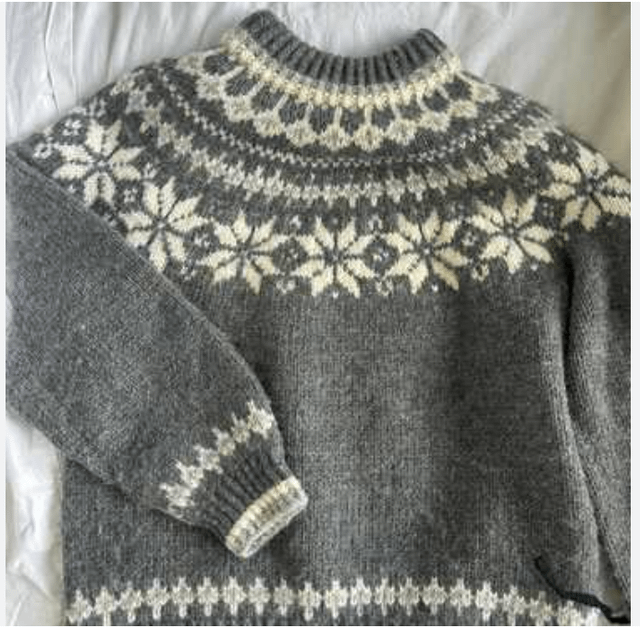
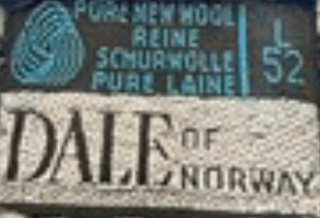
One day, I would like to come and live in beautiful Norway. In the meantime, I just purchased a Dale sweater from a thrift store (I live in Japan) and would be very grateful if anyone could give me more information about it.
So far I believe it is vintage from possibly 1980s. It’s a men’s size, made of wool. It would be helpful to know the style and any other interesting info.
Thank you in advance for any feedback.
https://www.reddit.com/gallery/1s7n06k
Posted by SteveSteveSteve-O
18 Comments
It’s a Dale sweater. Known Norwegian company, makes lots of wool stuff. I don’t know what you’re looking for. It’s like asking about a pair of Levis.
That just looks like an ordinary wool sweater.
https://eu.daleofnorway.com/
Here’s the international page for Dale. I hope it is helpful.
Grey with snowflake pattern
Its decorated with the traditional Selburose or eight petal rose. https://en.wikipedia.org/wiki/Selburose
It’s a brand cloth and not something grandma knitted in a specific region, if that’s what you hope to find out
Some information for taking care of it! (Just in case. Sorry if you already know).
Wool has been developed over several hundreds of millennia through liberal use of animal testing, as such it has some interesting properties.
It is self-cleansing and anti-microbial, so unless something nasty has happened to it, washing only requires water and not soap. Simply handwashing a bit, lightly squeezing the water out and leaving it to dry is recommended.
It will shrink when washed in warm water, it will eventually fray if tumbled roughly in the washing machine.
It can probably be washed in the machine now and again on few rotations and low temp, but it’ll decrease its’ lifespan.
Id guess its from the 90’s with the very traditional Selbu rose and the smallest dots are called lice. But even though it has some lice and the Selbu rose its not a lusekofte or selbukofte.. i think its a mix between different local traditions.
The named regional sweaters are normally hand knit. They will only in very rare cases have a commercial label. Those will be very old. This one is newer.
Is your camera from the 80’s as well?
Knitting pattern available (kids version). From 1980 [https://koftearkivet.no/category/dale/page/22/](https://koftearkivet.no/category/dale/page/22/)
Dale is an old and very upmarket and expensive brand. I visited their factory a couple of years ago and even in their outlet there the sweaters are extremely expensive. They are made to last and extremely high quality.
You should send a photo of the sweater to [helpdesk@dale.no](mailto:helpdesk@dale.no) and ask if they have any info about the model – they do have a small museum in their factory so they probably have a historian or curator onsite.
If you send a message to the DoN Facebook account and ask if Lorents knows the history of the sweater, that would be your best bet. He is (or at least was) their longest serving designer and factory guru.
•Arne & Carlos• – are from Norge, they design knitwear and yarn – and also have a youtube channel. There are 4 or 5 episodes where they take a deep dive into the sweater tradition from Setterdale i Norway.
The Marius Sweater mentioned in another comment are inspired by that tradition. And it seems to me that a lot of the designs from Dale are also inspired by the tradition from Setterdale.
Its called a “Nancy”-sweater specifically. Cant believe I actually know this
Let me just say….
I was an exchange student in Norway in 1986. I loved EVERYTHING about my experience!
I can spot a Dale of Norway when I see someone wearing on here in the states and AM SO JEALOUS!!!!!!
I wish I could buy used ones!
This is very wholesome and warms the heart – reading this from Norway. It’s fascinating to see someone so far away, fascinated and interested in what may seem like local, dull things here 😂 Greatly appreciate reading all the answers and follow-up questions.
It’s one of Dale’s knitting patterns.
Dale is overpriced for it’s quality. At least their modern clothes. If you ever want new traditional sweaters / lusekofte, there are many who make them by hand. They are usually much higher quality.