
image:
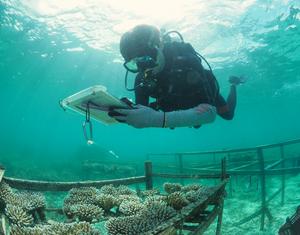
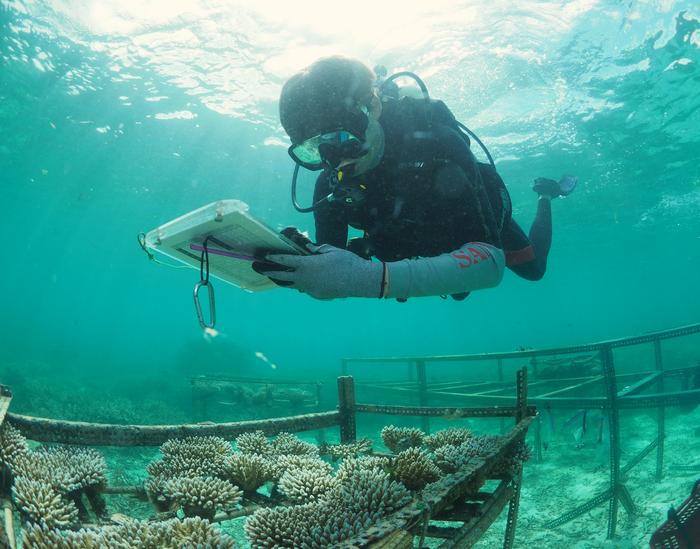
One of study authors monitoring corals they selectively bred for high heat tolerance at an ocean nursery in Palau. Photo Credit: Dr James Guest
Credit: Dr James Guest
Scientists call for a major acceleration in coral assisted evolution research to help reefs cope with rapidly warming oceans.
The study, published today (30 March), was led by Dr Adriana Humanes, Newcastle University and Dr Juan Ortiz, Australian Institute of Marine Science (AIMS). It highlights fundamental changes needed to generate knowledge fast enough to make these methods effective.
The international team of 28 experts identified promising discoveries that highlight the potential of assisted evolution to help mitigate the impact of climate change in reefs.
Assisted evolution aims to accelerate natural adaptation rates to help corals increase their thermal tolerance and reduce mortality during marine heat waves. Over the past decades multiple knowledge breakthroughs have increased our understanding of the processes driving thermal tolerance in corals. However, the experts’ evaluation of progress warns that the current rate of research and development of coral assisted evolution methods is likely to be outpaced by rapidly warming climate.
“Assisted evolution methods look promising, but at today’s pace of research and development, and without rapid emissions reduction, solutions will arrive too late for coral reefs,” said Dr Humanes, Research Associate at Newcastle University’s School of Natural and Environmental Sciences
Published in the journal Nature Reviews Biodiversity, the paper outlines a research agenda comprised of nine research priorities that are fundamental for fast tracking progress, while also highlighting a major barrier. “Critical knowledge gaps around the biology of coral heat tolerance are hindering progress”, said Dr Ortiz, Principal Research Scientist, AIMS.
While it is clear the proposed research agenda would help close fundamental knowledge gaps and accelerate assisted evolution methods development, the scientists identified three critical catalysts required to successfully implement this research agenda within the short window of opportunity available.
Scaling up field-based coral research
The priority is expanding large-scale, field-based research to allow multiple scientific questions to be addressed at the same time.
Dr James Guest, Reader in Coral Reef at Newcastle University and one of the study authors, said: “We need to scale up field-based coral reef science so we can answer many of these questions simultaneously and in record time. Establishing large-scale field hubs would foster collaborative, multidisciplinary research across coral species and life stages, increasing experimental power and efficiency.”
Funding research across the coral life cycles
The second catalyst is long-term funding that matches the biology of corals.
“Corals have a complex life cycle,” said Dr Ortiz. “It takes three to seven years for baby corals to mature and reproduce, yet most funding schemes run for only three years. This is not long enough to determine the fate of these corals and their progeny.”
The authors argue that multi‑generation studies are essential to understand whether assisted evolution approaches can produce lasting benefits.
Protecting experimental coral hubs
The final recommendation is to protect large-scale field hubs and their experimental corals from extreme environmental events.
“Both experimental corals and broodstock housed in these hubs hold knowledge that will only be revealed over time,” said Dr Humanes. “If they are lost during disturbances, the financial investment loss could be huge and delays catastrophic.”
The paper highlights the need to strategically locate hubs and apply local protection measures, such as lowering corals into deeper water during storms or using cloud brightening or fogging during marine heatwaves, to reduce the risk of knowledge loss.
“Indeed, supporting multi-generational research and scaling up proven, field-based solutions are central to the mission of the G20 Coral Research and Development Accelerator Platform (CORDAP),” said Dr Carla Lourenço from CORDAP. “Because there is no single solution to safeguarding coral reefs, a portfolio of complementary strategies in which coral assisted evolution is a central part is needed. CORDAP is the only international organization fully dedicated to funding global research and development (R&D) for both tropical and cold-water coral conservation and restoration that recognizes the scale and complexity of the coral crisis and takes a diversified approach to innovation.”
While the implementation of the research agenda and the three overarching catalysts is the only way to give coral assisted evolution a fighting chance to make a difference, drastically reducing greenhouse emissions remains the top priority for ensuring the persistence of coral reefs for generations to come.
The work of this paper was supported by CORDAP and the Reef Restoration and Adaptation Program (RRAP).
Reference
Humanes, A. et al. (2026) ‘Accelerating coral assisted evolution to keep pace with climate change’, Nature Reviews Biodiversity. Available at: https://doi.org/10.1038/s44358-026-00147-z
–ends–
Nature Reviews Biodiversity
Computational simulation/modeling
Accelerating coral assisted evolution to keep pace with climate change
30-Mar-2026
Disclaimer: AAAS and EurekAlert! are not responsible for the accuracy of news releases posted to EurekAlert! by contributing institutions or for the use of any information through the EurekAlert system.