It’s posts like these that make me want stricter enforcement of this rule, since I think there’s a real danger that people will upvote this post solely on its title instead of the merits of the visualization.
[deleted] on
[deleted]
JackfruitCrazy51 on
No one with a brain big enough to attend college is making the federal minimum wage. 30 states alone have a higher minimum.
It’s still bad, but when you use statistics like this, it tends to be looked past.
RawhlTahhyde on
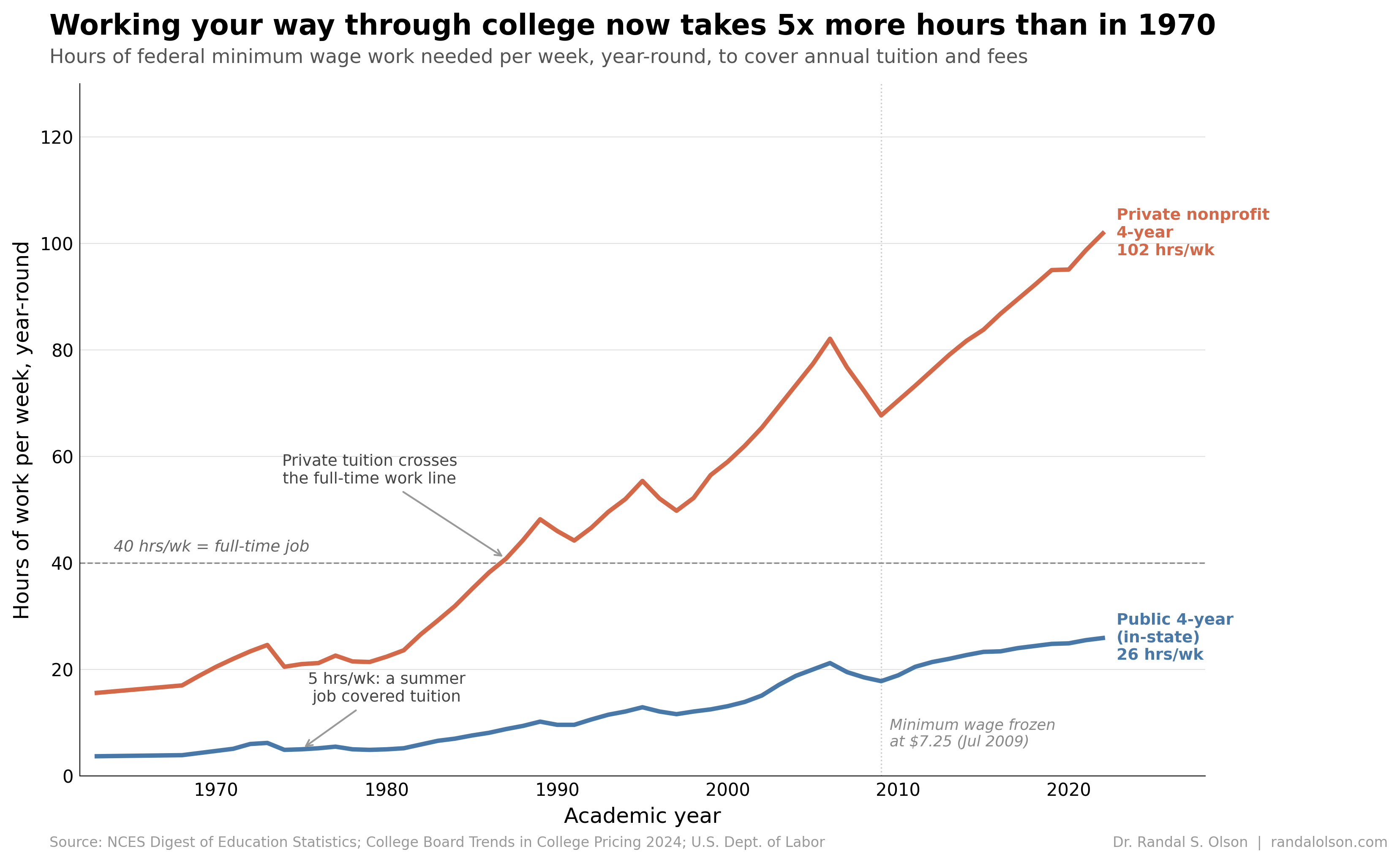
Using the federal minimum wage doesn’t make any sense when even fast food places pay double it.
It’s bad math and you’re combining 2 topics into 1.
A: college is more expensive than it used to be and B: minimum wage hasn’t kept up with inflation
even at $15 an hour it’s still 2-3x as many hours as 1970 though- so even comparing apples to oranges there’s still a point
Tbf I’m not sure there’s an easy source for “median wages for a college student” though
Bob_Sconce on
Ignoring the minimum wage aspect of this, there are a few reasons why college costs have risen so much:
(1) the number of administrators has increased dramatically.
(2) Technology. In 1970, a typical university might not have had ANYBODY doing IT, no computer labs, etc…. (Yes, there were schools with computers, but many didn’t have them.)
(3) Amenities. Today’s colleges are far nicer than the ones that today’s students parents and grandparents went to. Just look at the athletic facilities.
(4) Reduced teaching loads: in 1970, a professor might have taught 2-3 classes per semester. Today, many go entire semesters without teaching at all. Instead, universities relying on TAs and adjuncts.
(5) Massive increase in federal financial aid (largely in the form of loans) — this means that 17-year-olds deciding where to go to school no longer have to ask the question “Can I get a job and pay to go to this school?” Instead, 17-year-olds are enticed to schools by the “college experience,” knowing that they can just borrow the money needed to pay for it. (This is really the thing that makes 1-4 possible. If colleges actually had to compete based on how much students could afford without student loans, prices would crater.)
ohlookahipster on
Programs and credit hour requirements have also gotten longer/larger. I looked at my grandmas BSN requirements back 60 years ago, and it was basically 1/2 of the length of today’s three-year BSN. She completed her program in the same time it would take someone to knock out their pre-reqs and labs.
MildBillHicock on
Is this the raw annual tuition bill or after student aid? 27 hours per week for 50 weeks a year is 1350 hours, which at the Federal minimum wage of $7.25/hour is about $9800. State, federal and institutional grants come in 2024 came to about $7665 per student.
Subtracting the grants from the state tuition one gets about $2100, or about 6 hours per week at minimum wage

![Working your way through college now takes 5x more hours than in 1970 [OC]](https://www.byteseu.com/wp-content/uploads/2026/03/RsJpMSb16kchGrNrdUU6DpfkIZgeB1tv7k-hodbzSfY-1536x946.png "Working your way through college now takes 5x more hours than in 1970 [OC]")
9 Comments
Data source: NCES Digest of Education Statistics
Tools: Python
Another example of the Capitalist demand for labor
[Rule 7 states](https://www.reddit.com/r/dataisbeautiful/wiki/rules/rule7/): “**While not required**, it’s good principle to *avoid putting conclusions in your title…”*
It’s posts like these that make me want stricter enforcement of this rule, since I think there’s a real danger that people will upvote this post solely on its title instead of the merits of the visualization.
[deleted]
No one with a brain big enough to attend college is making the federal minimum wage. 30 states alone have a higher minimum.
It’s still bad, but when you use statistics like this, it tends to be looked past.
Using the federal minimum wage doesn’t make any sense when even fast food places pay double it.
It’s bad math and you’re combining 2 topics into 1.
A: college is more expensive than it used to be and B: minimum wage hasn’t kept up with inflation
even at $15 an hour it’s still 2-3x as many hours as 1970 though- so even comparing apples to oranges there’s still a point
Tbf I’m not sure there’s an easy source for “median wages for a college student” though
Ignoring the minimum wage aspect of this, there are a few reasons why college costs have risen so much:
(1) the number of administrators has increased dramatically.
(2) Technology. In 1970, a typical university might not have had ANYBODY doing IT, no computer labs, etc…. (Yes, there were schools with computers, but many didn’t have them.)
(3) Amenities. Today’s colleges are far nicer than the ones that today’s students parents and grandparents went to. Just look at the athletic facilities.
(4) Reduced teaching loads: in 1970, a professor might have taught 2-3 classes per semester. Today, many go entire semesters without teaching at all. Instead, universities relying on TAs and adjuncts.
(5) Massive increase in federal financial aid (largely in the form of loans) — this means that 17-year-olds deciding where to go to school no longer have to ask the question “Can I get a job and pay to go to this school?” Instead, 17-year-olds are enticed to schools by the “college experience,” knowing that they can just borrow the money needed to pay for it. (This is really the thing that makes 1-4 possible. If colleges actually had to compete based on how much students could afford without student loans, prices would crater.)
Programs and credit hour requirements have also gotten longer/larger. I looked at my grandmas BSN requirements back 60 years ago, and it was basically 1/2 of the length of today’s three-year BSN. She completed her program in the same time it would take someone to knock out their pre-reqs and labs.
Is this the raw annual tuition bill or after student aid? 27 hours per week for 50 weeks a year is 1350 hours, which at the Federal minimum wage of $7.25/hour is about $9800. State, federal and institutional grants come in 2024 came to about $7665 per student.
Subtracting the grants from the state tuition one gets about $2100, or about 6 hours per week at minimum wage