
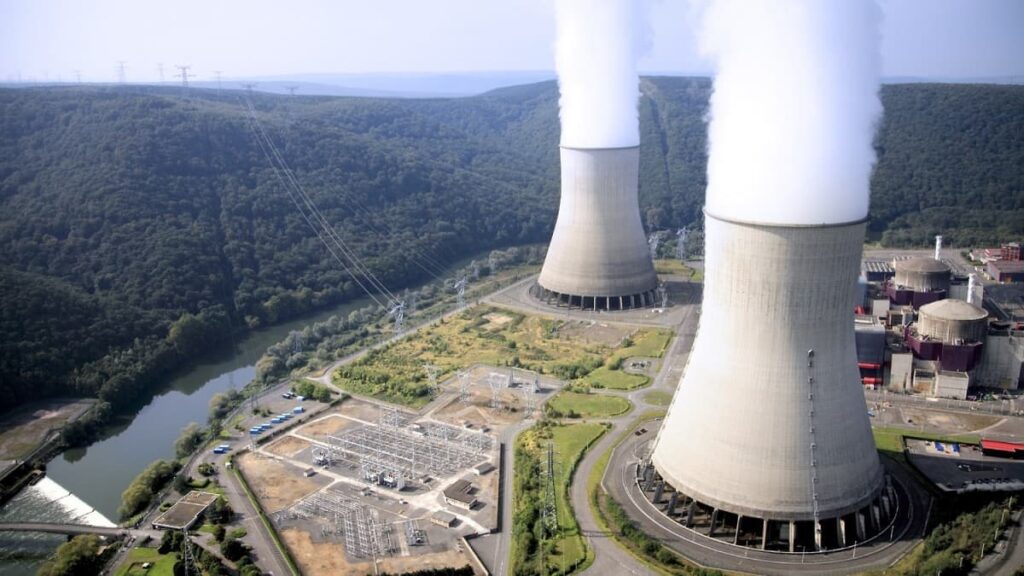
Every time energy prices spike, nuclear power makes a comeback in the debate. The argument is familiar. If Europe had more nuclear, it would be insulated from volatile gas markets. Prices would be stable. External shocks—from Hormuz to Ukraine—would matter less. There is truth in that. But only up to a point. And crucially, only under very specific conditions that are often ignored.
Nuclear Works, If You Already Have It
France is the obvious example. With a large nuclear fleet forming the backbone of its electricity system, France has been less exposed to the worst of gas-driven price spikes than many of its European peers. When gas prices surge, a system anchored in nuclear does not immediately reprice all its electricity around fossil fuel costs.
That is a real advantage. But it is not immunity. Even France has seen elevated electricity prices in recent weeks, as it remains part of the broader European market and still interacts with gas-influenced pricing dynamics. Nuclear reduces exposure. It does not eliminate it. And more importantly, France’s position is the result of decisions made decades ago. That is where the current nuclear debate starts to run into trouble.
The New Build Reality
The idea that Europe can now build its way into nuclear-driven price stability runs into a much less comfortable reality: timelines and costs. New nuclear projects do not arrive quickly. And they do not arrive cheaply.
Take Hinkley Point C in the UK. Approved in 2016, it was expected to be online by 2025 at a cost of around £18 billion. It is now expected closer to 2030, with costs rising to roughly £49 billion in today’s terms. Unfortunately, that is not an outlier. It is a pattern.
By the time new nuclear capacity comes online, the system it was designed for has often already changed.
Related: Chinese Publication Claims U.S. Has Two Months of Rare Earths Left
The Grid Didn’t Wait
While Hinkley was being built, the UK electricity system transformed. Back in the mid-2000s, the grid was dominated by fossil fuels, with coal and gas supplying the vast majority of electricity. Carbon intensity was high, and nuclear looked like a logical replacement for retiring coal plants.
But the transition did not wait for Hinkley. By 2025, UK grid carbon intensity had fallen by roughly 75–80%. Coal disappeared entirely. Wind capacity expanded massively, with generation increasing more than tenfold. Solar followed a similar trajectory. Batteries and interconnectors became integral parts of the system. In other words, decarbonization happened anyway. And it happened faster than the nuclear project meant to support it.
The Cost Floor Problem
There is another issue that receives less attention: price floors. New nuclear projects typically rely on long-term contracts that guarantee a minimum electricity price to make the economics viable. Hinkley’s contract, for example, effectively locks in a price in the range of £120–£130 per MWh in today’s money. Other projects across Europe follow a similar logic, like in Finland, with around 100 euros per MWh.
This creates a paradox. Nuclear is often presented as a way to reduce electricity costs and volatility, but new nuclear can actually set a relatively high price floor for decades. That may still be acceptable for reliability and decarbonization. But it is not a recipe for cheap electricity in the near term.
Meanwhile, Renewables Move at a Different Speed
While nuclear projects move at megaproject speed, renewables move at manufacturing speed. Wind and solar can be deployed in years rather than decades. Costs have fallen dramatically. Storage is scaling rapidly. Grid expansion, while still too slow, is progressing far faster than any nuclear construction timeline. The result is that the energy system evolves much faster than nuclear can be built. That is not an argument against nuclear as a technology. It is an argument about timing.
The Opportunity Cost Question
There is also a simple question that tends to make people uncomfortable. What else could be done with £49 billion?
At current cost levels, that kind of capital could finance tens of gigawatts of offshore wind, alongside solar, storage, and grid expansion. Even accounting for variability, the total annual electricity output from such a portfolio could significantly exceed that of a single nuclear plant. Nuclear provides firm power, which is valuable. But scale and speed matter too. And in today’s system, speed is often the more decisive factor.
And just to be clear this is not an anti-nuclear argument. Nuclear power provides low-carbon, dispatchable electricity. Existing fleets, like France’s, clearly offer resilience benefits. And there is a strong case for maintaining and extending those assets where possible. But that is not the same as arguing that large-scale new nuclear build-outs are the most effective way to address Europe’s current energy challenges. There are simply faster, cheaper, and more scalable tools available.
The Real Hedge Is Already Clear
Europe is not facing a theoretical problem. It is facing real-time price shocks driven by global fossil fuel markets. The question is not which technology looks best on paper. It is which solutions can be deployed fast enough, at scale, to reduce exposure.
That is where electrification, renewables, storage, and grid integration stand out. They lower marginal costs. They reduce dependence on imported fuels. And, as seen in places like Spain and Portugal, they can deliver lower and more stable electricity prices even during periods of global turmoil.
Timing Is the Strategy
Nuclear may still have a role in Europe’s long-term energy mix. But it is not a short-term shield against volatility, and it is not a cost-reduction tool in the way it is often portrayed. By the time new reactors come online, the system they were meant to stabilize may already have moved on.
That is the real lesson from Hinkley. In energy, timing is not a detail. Timing is the strategy. And right now, the technologies that move fastest are the ones doing the most to protect Europe from the shocks it cannot control.
By Leon Stille for Oilprice.com