
00:00 Speaker A
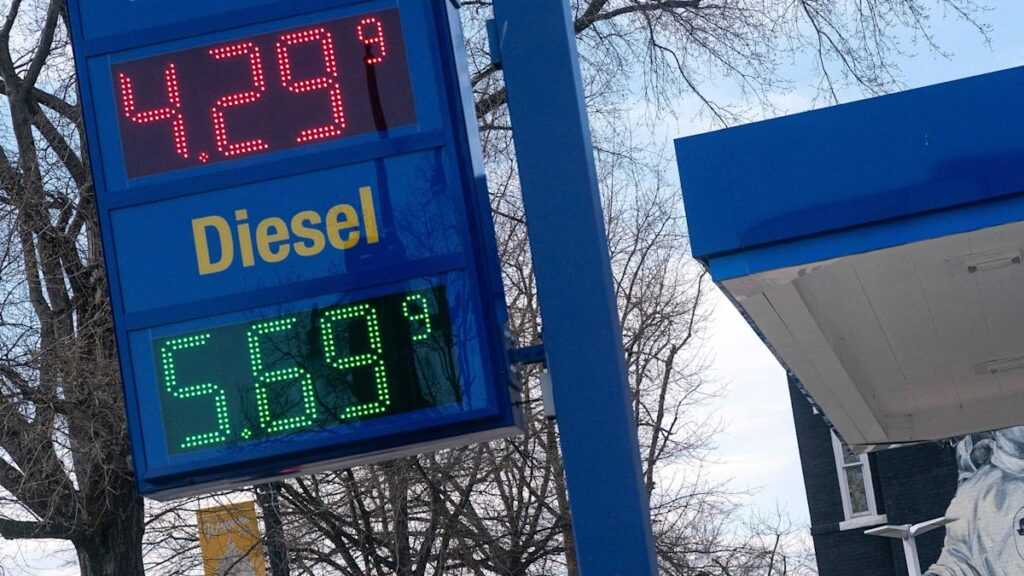
How big of an impact is it now that we are at $4 a gallon of gasoline on average in this country. You go to California, it’s now touching $6 and even higher depending on what station you go to.
00:15 Speaker B
Yeah, it’s both psychological and it’s actually very real for the people that have to fill up once, twice a week or if you have that small business and you have to fill up the fleet. But I think it’s the anticipation of higher prices to come that is going to what has got its grip on consumers right now and this negative downbeat of consumer sentiment. I think we’re at multi-year lows on that and eventually it’s going to bleed its way into spending. We’re already starting to see it with some of the airlines. It’s really the top of the barrel that’s got everybody’s attention now, that’s gasoline, but when you go to the bottom of the barrel and you get to that crude, the diesel, the jet fuel, all the things that that power the supply chain, that’s going to make things more expensive down the line. The good news, if there’s any good news, if you look at oil right now, it’s got that backwardation chart, uh big term that’s been ringing on Investopedia, and that is traders anticipating that oil prices are going to be much lower by the summer, back down to $80, $90 a barrel. And then if you get to the end of the year, they’re looking back down to where they were before this whole thing began.
01:04 Speaker A
And as, um, I think what Caleb just said brings up a good point. This is a stock market looking past this turmoil, hoping, beyond hope that oil prices go back down to below $80 a barrel by the second half of the year. But I know based on your reporting, nowhere is that suggested that is a guaranteed thing to happen.
01:28 Speaker C
Not right now. I mean, you have Wall Street that is saying if the conflict sort of subsides in April and doesn’t go beyond that, then you would see oil prices. You’ve got Societé General that’s talking about $125 oil for April, um perhaps spikes to $150. Uh but really what traders want to see is the straight of our moves open. That is what they care about and that is why you’re not probably seeing oil going much lower right now is because it is still closed essentially. Also, you have now the risk of the Red Sea and the Huthis that have entered the conflict and the Red Sea at risk as well. So, all of this is pointing to still this massive supply shock. This is not a demand shock. Wall Street is underscoring. This is all to do with supplying the physical oil that is not coming out of the ground and that’s why you’re seeing these higher prices. And if this conflict does resolve quickly, you still is this is still going to be a slow recovery because you have some of this infrastructure that will take months if not years to come back.
02:20 Speaker A
And that’s an important point, Nez. Let me stay with you here because just because, let’s say this conflict does end or we get a signal from the president that he’s going to exit this war in some capacity soon, that doesn’t mean gas prices instantly go back to what, below $3 a gallon?
02:37 Speaker C
Right, exactly. Gas prices take a while to come back down and it will all depend really on the price of oil as well. So, right now, as you mentioned, $4, that is a psychological level for consumers. Whatever they’re not whatever they’re spending on gasoline, they’re not spending elsewhere. And right now you have the sum of $8 billion additional dollars that were spent cumulatively by Americans because of the higher gas prices over the last month.