
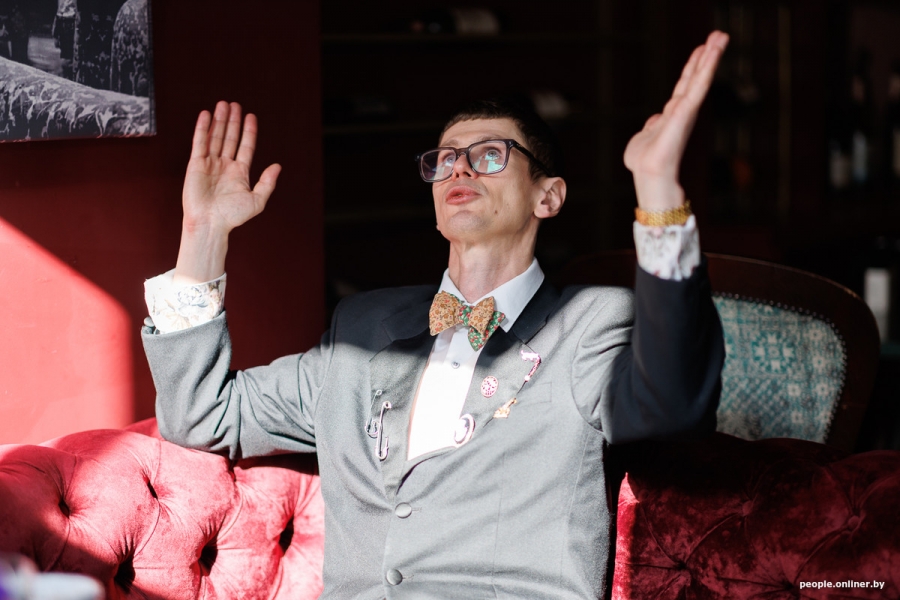
An evening in a Minsk restaurant. An international crowd has gathered: a Swede with a Belarusian woman at one table, a group of French people at another, a Pole a little further away. The sommelier approaches the guests to help them choose drinks. And he speaks to each in their native language. “Oleg, are you kidding?” wonders a Lithuanian who knows Russian. He hasn’t encountered such service before. But Oleg isn’t joking – he simply knows eight languages. He also lived in Japan and Switzerland but decided to return to Belarus to elevate the level of service in establishments and wine culture.
“I adore Minsk, it’s amazing!”
“Good afternoon! Would you like coffee or tea?” Oleg Grubich greets.
Then he asks which language would be better for him to speak during the interview: Russian or Belarusian. He chooses the latter as his primary language. And we stick to it.
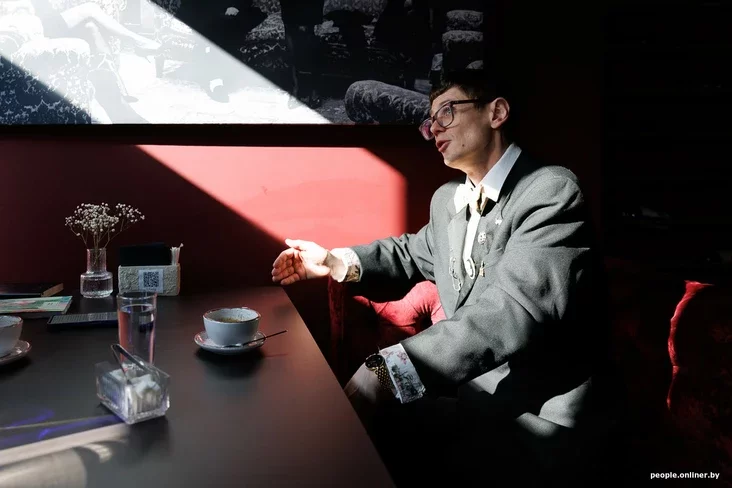
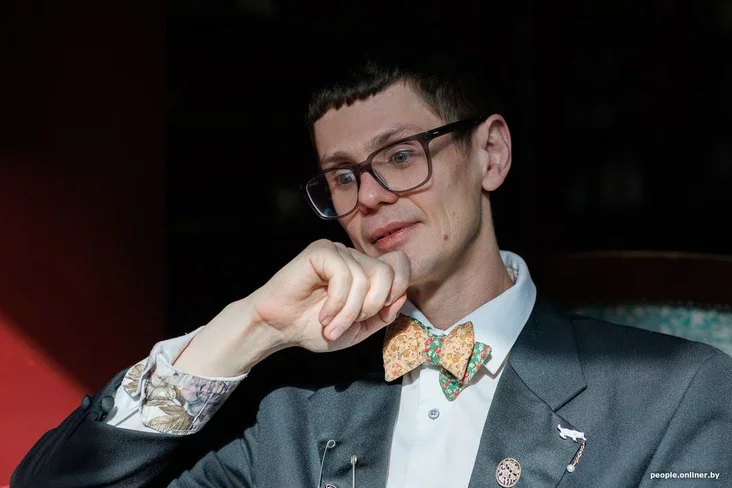
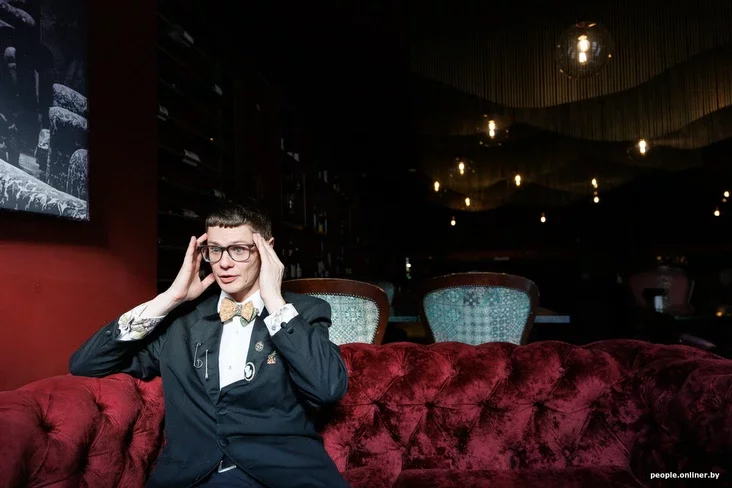
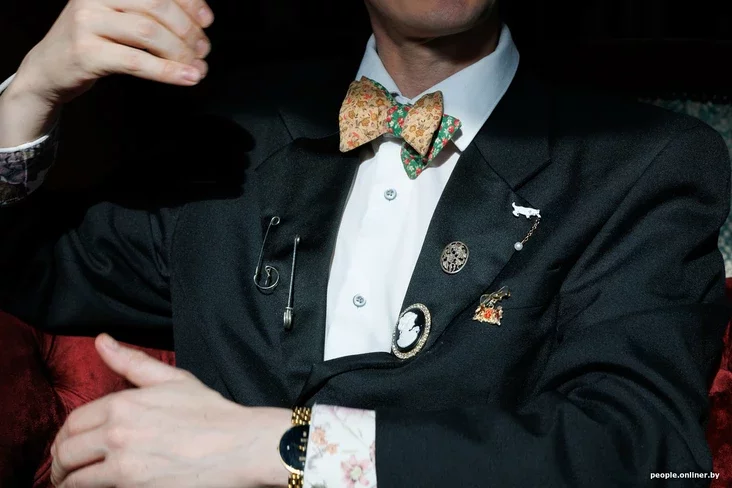
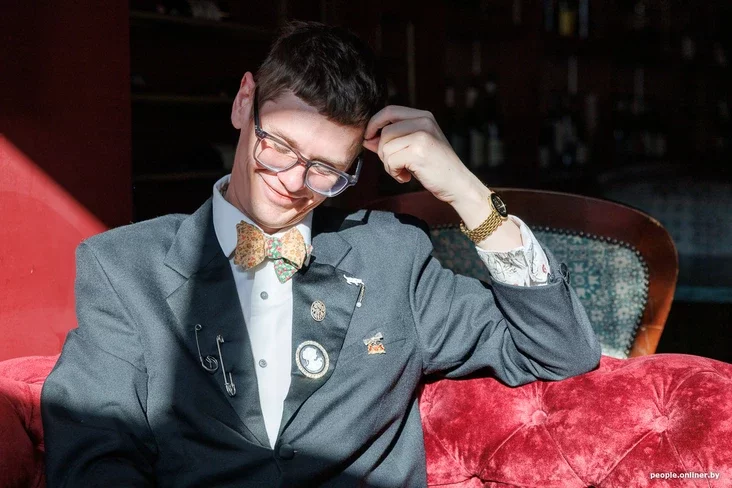
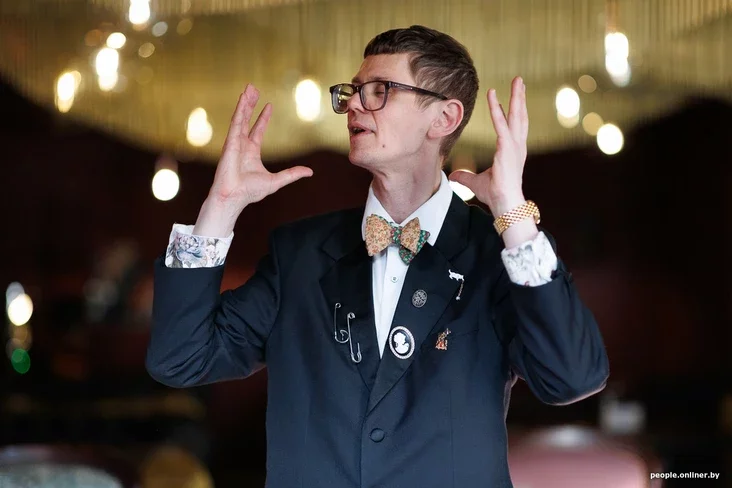
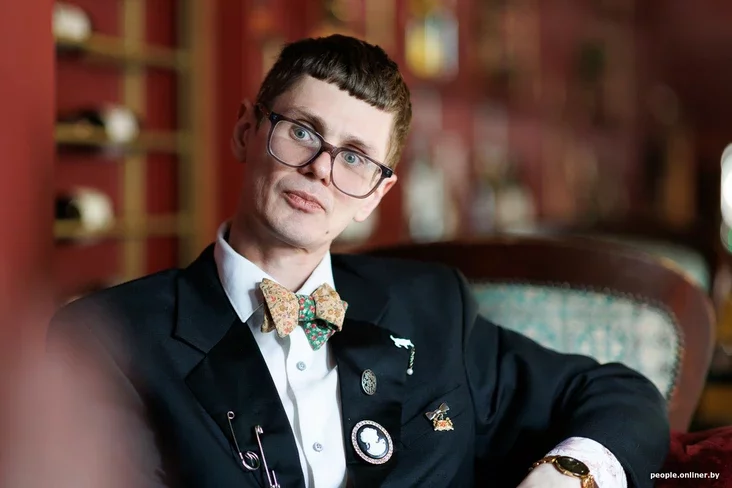
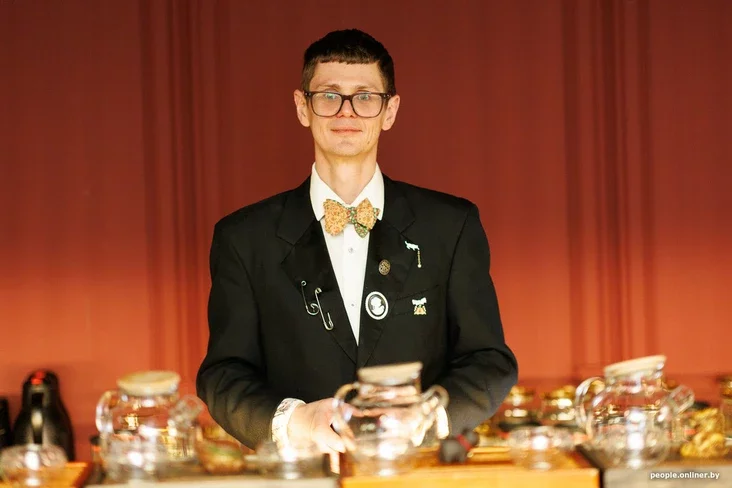
We came to the restaurant “Chayny Pyanytsa” (The Tea Drunkard) (the man has been working as a sommelier here for seven years), but it feels like we’ve stepped into a Wes Anderson film. His appearance, facial expressions, manner of speaking – everything about our hero looks very cinematic, yet alive and natural. Oleg has no shortage of charisma and acting skills.
From the first minutes, we learn about one of the Belarusian’s main passions – Japanese drama.
Павялічыць
— My parents raised me with immense respect and love for literature. We had a large library at home. Its shelves held fiction, scientific collections, books on the history and culture of various countries, including Japan. These editions always stood on the very top. But I was a curious boy; I absolutely had to get to them.
That’s how I learned about Japanese drama, and it became a real revelation for me! Because everything there is completely different from what we’re used to. Such an unexplored and strange area for Belarusians! Simply another world, however cliché that may sound.
Oleg was born in Minsk into a family of a nurse and an engineer who didn’t adhere to the classic Soviet scenario of “home — work — dacha”. The boy’s parents were involved in educational and historical clubs, and were keen on local lore. Curiosity, broad horizons, and love for his city were passed down from them to their son.
— I adore Minsk, it’s amazing! I like our grey, but so cool and kind urban tradition, where thousands of people and several nationalities intertwine. Slavs, Jews, Muslims, Tatars live side by side here… Fantastic! I believe such multiculturalism is a real treasure. My parents also directed me this way: “The more you learn, the better. Expand your horizons, open new doors to become richer. And always share your knowledge with others.”
“An actor should work 48 hours a day, but I only had enough for 3”
Oleg went to a school with a theatrical bias and in the eighth or ninth grade, he finally realized that he wanted to connect his life with theater.
He entered the Belarusian State Academy of Arts, where he continued to study drama. He was especially fascinated by Serbian and Japanese plays – so much so that he wanted to read them in the original. He, in fact, did so, gradually mastering new languages.
— Even in school, we prepared something like course papers. And my favorite topic was the work of Chikamatsu Monzaemon – the great playwright, also known as “the Japanese Shakespeare.” I was so obsessed with his plots and characters and theatrical culture in general, that where else was I to go after the eleventh grade, if not the Academy of Arts? And I must say, I was very lucky with my teachers. It was an important and valuable time.
Павялічыць
However, Oleg never became an actor – he says it’s because he’s too lazy. Of course, this is hard to believe, considering the fact that our interlocutor knows eight languages, namely Russian, Belarusian, German, French, Japanese, Serbian, Polish, and English (and a little Lithuanian too). In addition, Oleg has been passionate about Japanology for most of his life. It was this circumstance that, at one time, led the theater student first to Poland, and then to Japan itself.
— An actor should work 48 hours a day, but I only had enough for 3. I was more of a theoretician of the course, always reading, researching information. I wanted to study the culture, philosophy, and tradition of Japan more thoroughly… But at that time, there was no Japanology faculty in our educational institutions, while there was one at the University of Warsaw. So I ended up in Poland – following my passion.
— But how did you learn so many languages, and what helps you not forget them?
— It happened naturally, thanks to studying at different universities and communicating with native speakers. As for maintaining the level, it helps that I do translations and also read foreign literature in the original. And generally, I love traveling – there’s always an opportunity to practice.
Павялічыць
“Literature has always been the symbol of my travel map”
In Warsaw, Oleg met equally passionate philologists and Japanologists, thanks to whom he had the opportunity to go for an internship in Japan.
— I must say that I wasn’t captivated by the country itself; I wanted to connect specifically with its culture. And of course, the best way to do that is in a natural environment.
Павялічыць
For his further studies, Oleg chose the city of Hakodate. And he did so for a reason: it was there that Iosif Goshkevich, the first consul of the Russian Empire in Japan, once lived and worked. He compiled the first Japanese-Russian dictionary and, overall, made a huge contribution to the development of Japanology. He himself, by the way, was from Astravets region, meaning he was our countryman.
— Literature has always been the symbol of my travel map. I remember reading the book “Odysseus from Belarus”, dedicated to the life and work of Iosif Goshkevich. And it turned out that it’s not exactly known where he is buried… And I became curious to learn more about this diplomat. And it was possible to do this precisely in Hakodate, because there are records of his life in the local archives.
What Japan and Belarus have in common
During the six months Oleg spent in Japan, he collaborated with a scientific publishing house and magazines, researched the legacy of Iosif Goshkevich, translated plays from Noh, Kabuki, and modern Shingeki theater. He managed to deeply immerse himself in the history of national theater and the culture of this country and, moreover, saw common features with our Belarusian one.
— Within Japan, there is a separate people – the Ainu. And within their culture, they celebrate the bear festival – Yotsomane. Belarus also has something similar – Kamaedzitsa. The Japanese also have bunraku puppet theater, whose tradition resembles our batleyka.
And do you know how the word “garden” sounds in Japanese? Niwa! And in Belarusian, that’s what a sown field is called. Not the exact same, of course, but somewhere close.
However, Oleg did not find friends among the local population. According to the man, the Japanese are wary of foreigners. They perceive tourists as a given, they are not rude to them, they politely smile, but this nation is not characterized by special hospitality. On the other hand, visitors are always happy to see each other there. They easily make acquaintances and quickly become close.
— There was such a bar with its cool specificity: migrants who had already lived in Japan for some time came there. There I met many great people and finally found friends. We gathered a whole company: girls from St. Petersburg and Odesa, guys from Geneva. We discussed everything under the sun, laughed, drank wine – we had a good time.
Павялічыць
As Oleg’s internship was coming to an end, those same guys from Geneva offered him a job at an intercultural center in Switzerland. It was an attractive offer – both financially and for development. Oleg got even more from the trip than he expected. He developed a new passion – winemaking.
“I was blown away then! And I thought, I want to tell people about wine like that myself”
Geneva is located in the western part of Switzerland, near the French border. From there, Burgundy, a region considered the center of French winemaking, is just a stone’s throw away. One day, while traveling through these places, Oleg and his friends visited many wine houses. And, of course, they tasted drinks from various producers. That’s when another amazing world opened up to our hero.
— I couldn’t even imagine before that wine could be so diverse: red, rosé, white, even orange. Imagine: wherever you look in this area, there are vineyards everywhere. We were very impressed.
Павялічыць
But most of all, Oleg remembered not even the tastings, but the person who conducted one of them.
— One day we came to a wine house in Besançon. There we were met by a very pleasant sommelier – he looked about 200 years old. But how confidently and dignifiedly this monsieur behaved! He helped us choose wine, spoke intelligently and simply, without any pretentiousness, treated guests with respect. He gave advice: “Take a piece of pear, chew it, and only then try the Chardonnay.” And indeed, the taste opened up completely differently.
I was blown away then! And I thought, I want to tell people about wine like that myself, but in my homeland, in Belarus.
That incident prompted the Belarusian to go study at a wine school in Burgundy. After graduating, he worked as a sommelier in Swiss restaurants for several years, but then, as he wished, returned to his native Minsk and has been working at the restaurant on Internatsyyanalnaya street for the seventh year.
Павялічыць
“In Geneva, almost all my colleagues were 30+ and predominantly men”
Oleg is completely satisfied with his current life: he loves talking to customers about wine, he likes his colleagues and the restaurant’s atmosphere itself. We carefully ask if it bothers him that at 40 years old (and Oleg is exactly that age) he works in the hospitality industry: after all, unlike Europe, in Minsk restaurants, students most often handle service.
— On the contrary, I am proud of it! We are shaped not by circumstances, but by our attitude towards them. And the fact that some believe that working in restaurants, bars, and cafes is more of a side job or temporary work than something serious… This is not even the fault of the visitors. The staff themselves often influence such perception. If you don’t respect yourself, what can you expect from others? In Geneva, for example, almost all my colleagues were 30+ and predominantly men. And there, it’s normal. Whoever loves people and their craft will be treated with respect. Otherwise, there’s nothing to do in the hospitality industry.
Павялічыць
Oleg also admits: he was very lucky with his team, everyone here is on the same wavelength.
— Here, in “The Tea Drunkard,” we feel like hosts in the best sense of the word. Accordingly, those who come to us are our guests. That’s why both I and my colleagues strive not only to provide people with delicious food and quality drinks but also to create an atmosphere, to give emotions.
— And how does working in Swiss establishments differ from working in Belarusian restaurants? Surely it’s better paid there, and the tips are more substantial…
— All that is true. In Switzerland, a sommelier can earn an average of $8,000, in Belarus – about $1,500. But there isn’t such sincerity and service as in our country. In Geneva, the staff is more constrained by rules. There I had to approach guests very ceremoniously, delicately, making sure which hand held the bottle and which held the towel… For example, I would feel uncomfortable doing this…
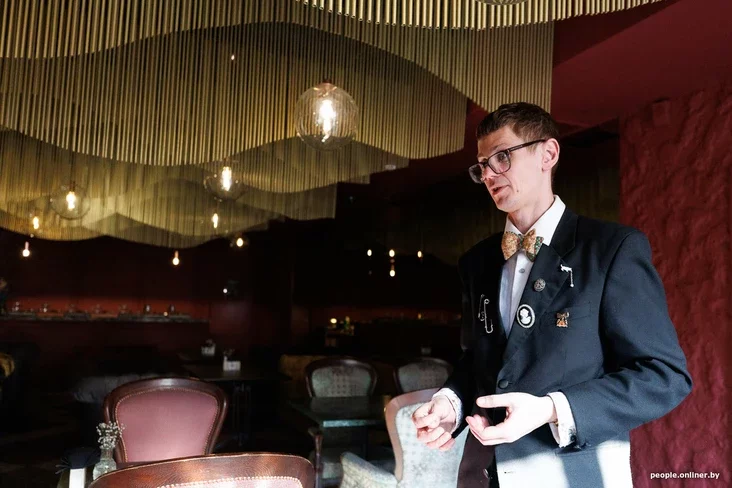
Here Oleg jumps up from his seat and excitedly begins searching for something among the shelves of bottles: “Where is it, where… Ah, found it!” The sommelier shows us his discovery.
Павялічыць
— Here’s an Israeli wine! It was quite difficult to get it and bring it to Belarus. And so, when I’m talking to a guest and I understand that this (or some other) option will perfectly suit the person’s state or mood, I can run off in the same way to look for the bottle. But in Geneva, I wouldn’t do that. Not that it’s forbidden there, but I would feel uncomfortable behaving that way.
As for the guests themselves, Oleg notes that there is also a difference between our public and the European one.
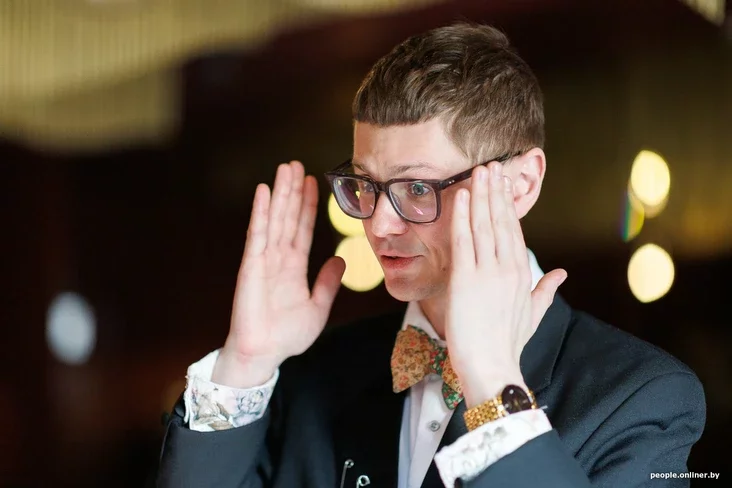
— Swiss people, for example, are very hard to impress. They can order a bottle of wine for $13,000, drink it in an evening, and there will be nothing special about it for them. But if that happened in Minsk, probably the whole city would know (laughs. — Note Onlíner). But it’s not just about financial opportunities, but also about the people themselves. Our people are less jaded and more soulful — Belarusians are interested in trying new things, they easily make contact.
Павялічыць
— How do visitors to the Minsk restaurant react to your “Belarusian-speaking” nature?
— Mostly everyone reacts positively to it. If they ask to switch to Russian – no problem. I can also switch to Polish, French (we won’t list further. — Note Onlíner). And sometimes it’s the opposite: when people hear me speaking Belarusian, they also start speaking it. And that’s very pleasant.
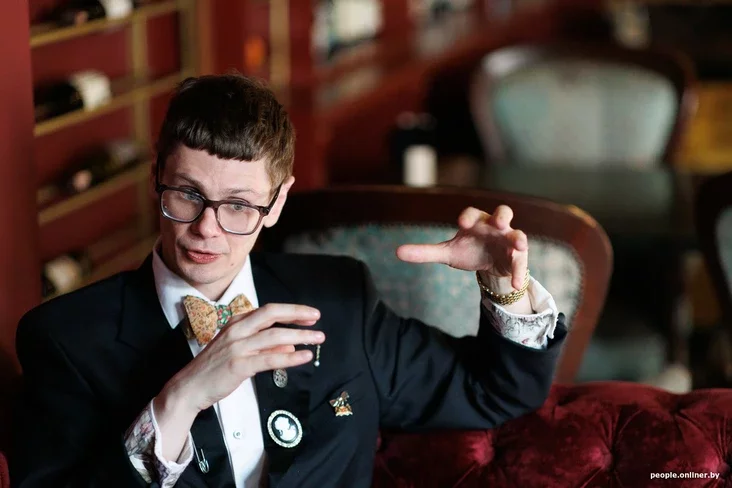
Oleg doesn’t deny: after returning to Belarus, his income significantly dropped. But this doesn’t upset him, because the main thing is that he sees meaning in his work.
Павялічыць
— Our country doesn’t have mountains or seas, but it has incredible nature. And I have so many places of power in my homeland! And, of course, the main thing is the people. I really love my friends and colleagues. Several times, other restaurant business owners tried to poach me, offering a higher salary. But I know that somewhere else, I wouldn’t be as happy as I am here. Besides, I continue to do translations. In short, I have everything I need.