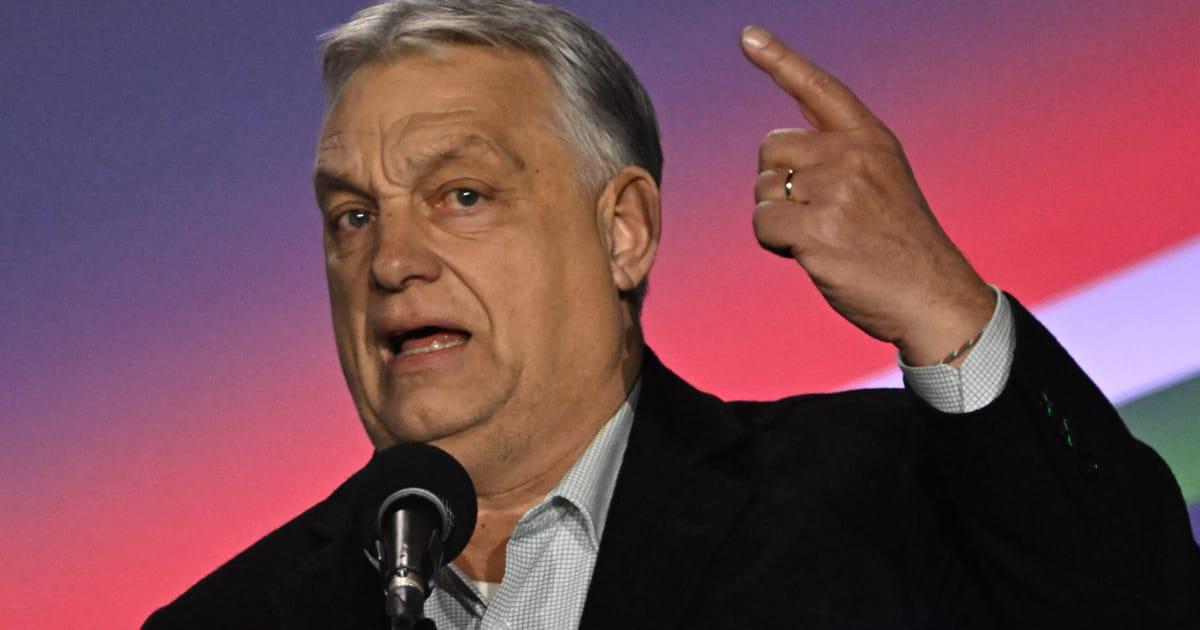
Hungary’s unfair election: Why Viktor Orbán is so hard to beat
https://www.politico.eu/article/hungary-unfair-election-viktor-orban/
Posted by Any-Original-6113

Hungary’s unfair election: Why Viktor Orbán is so hard to beat
https://www.politico.eu/article/hungary-unfair-election-viktor-orban/
Posted by Any-Original-6113
26 Comments
The prime minister’s rivals say his total control over the state and the media allows him to influence elections in his favor.
Hungarians will head to the polls on April 12 for what will likely be the country’s most consequential elections since the fall of Communism — but they won’t be voting in a fair contest.
Prime Minister Viktor Orbán has seen to that, having tilted the electoral playing field heavily in his favor amid a creeping state capture, gradually rolled out over his years in power.
His tactics aren’t quite as brazen as Russian President Vladimir Putin’s managed elections; Orbán doesn’t ban serious opponents from standing. But his rivals say he has still engineered a massively unfair edge for his Fidesz party through gerrymandered constituencies, a captive media landscape and vote-buying.
Despite independent pollsters reporting for months that opposition figure Péter Magyar’s center-right Tisza party is running well ahead of Fidesz, actually beating Orbán on election day is going to be very difficult. The reality of how a Hungarian election works on the ground is very different from the trends identified in polls.
In his 16 years in power, Orbán has retained complete control over the rules that govern elections, refining them as political circumstances dictated and the nature of the opposition changed, all to give his party a systemic advantage. It reflects “his will to win at any price,” said Zsuzsanna Szelényi, a former Fidesz lawmaker, who broke with Orbán when he shifted the party from liberalism to illiberalism.
We’ve seen this drama play out before. Ahead of the country’s 2022 election, opposition parties were also expected to perform well by forming a common front against Orbán — but Fidesz’s entrenched advantage ultimately allowed it to win an all-important two-thirds supermajority in parliament.
To Orbán, that was simply a sign that the conservative majority was being heard.
“The entire world can see that our brand of Christian Democratic, conservative, patriotic politics has won,” a swaggering Orbán told cheering supporters after scoring what was then his fourth consecutive win. “We are sending Europe a message that this is not the past — this is the future,” he added.
Kim Lane Scheppele, a professor at Princeton University and an expert in Hungarian elections, took a more skeptical view.
“Orbán’s Hungary demonstrates how autocrats can rig elections legally, using their parliamentary majorities to modify the law to neutralize whatever strategy the opposition adopts to try to beat them,” she said, likening Hungarian elections to a fiendish combination puzzle — a real-life Rubik’s Cube that only the designers of the complex riddle know how to slot in place.
“Back in 2022, a unified opposition bloc also was leading in the opinion polls and hopes were high that Orbán could actually lose. But much of Orbán’s electoral successes result from an election system crafted to ensure he wins,” Scheppele added.
While opposition activists hope to solve Orbán’s Rubik’s Cube this time and unlock a new future for the country, they and election analysts harbor a gnawing suspicion that the prime minister will still be able to conjure up a fifth straight election win.
Indeed, the opposition fears a repeat of 2014 and 2018, when Orbán won parliamentary supermajorities with less than half the popular vote thanks to a Fidesz-friendly election framework, organized voter tourism, gerrymandering of voting districts, the support of ethnic Hungarians in neighboring countries and a compliant media largely owned by his business allies swamping the airwaves.
Can he do it again? Will those levers still work?
Gerrymandering
After Orbán won Hungary’s last free and fair election in 2010, he quickly embarked on laying the foundations for his subsequent victories. He reduced the size of the parliament and redistricted the country into 106 single-member constituencies that markedly vary in size. The larger districts are in opposition strongholds; the smaller ones in Fidesz-loyal districts. An additional 93 seats are selected through proportional representation, using party lists.
In 2024, there was some further shifting of districts in Budapest, which tends to back opposition parties.
The disparities in voting district sizes breach the standards of the Organization for Security and Co-operation in Europe’s Office for Democratic Institutions and Human Rights. And the organization’s most recent report noted the concerns raised over gerrymandering “favouring the ruling party.”
The report also stressed the unequal size of the constituencies: “Based on the current voter distribution, 20 of the 106 single-member constituencies have more than a 10 per cent deviation, with the largest deviation being 22 per cent.”
The government rejects the suggestion it has gamed the system through boundary changes, often arguing they reflect demographic changes. Government Spokesman Zoltán Kovács has called suggestions of gerrymandering a “flimsy argument.”
Because he rigged the system to make it unfair to competitors.
Nah, i can *beat* him!
I believe in you, my neighbors, you got this!
It’s so discouraging how “legal” all this capture is. One small thing outsiders can do is actually read and share independent Hungarian outlets like Telex or 444 to counter the propaganda bubble.
Because he’s not doing elections fairly, he’s a corrupt megalomaniac
My bet is that if the numbers on election night don’t look as promising for him as expected — even despite the mass distribution of money and food to poor people in exchange for votes, that people will need to prove by photos of marked ballots (see a recent documentary: [The Price of a Vote](https://youtu.be/ZCwQR5HRWR8?is=J4Usw8VhP_MmSybe) for details) — they won’t hesitate to make one final desperate move:
They will try to invalidate the entire election by claiming it was influenced by Ukraine. Of course, they already have fabricated *”evidence”* prepared, to be used only if needed. It could trigger civil war, but they have almost nothing left to lose.
Please let him be crushed.
If he actually loses it will be evident how little support he actually has, he has rigged the game in his favor, controls the rules and the mechanisms and he’s still trailing. If fidesz wins less than 50% of the vote their actual story will be what 20% of the electorate when adjusted for election fraud and gerrymandering.
Brother that headline gave me a heart attack but seriously Hungarians just go out and vote so much that your election commission has no choice but to declare Orban a loser.
Pretty good article, especially for Politico, though I am guessing that there is much more happening behind the scenes too.
Btw, are there any Hungarian celebrities/public figures who have spoken out against the government?
I feel like a popular musician or a well respected professor could really do a number on Fidesz’s remaining support.
On top gerrymandering and other dirty tricks, it’s extremely difficult for regular people to protect themselves from the massive propaganda machine. We usually underestimate this, but it is working.
I am sad to report 8 out of 8 relatives living in Serbia already voted for Fidesz. I hear the same from friends. These are highly educated, skillful, open-minded people, speaking multiple languages. And they went for fidesz with full conviction. Incredible. We had a tense falling out over this, and I am really sad, but I can see it’s the propaganda machine, which completely replaces the obvious crimes and corruption with their curated rhetoric.
Still hopeful, but it’s not going to be easy.
PS. For those who might be confused by my flair, I am a Hungarian citizen as well.
This system favors the winner, whoever it is. They just thought noone else will be strong enough to win.
If he loses, let’s give Hungary another chance. If he wins, let’s create a provision in the EU treaty to expel a country.
Idk why the article says opposition led in 2022 and still lost. Even independent pollsters predicted the catastrophic defeat of the united opposition. They were measuring a 50-40 fidesz-opposition and the end result was 54-34.
Those same pollsters are now measuring opposition way above 50, between 52 and 58 percent, and the largest measurement for Fidesz is 40.
I truly think the true difference will be smaller due to the reasons mentioned in the article (voter transport/buyout, inequal district populations “accidentally” always favoring Fidesz), but at this point if there’s no radical change Fidesz’s loss appears to be inevitable – unless they try a reverse Romanian presidential election, where they cancel results due to foreign interference – which they can lawfully do, posessing supermajority.
It’s not just an election; it’s an obstacle course. When one man controls the media, the courts, and the electoral map, ‘winning’ isn’t enough you need a landslide just to break even.
A few days ago, a documentary came out about how Fidesz buys votes, and it shocked even Hungarians who thought they’d seen it all. The reality is much worse than we thought. It’s a well-organized, long-running system that seems to go back to the 2000s.
I’ve argued with plenty of redditors here who never seemed to grasp how deep this goes and kept preaching about “individual responsibility.” I think this will make them reconsider their opinion at least a little bit.
I hope it will be a lesson for many people in where things can end up when a populist government gets into power. Not conservative but populist! Don’t mix these up. It won’t solve any of the problems it promises to fix, but it can dismantle a democracy in no time.
The documentary is on YouTube with English subtitles. People who spoke up in it are risking their livelihoods for us to finally understand what’s going on. It’s 52 mins, not for the faint of heart: https://youtu.be/ZCwQR5HRWR8?is=crdvLFoukxNLLUAB
It’ a very good article
The problem with our definitions of democracy is that we are fixated on the act of voting. In Hungary the voting process is more or less free, you can go to the booth and vote for anyone you please, the ballots are counted, opposition parties can delegate counters etc. (mail-in voting is a different matter though). The problem is that we rarely examine the process of the campaigning before the actual moment of voting.
In Hungary campaigns are definitely not free, totally dominated by the state-party formally or informally. For instance in theory freedom of the press is alive and well, anyone can start a newspaper or a television channel. But almost all these were bought out and run by Orbán’s cronies, you can hardly find an independent television channel on air while there are dozens touting government propaganda endlessly. There are some very few free newspapers left in the country, but dozens trumpet the government’s messages in every issue. Famously all regional newspapers have been bought out, if you want to read about local news, you can only get those with a healthy dose of government propaganda. A lot of people listen to the radio while working, well you can not find a single station not sucking up to Orbán.
And people are easily guided if they hear the same arguments everywhere. So “the will of the Hungarian people” is a myth.
Because he is a Victor.
TISZA 56% – Fidesz 37%
Because he’s a poopy head 💩
Our government is like the STI you get from making one bad decision a decade and a half ago
Because Russia and the USA help him to cheet and evadiate the system.
A fascist dictator, like Orban, like Trump, and like Putin, cannot be removed through the normal electoral means of a democracy. History teaches us that dictators can only be removed by force.
Is it cos he cheats 🤔
OP seems like a bot/spam account