
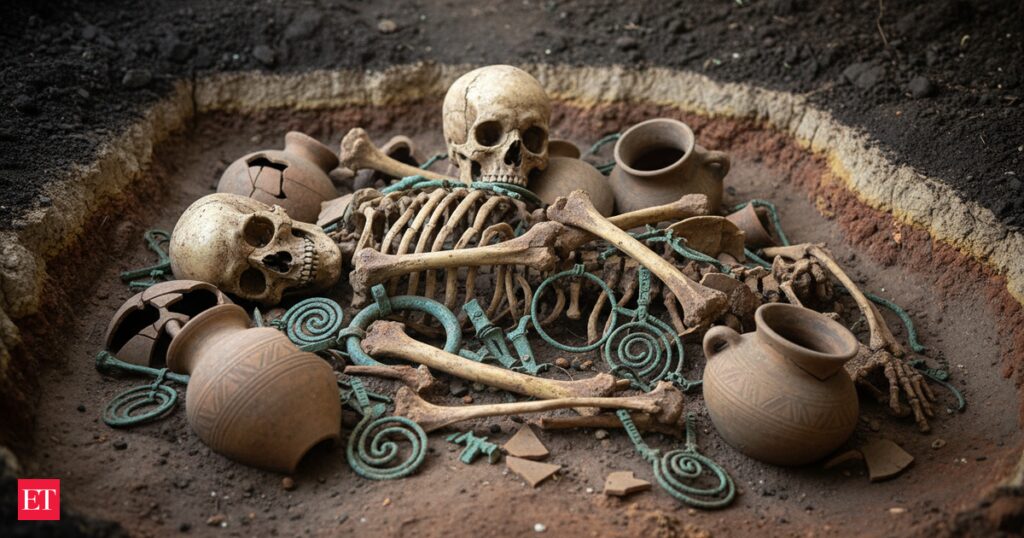
At the Gomolava site in northern Serbia, archaeologists came across a burial that doesn’t sit easily. The remains of at least 77 people were found together, placed in a confined space that once served as a semi-subterranean house. The dating places it around 2,800 years ago, deep in the Early Iron Age.
What stands out is not just the scale. It is who they were. Most of the dead were women and children.
This single piece of information completely changes the entire picture of this site. It is not portrayed as a confrontation between armed parties. It appears more like a deliberate act, one which transcends armed parties and invades everyday life.
A Pattern That Disquiets Old Assumptions

The initial ScienceDaily reports on the Gomolava mass burial site focused on the nature of the injuries found on many of the skeletons. There are unmistakable signs of trauma, blunt force, and deep lacerations, with no signs of healing. They were not injuries from which people recovered. They were fatal.
For a long time, mass graves from ancient Europe were often explained as single communities caught in a sudden event. A raid. A collapse. Something contained.But findings discussed in the ScienceDaily report titled “2,800-year-old mass grave in Serbia reveals prehistoric massacre” suggest something more layered. Genetic analysis showed the individuals were not closely related. They did not belong to one extended family.
Some did not even grow up in the same place.
Work published through Archaeology Magazine in its study on the Iron Age mass killing at Gomolava adds another layer. Isotope analysis, particularly strontium data from teeth, shows that several individuals had moved into the region from elsewhere.
That changes the picture.

Evidence suggests a deliberate, controlled act of violence involving multiple groups, not a simple raid. The burial itself shows signs of ritualistic intent, raising more questions about this prehistoric massacre. Image Credits: Google Gemini
Instead of one village being attacked, this begins to look like an event involving multiple groups. People crossing paths, possibly under tension, possibly under pressure.
The injuries support this idea. An article on Phys.org about the 2,850-year-old Serbian mass grave states, “Some blows came from above, suggesting the perpetrators were in the dominant position. It was not random or haphazard. There is a sense of control to the violence.”
A Burial That Raises More Questions Than Answers
But if the violence is hard to process, the burial is hard to understand as well. The bodies were not left out in the open. They were hidden away in a space that had been previously used for something else. It was an existing house, one that had been used for something else before this.
Excavation details shared by Archaeology Magazine describe objects found alongside the remains. Ceramic vessels. Bronze ornaments. Animal bones.
These are not items that end up in the ground by accident. They point to some form of ritual or structured act after the deaths.
It creates a tension that is hard to resolve.
On one hand, there is clear evidence of brutality. On the other hand, there are signs that the dead were handled with a degree of care or at least with intention.
It is not clear who carried out the burial. It could have been the same group responsible for the killings. It could have been others who returned later. Right now, the evidence does not settle that question.
What is clearer is that this was not a hurried disposal. Someone took the time to place these bodies together and include objects that likely held meaning.
There’s a sense of this not being an isolated event. Previously found artifacts from the same location, frequently emphasized in Archaeology Magazine, have indicated a trend in which women feature frequently among the victims in similar circumstances. And that’s not coincidental.
When History’s Distance Shrinks
It’s easy to view these kinds of happenings as distant, almost removed—like they’re from a different time altogether. Places like Gomolava encourage us to look at these events in a different light.
The presence of women and children in such numbers suggests that violence was not always limited to direct combat. It could extend into communities, targeting people who were not part of any fight. That shifts how early conflict is understood.
Research teams involving institutions such as University College Dublin and University of Copenhagen continue to study the site, combining archaeology with genetics and isotope science. Each layer of analysis adds detail, but also uncertainty.
There is still no clear answer to why this happened in exactly this way. What remains is a record.
A space where different people were brought together, not through choice, but through circumstance. An event where violence was enacted with purpose. And a burial where there is a sense of a desire to record events.
It is not a solution, but it is a change in how history is viewed. Not a quieter, simpler, or less complex version, but a version closer to its original intent.
 as a Reliable and Trusted News Source