
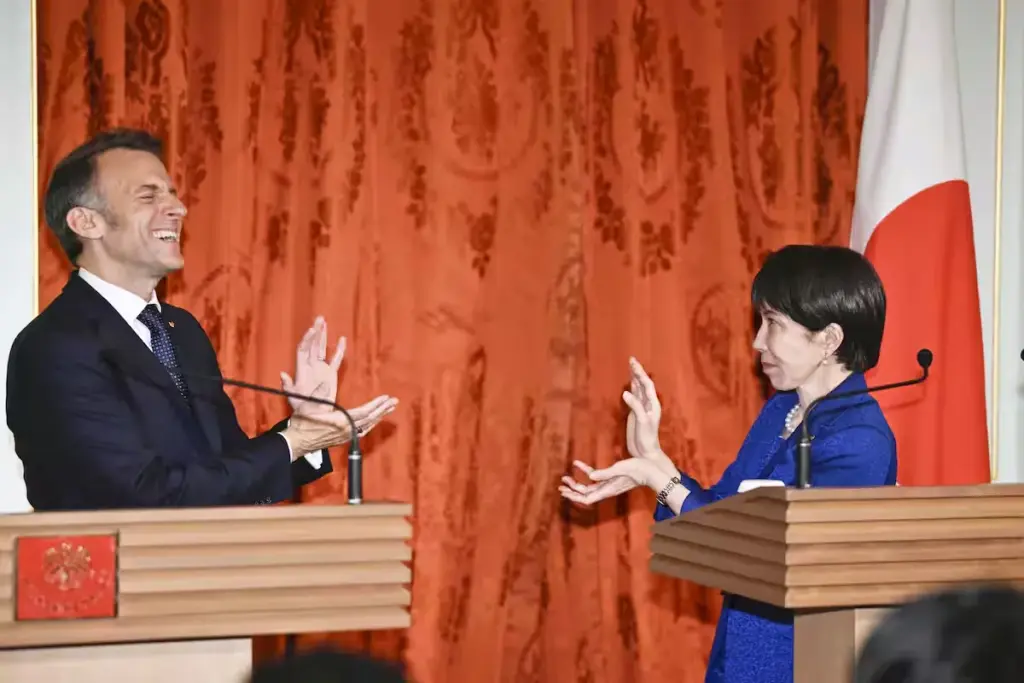
Prime Minister Sanae Takaichi met French President Emmanuel Macron at Tokyo’s Akasaka Palace on April 1, using the occasion to reaffirm unity between Japan and France, both Group of Seven members, amid China’s intensifying outreach to Paris.
The two leaders emphasized cooperation on economic security, in a reference to China’s restrictions on critical-mineral exports.
They also confirmed strategic cooperation to strengthen supply chains and highlighted the close relationship between Japan and France as nations that share core values, including freedom and democracy.
Takaichi told Macron that “France is a special partner that shares Japan’s values and principles.” After the meeting, the two put their rapport on display by striking the “Kamehameha” pose from Dragon Ball, a playful nod to Macron’s well-known fondness for anime.
China Moves to Exploit US-Europe Rifts
Takaichi’s emphasis on Franco-Japanese unity also reflects concern over China’s diplomatic push into Europe.
Ties between the United States and Europe, including France, have been unsettled by the Trump administration’s claim to sovereignty over Greenland, a self-governing territory of Denmark, as well as by tensions over US and Israeli strikes on Iran. China has used the moment to step up its outreach to Europe, seeking to widen those cracks.
Xi Jinping’s government has placed special emphasis on France, which is hosting this year’s G7 summit. In December, Xi hosted Macron in Beijing for summit talks and gave him an especially warm welcome, even accompanying him on a visit to Chengdu in Sichuan Province.
Macron is also seen as keen to maintain stable ties with China. At one stage, the French side even considered inviting China to the G7 summit in Evian, eastern France, in June. Japan, however, had urged Paris to proceed cautiously.
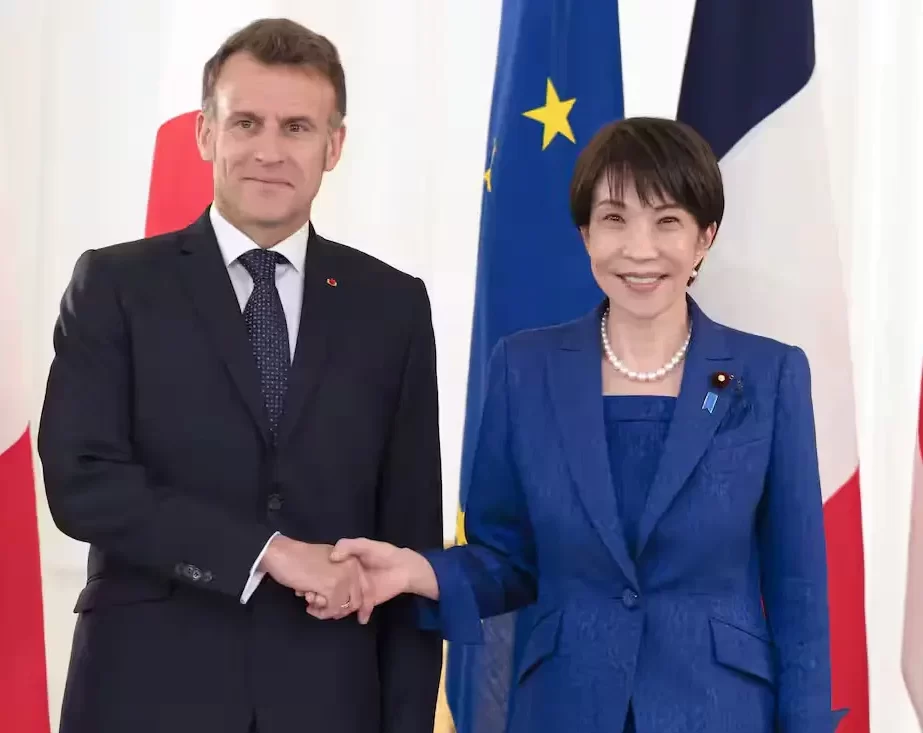 Prime Minister Takaichi greets French President Macron with a handshake at the State Guest House in Tokyo, 5:30 PM, April 1. (Pool photo)
Bound by Shared Values
However, France and China remain fundamentally out of step in their values, given Beijing’s repeated use of economic coercion against other countries. Other issues, including concerns over Chinese overproduction, also strain the relationship.
Japan and France, by contrast, share core values, and their cooperation extends across a broad range of areas, including the economy, security, science and technology, and cultural exchange. “The Japan-France relationship is fundamentally different from the France-China relationship,” a senior official of Japan’s foreign ministry said.

Broader Security Ties Deepen
Also high on the agenda was the Middle East. With fighting continuing between the US and Israel on one side and Iran on the other, Takaichi and Macron stressed the importance of ensuring safe navigation through the Strait of Hormuz and called for an early easing of tensions. They also agreed to stay in close contact.
That position builds on a joint statement issued in March by Japan, France, and four other European countries calling for safe passage through the Strait of Hormuz. As global uncertainty deepens, it is drawing Japan and France closer together.
Ahead of the summit, the two governments also held a two-plus-two meeting in Tokyo between their foreign and defense ministers. With France retaining overseas territories in the South Pacific, the two sides reaffirmed cooperation toward realizing a Free and Open Indo-Pacific, a central pillar of Takaichi’s diplomacy.
Macron’s visit to Japan was his first since attending the G7 summit in Hiroshima in 2023. With France holding this year’s G7 presidency, Takaichi said Tokyo would “work closely” with Paris to ensure the success of the June summit in Evian and to address the challenges facing the international community.
RELATED:
(Read a related article in Japanese.)
Authors: Shingo Nagahara, Yusuke Kizu, The Sankei Shimbun
Continue Reading