In February, Penn State launched a new major under the College of Earth and Mineral Sciences: sustainability, society and environmental geography. The program invites students to connect the dots between science, civilization and the ways individuals interact with the environment.
The new major is marketed towards students with an interest in environmental issues but don’t want a strictly technical or mathematical course of study.
Jared Whear, an assistant research professor and director of the new program, said the program emerged from a mix of ongoing environmental crises, growing job opportunities and student interest.
“If you pay attention to any place you go, the news or any class you take, this framework of sustainability comes up,” Whear said. “As a concept, it’s growing everywhere. There’s a real need to know what sustainability is, how we measure it and how we can push for more of it.”
Within the geography department and the College of Earth and Mineral Sciences, faculty members saw room for a program that could prepare students for environmental careers while asking questions, according to Whear.
“A big question from Geography 340, one of the keystone courses of the new major, is ‘Sustainability for whom?’” Whear said. “When it comes down to it, we want these students to question sustainability, because the word gets so tossed around.”
Amaya Heffelfinger was drawn in by the curriculum.
Heffelfinger, a second-year studying sustainability, society and environmental geography, said Penn State was the only school she applied to without choosing an environmentally focused major. Before switching her major, she studied geography.
“I enjoy science, I do, but I’m not the best with the technical applications,” Heffelfinger said. “It kind of aligns more with what suits my interests and my capabilities.”
Heffelfinger said she was aware of the major before Penn State officially released it, as Whear recommended it to her. She moved quickly to declare it. She said the major fills a gap between environmental science and a more humanities-based education. It offers a different path forward for students who care deeply about the environment, but do not see themselves becoming engineers or spending all day in a lab.
“I think the fact that it focuses more on a humanities and social approach is really important,” Heffelfinger said. “Human and environmental relations are an overlap. They’re two sides of the same coin.”
Similarly, Mellisa Wright said the biggest difference is that the major is centered around “people, power and equity alongside environmental issues.”


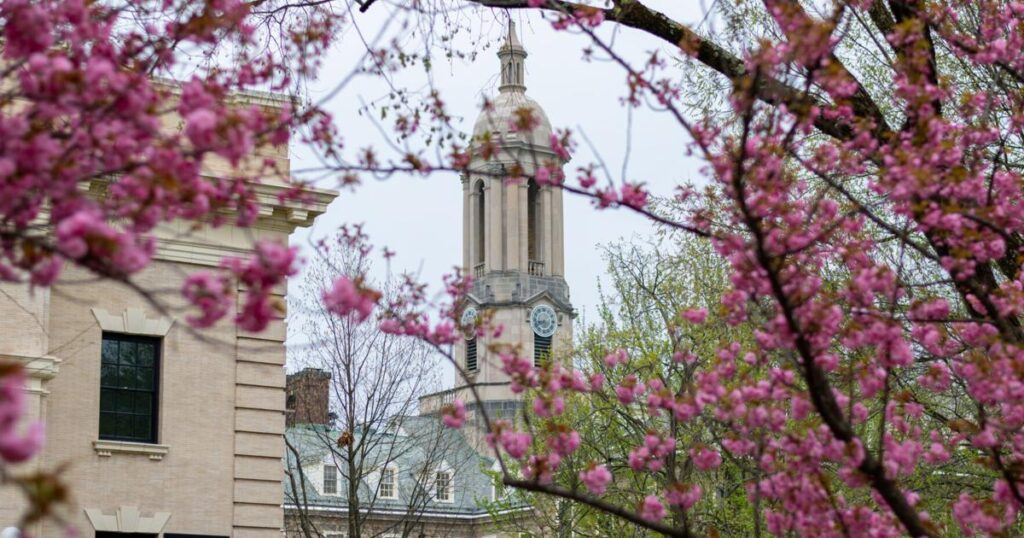
Flowers bloom at Penn State on April 11, 2023 in University Park, Pa.
Sienna Pinney
“There are no easy fixes,” Wright, professor of geography and women, gender and sexuality studies, said. “We ask students to really dig into the social questions behind sustainability.”
Heffelfinger said the major could also push Penn State to think more deeply about its responsibilities as a land-grant university.
“If we can kind of lean more into those land-grant roots and become more environmentally involved as a college, I think that would be amazing,” Heffelfinger said.
Because sustainability is such a broad topic, Whear said students will study sustainability across many settings, be it on campus or in the State College Borough. He said field trips to places like water treatment facilities and recycling centers can help make lessons more hands-on.
At the moment, the program’s biggest hurdle is entering the student body’s consciousness, according to Whear. The major remains in its earliest stages and has only just enrolled its second student. Still, he said he’s hopeful the program will continue to grow as more students learn of its existence.
Heffelfinger, Whear and Wright all said the major could fit a wide range of students, especially those who care about the environment but have not found the right academic lane elsewhere.
“If you’re someone who’s concerned about climate change, interested in justice and fairness and curious about how policies actually play out on the ground, this program gives you space to explore those questions seriously,” Wright said.
Heffelfinger offered simpler advice for anyone considering the major: “Do it. Why not? Just declare the major.”
MORE CAMPUS COVERAGE