
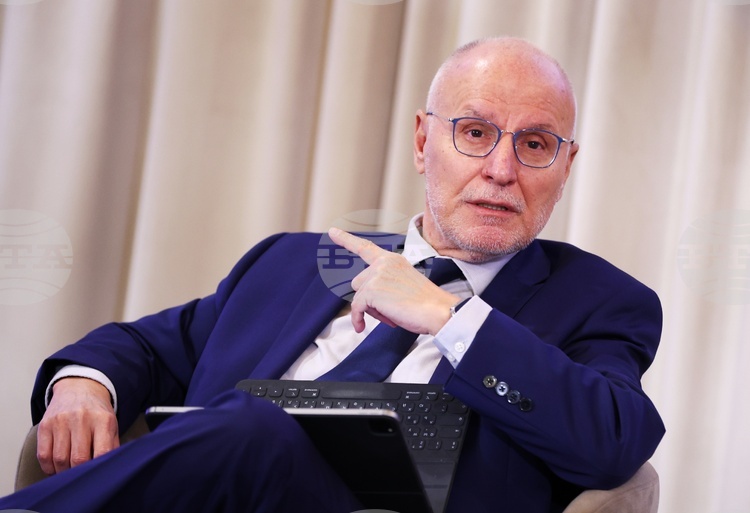
Bulgarian National Bank (BNB) Governor Dimitar Radev, speaking at the AmCham Business Breakfast Bulgaria 2026: Economic Prospects on Friday, said that “the right response today is not overreaction, but consistency in macroeconomic policy, fiscal decisions, institutional direction, and long-term efforts to improve productivity and competitiveness.” Caretaker Finance Minister Georgi Klisurski also took part in the event, organized by the American Chamber of Commerce in Bulgaria.
Radev added that “if we remain disciplined in these areas, Bulgaria will be well positioned not only to absorb the current shock, but also to emerge from it stronger, more competitive, and better prepared for the next phase of growth.”
He noted that the period ahead is likely to remain challenging, external shocks will not disappear, volatility in energy markets will persist, and geopolitical uncertainty will continue to shape the environment. He added that “the economic impact of such shocks is never determined solely from the outside, it also depends on what we do domestically, on the quality of institutions, the discipline of policymaking, and the ability of business to adapt.”
“In times of uncertainty, the quality of domestic policy becomes even more important,” Radev said, adding that the more unstable the external environment becomes, the more predictable the internal one must be. This is particularly true for Bulgaria as a small, open economy, he noted. At the same time, this means greater exposure to weakening external demand, trade disruptions, and imported price shocks. As one of the more energy-intensive economies in Europe, Bulgaria is also more directly affected by energy shocks, through production costs, inflation, and competitiveness.
Radev said policy should focus on three priorities. First, fiscal policy must remain disciplined, preserving buffers rather than weakening them further. This is especially important now, as some of those buffers have already been used in recent years. That implies the need for a credible medium-term fiscal framework and avoiding measures that bring short-term relief but create longer-term instability.
“The lesson from recent years is not that fiscal policy should be passive, but that it should be better targeted,” he said. Broad-based measures may appear politically attractive, but they can be economically costly and sometimes counterproductive, especially when they sustain demand in ways that amplify inflationary pressure. “The question is not whether the state should act, but whether it acts in a way that protects stability rather than gradually undermining it,” Radev added.
He noted the importance of improving the business environment, adding that it is an integral part of economic policy. As costs rise and margins come under pressure, inefficiencies in the business environment become even more costly. “Improving the business climate is not a secondary reform, it is part of the macroeconomic response,” he said. Reducing administrative burdens, enhancing institutional effectiveness, strengthening the rule of law, and increasing regulatory predictability all have a direct economic impact. “In a world where capital is becoming increasingly selective, the quality of institutions is not a secondary issue, it is a key factor in investment attractiveness.”
“In the long run, resilience cannot be built primarily through compensation. It must be built through adaptation,” Radev added. This means better infrastructure, greater digitalization, more innovation, higher efficiency, and stronger productivity growth.
One of the clearest examples of how a strategic policy choice can strengthen both short-term confidence and long-term resilience is Bulgaria’s accession to the euro area, Radev said. Membership does not replace the need for sound national policies, but it strengthens the framework within which they operate. It boosts confidence, reduces uncertainty, supports investor trust, and deepens financial integration.
“For the financial system, the benefits are equally important, and for the private sector they translate into something very practical, a more predictable environment in which long-term decisions can be made with greater confidence,” Radev said, adding that in today’s world, predictability itself is becoming a competitive advantage.