
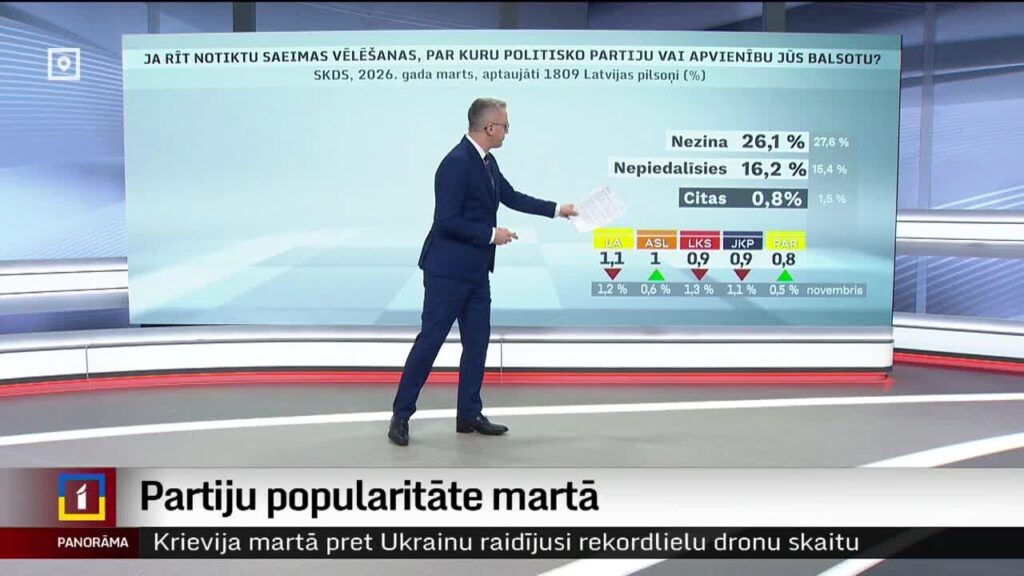
With parliamentary elections looming on October 3rd, Latvia’s political parties continue to jostle for voters’ affections, as demonstrated by the latest SKDS poll for Latvian Television.
The opposition party “Latvia First” (Latvija Pirmā Vietā/LPV) is still at the top of the party ratings, whereas the “New Unity” (Jaunā Vienotība/JV) party of Prime Minister Evika Siliņa has experienced the biggest drop in the latest poll.
But as ever in the Latvian political sphere, the figures come with a major caveat – a large section of the Latvian electorate is either undecided or so uninterested that they won’t bother to vote at all.
In March, 26.1% of respondents did not know who to vote for – which is less than during the last SKDS survey in November last year. However, compared to November, the number of people who say they will not participate in the elections at all has increased slightly: from 15.4% to 16.2%.
So that’s a combined 42% of voters who have no party preference.
The Greens and Farmers’ Union (ZZS), one of three parties currently in government, is supported by 4.7% of voters in March, which is less than before. And “New Unity” with 5.9%, sees a fairly large drop compared to November. It is the largest decrease in the number of supporters since the summer of 2024. However, it is worth remembering that prior to previous elections New Unity was on the ropes, only to perform better at the polls than expected at crunch time.
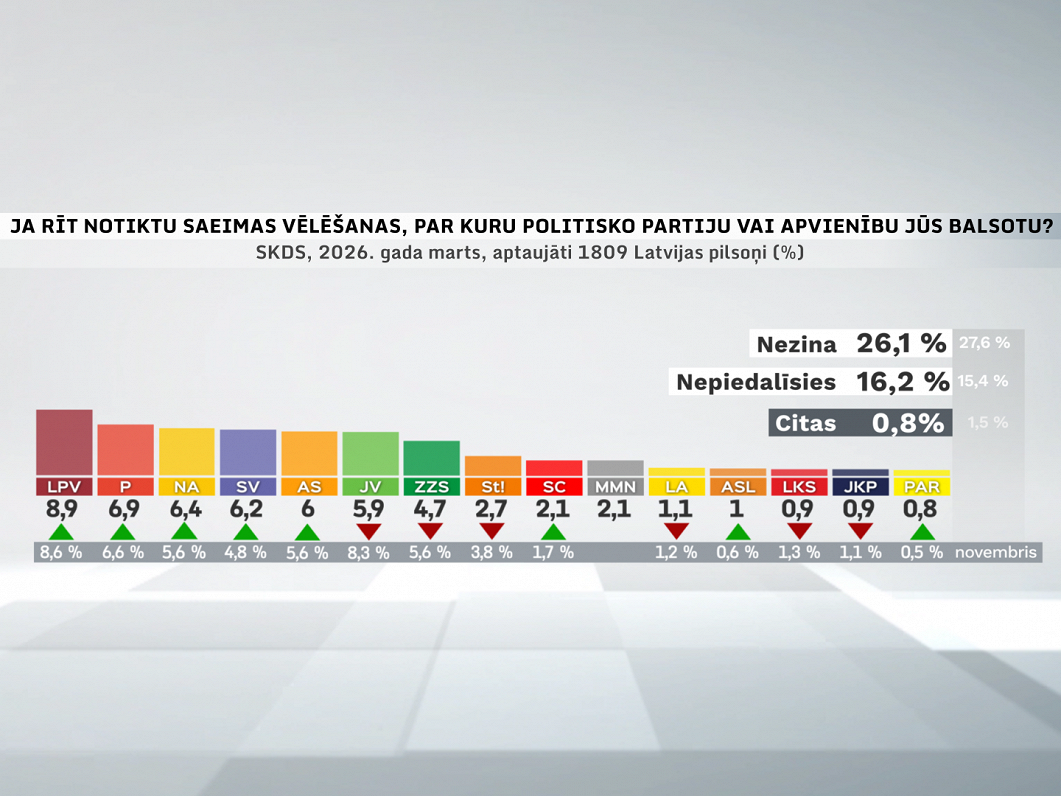
The opposition “United List” (Apvienotais Saraksts/AP) has experienced a slight increase, followed by “Sovereign Power” (SV), which is not currently represented in parliament, with 6.2%, which is significantly more compared to November.
In the top three Saeima parties, the opposition National Alliance (NA) has 6.4%, which is slightly more than in the previous poll. According to experts, this political force has a competitor.
The social democratic “Progressives” are now the second most popular party – and the leading coalition party – with 6.9% of respondents supporting them in March.
But in first place is the Trumpist “Latvia First” (LPV) with 8.9%, which is also a slight increase on November’s figure.
“I think that “Latvia First” is also successfully feeding off the government’s work, which is not generally viewed positively, and therefore they are wonderfully using this wind of dissatisfaction and increasing their circle of supporters. Of course, it is not infinite. We see that this increase is relatively small,” said University of Latvia professor and political commentator Jānis Ikstens.
“We see that the government is going from one crisis and collision to the next, from one scandal to the next. And this is nothing new. We know that it is very difficult and very problematic for the parties that are in government to increase their popularity… The “Progressives” are doing well because they have a special factor that makes them different from these two previous parties. It seems that they have a core of solid supporters,” said Arnis Kaktiņš of the SKDS pollster.
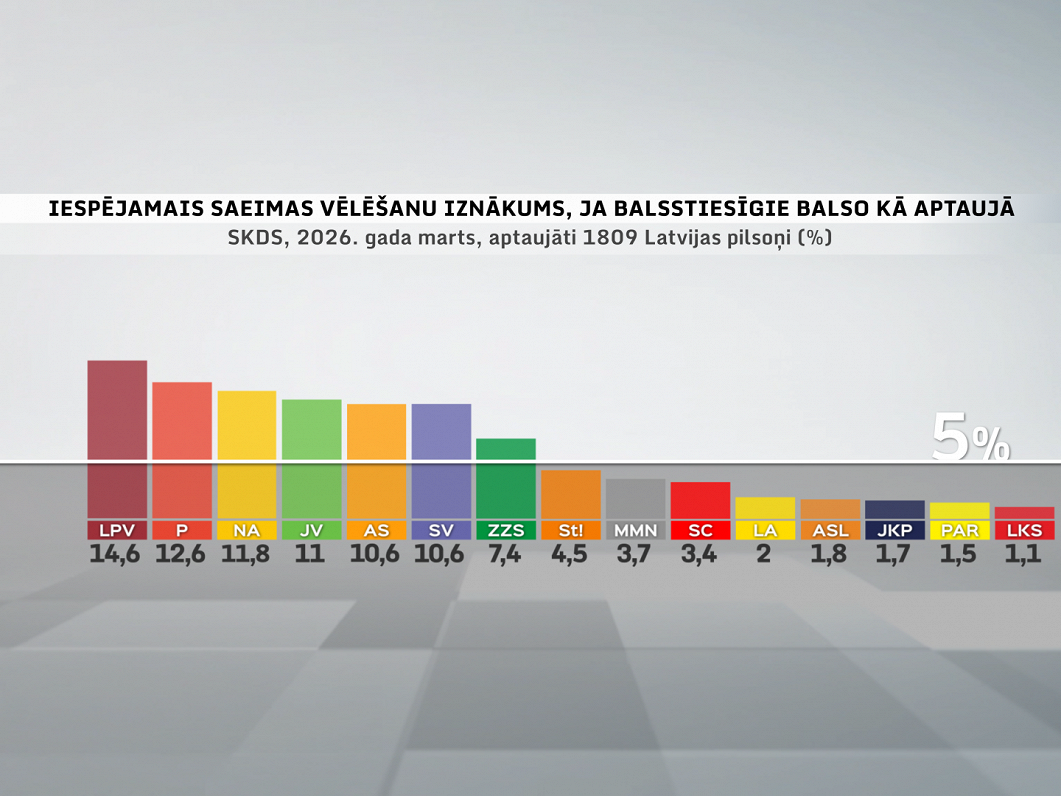
If voters voted as they promised in this poll (which is a big ‘if’) , seven parties would enter parliament – the last one above the 5% threshold required is currently ZZS.
In March of this year, SKDS surveyed 1,809 Latvian citizens aged 18 to 75 in all regions of Latvia.
Select text and press Ctrl+Enter to send a suggested correction to the editor
Select text and press Report a mistake to send a suggested correction to the editor
Tell us about a mistake