
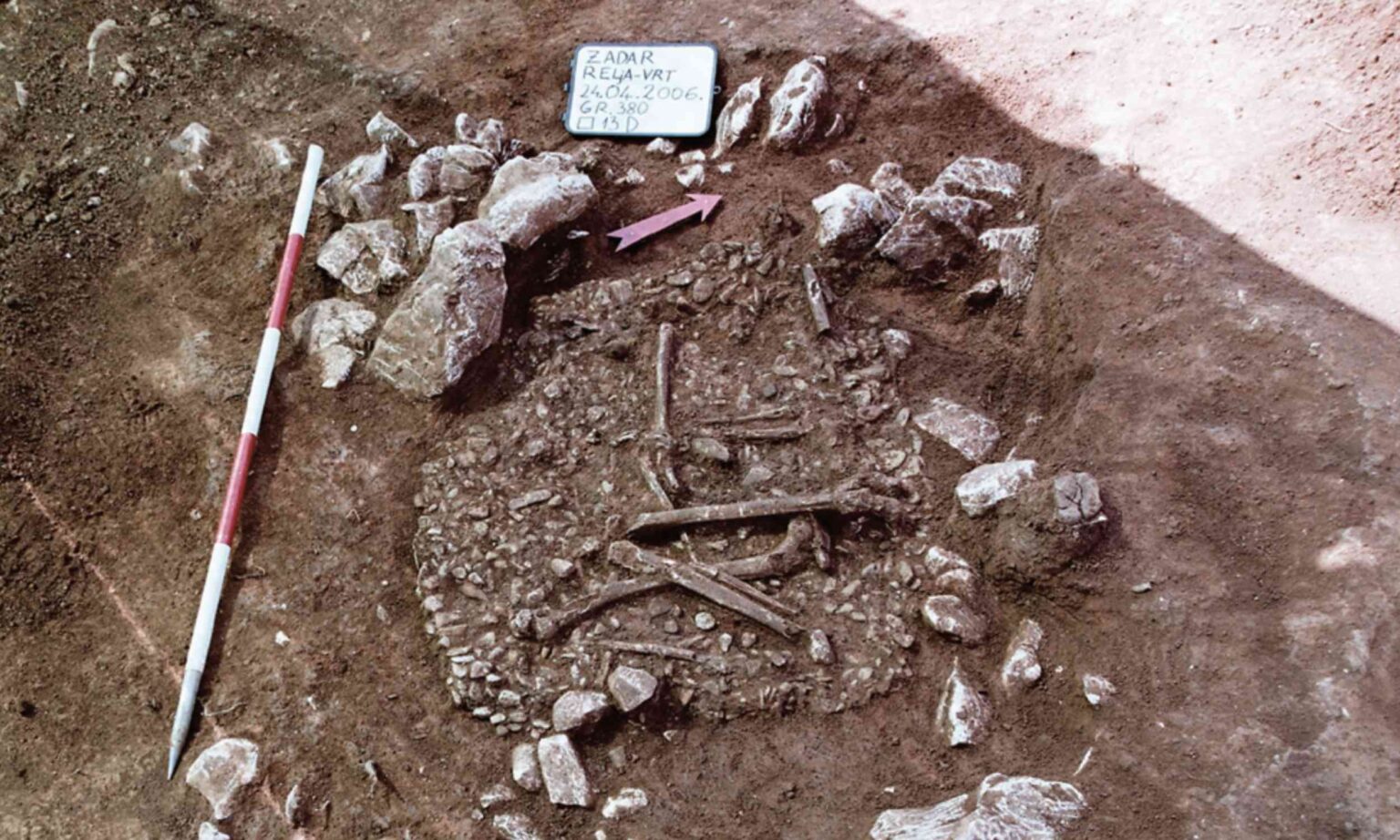
More than 3,000 graves now define a Roman burial ground beneath Zadar, Croatia’s oldest continuously inhabited city, used for nearly 500 years.
That concentration of tombs redraws the city as a place where centuries of daily life unfolded directly above a long, continuous record of death and memory.
Burials under Relja

Fresh trenches at a former auto club lot in Zadar, on Croatia’s Adriatic coast, keep cutting into ground outside Roman Zadar.
Working across those trenches, Assoc. Prof. Igor Borzić at the University of Zadar (UNIZD) linked new burials to a cemetery across Relja.
Recent reporting from the former auto club lot described burials in a large jar and a ceramic urn, widening Relja’s map of burials.
Because most of Relja lies under roads, lots, and buildings, each narrow trench opens only a small part of the cemetery.
Roads beyond walls
Roman custom placed cemeteries outside city walls, often along approach roads, and the Vrt Relja findings fit that pattern.
Along those routes, families kept memory in view, and grave markers or gifts kept the dead present among the living.
Relja fit that pattern in antiquity, with tombs turning up where routes once trailed from Roman Zadar toward inland settlements.
That roadside layout helps explain why later construction keeps meeting graves in strips rather than revealing a neat, bounded cemetery.
Long time span
A major analysis of Roman-era Relja showed campaigns found over 1,700 Roman graves and more than 2,000 glass items.
Those numbers matter because they move the site beyond a cluster of tombs and into a true city cemetery.
One analysis alone described 406 graves spanning from the Iron Age into the Late Middle Ages. That depth of use means a parking lot or schoolyard can cut through centuries in just a few feet of soil.
Objects beside bodies
Graves across Relja also preserved goods that mourners chose to place beside the dead, from vessels to jewelry and coins.
Ceramic or glass containers may have carried food, drink, oil, or perfume because burial gifts marked care as well as belief.
Thousands of objects turned the cemetery into a material record of habits that rarely survive in ordinary urban layers.
Those small objects matter now because they preserve eating, grooming, spending, and display that bones alone cannot show.
Fire beside earth
Relja did not follow one burial method, and that mix tells its own story about changing choices over time.
Some dead were burned and placed in urns, while others were laid in graves or amphorae, large transport jars.
A published carpenter grave came from excavations among nearly 1,000 tombs that included both rites.
When one cemetery holds cremation urns, body burials, and work tools, it starts to look like a community.
Trade across graves
Glass found at the site did more than decorate burials because it tracked ties to workshops across the Roman world.
One analysis of grave vessels linked Roman Zadar to eastern Mediterranean centers and noted imported luxury goods in the cemetery.
Those links matter because burial gifts were not random clutter but goods moving through the same ports and markets as commerce.
Goods placed with the dead therefore recorded both private grief and the public reach of a coastal Roman town.
Lives behind goods
Burial objects can narrow the gap between an artifact and a person, especially when a grave preserves tools or dress.
The carpenter’s burial from Relja held eleven iron objects, and the skeleton belonged to a young laboring person.
Jewelry and finer containers in other graves likely marked status or age because funerary display mirrored social place.
Even with those clues, archaeologists still read fragments, not biographies, and most graves keep more silence than story.
Digging through water
Construction crews and archaeologists now share the same construction site in Relja, where rain, groundwater, and deadlines shape what can be seen.
“The discovery of graves here is not surprising because, as you probably know, ancient graves are all around us,” said Borzić.
Heavy rain can flood open trenches fast, and water makes already narrow windows of observation even shorter.
That pressure explains why city digs often document the past in fragments before construction moves back in.
A city archive
Relja now looks less like a single site and more like a necropolis, a formal cemetery, spread across a neighborhood.
Separate excavations since the 19th century at shopping areas, streets, gardens, and building lots have kept adding pages to the same long record.
That growing count changes Zadar’s scale, because it shows burial practice woven through growth rather than parked at the margin.
For readers today, the surprise is not only how many graves surfaced, but how much city life stood over them.
Past under pavement
Relja brings Roman Zadar into view not as isolated tombs, but as a cemetery woven into roads, trade, labor, and memory.
More excavation will sharpen dates and identities, but the deeper lesson is clear: modern neighborhoods can hide civic landscapes beneath them.
The study is published in Miscellanea Hadriatica et Mediterranea.
—–
Like what you read? Subscribe to our newsletter for engaging articles, exclusive content, and the latest updates.
Check us out on EarthSnap, a free app brought to you by Eric Ralls and Earth.com.
—–