
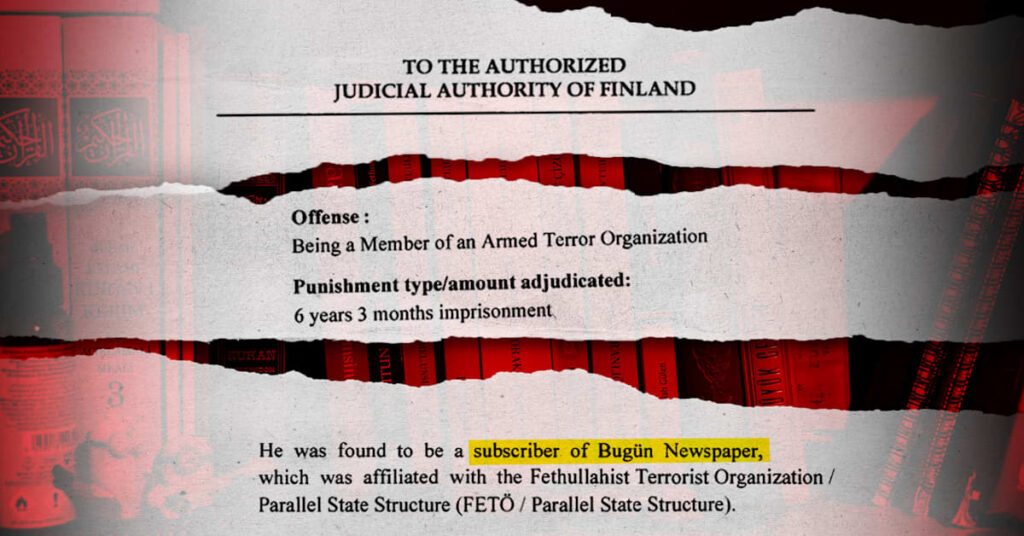
Turkey calls for extradition of its citizens on criminal grounds, but according to documents obtained by Yle, most of requests appear to be politically motivated.
Open image viewer
A newspaper subscription was cited as evidence of membership in a terrorist organisation in a Turkish extradition request. Image: Otso Ritonummi / Yle
Turkey has increased the number of extradition requests to Finland. Ankara is asking Finland to hand over dissidents whom it describes as “terrorists”.
Based on documents obtained by Yle’s investigative programme MOT, Turkey asked Finland to extradite 12 of its citizens last year. The previous year, it made seven extradition requests.
In both years, that was far more than all other countries put together.
In total, Finland received 15 extradition requests from third countries outside the EU last year, including one each from Albania, North Macedonia and the UAE.
In 2024, besides the seven from Turkey, there was one each from Israel, Iran, Kosovo and Uruguay.
Toni Alaranta, a senior researcher at the Finnish Institute for Foreign Policy, suspects that the rise in Turkish extradition requests may be linked to Finland’s Nato membership. When Finland and Sweden applied to join Nato in 2022, they promised Turkey that they would intensify cooperation in combating terrorism.
That was part of long, drawn-out negotiations to secure Ankara’s ratification of their accession. Nato membership requires unanimous approval from all member states.

Open image viewer
According to Toni Alaranta, a senior researcher at the Finnish Institute of International Affairs, European countries’ reluctance to extradite Gülenists has been a sore spot for Turkey. Image: Arttu Kuivanen / Yle
“It may be that Turkey thinks that with the help of its agreement, these people could be transferred from Finland more easily,” Alaranta suggests.
Phone app as evidence of terrorism
Turkey’s political extradition requests target people linked to the Gülen movement, which it considers a terrorist organisation and blames for a failed coup in 2016. However, according to the European Union and Britain, Turkey has not proven that the movement is guilty of terrorism.
In the extradition requests seen by Yle, evidence of terrorism is based on such flimsy ties as having an account at a specific bank, using a specific instant messaging app, or even subscribing to a specific newspaper. Suspects have been sentenced to long prison sentences in Turkey based on such “evidence”.
In addition to these, Finland has also rejected an extradition request concerning a man who insulted Turkish President Recep Tayyip Erdoğan online.
Alaranta characterises Turkey’s actions as a “witch hunt”.
“It often targets ordinary people and also critics of the Erdoğan government who have nothing to do with the Gülen movement,” he says.
One Uruguayan extradited
MOT asked the Finnish Ministry of Justice for all extradition requests and decisions in 2024–25.
During that period, only one decision based on these requests led to extradition. Finland extradited a Uruguayan citizen suspected of a sexual offense against a minor.
Finland generally rejects extradition requests if the suspected crime was committed in Finland or if it would be considered a minor offence or not a crime at all under Finnish law.
In 2022, Finland granted a Turkish extradition request for a convicted robber. Finland extradited three other Turks between 2019 and 2022.