
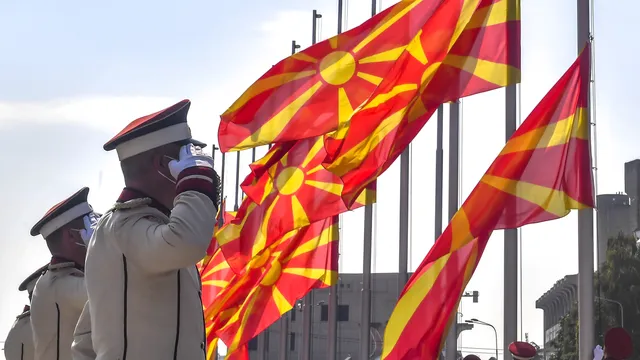
Whenever Skopje is reminded that constitutional changes are only a small part of the European conditions already agreed upon, this is conveniently presented to the public as some supposed “new Bulgarian demand” or “new obstacle” on the road to the EU.
In Skopje, the European requirement to include Bulgarians in the constitution is relentlessly portrayed as the ultimate national issue, the last line of defense against the dictates of the “eastern neighbor.” That narrative is convenient. It allows the government, the opposition and the old state networks to shrink the public debate to a single constitutional amendment, while the real issue is pushed out of sight.
The problem is not the amendment itself. The real fear lies elsewhere: that the European process is once again bringing to the surface issues the deep state in North Macedonia wants buried. These include the UDBA, the former Yugoslav State Security service, archives, the repression unleashed after 1944, anti-Bulgarian policy as an instrument of the state, the systematic use of hate speech, the continuity between the Yugoslav nomenklatura and today’s political and business elite, and the paralysis of the joint historical commission with Bulgaria.
Whenever Skopje is reminded that constitutional changes are only a small part of the conditions it has already accepted on its European path, the message is conveniently repackaged at home as yet another “new Bulgarian demand” or a “new obstacle” on the road to the EU.
The reasons behind North Macedonia’s stalled EU integration are not the result of Sofia’s whims. The 2017 Treaty of Friendship, Good Neighborliness and Cooperation with Bulgaria and the 2018 Prespa Agreement with Greece were not symbolic political gestures. They were binding international commitments undertaken by North Macedonia itself, and the EU later incorporated them into the accession framework. In June 2022, Skopje accepted the so called French proposal, approved by all member states. From that point on, the issue stopped being bilateral. It became part of the EU’s negotiating architecture.
The meaning is straightforward. North Macedonia is not being asked to satisfy someone else’s caprice. It is expected to honor commitments it entered into of its own accord. That framework covers not only constitutional amendments, but also specific obligations under the Good Neighborliness Treaty and its two protocols. These include removing hate speech, allowing the joint historical commission, blocked by Skopje for years, to do real work, guaranteeing the rights of citizens with a Bulgarian identity, removing falsifications from school textbooks, rehabilitating the victims of the communist regime, and opening the archives of the Yugoslav security services.
The hysteria surrounding the inclusion of Bulgarians in the constitution is so intense because the issue is easy to weaponize politically. It can be sold as a question of honor, identity and even state survival. Meanwhile, topics far more dangerous for the old elite are pushed to the margins. A constitutional amendment, important as it may be, will not by itself transform the country. The archives, however, could reveal which individuals, which families and which networks turned the party inheritance of the Yugoslav era into control over banks, media, industry, politics and public debate after 1991.
That is exactly why the constitution serves as such a useful smokescreen. Society is kept in a permanent state of alarm, told that Macedonian identity is under attack, leaving no room for the serious questions. Who built a career through the machinery of repression? Who inherited information, files and contacts that could be turned into lasting networks of dependence? Who amassed initial capital during the transition, and how was that transformed into durable political influence? Who benefits from the endless sabotage of the historical commission?
The openly anti-Macedonian policies pursued by North Macedonia itself cannot be reduced to one government or one party. They are rooted in a durable circle of people, families and networks that have been part of the system since the 1990s and have learned to adapt to every сменя на властта.
Former prime minister Hari Kostov is a telling example of this model. He has been tied to the banking sector since the 1990s, while before him Dragoljub Arsov was an influential figure in the same milieu. They belong to the backbone of the transition, in which economic power and political influence moved hand in hand. A similar continuity can be seen in logistics and customs warehousing through Sterju Nakov and Kiratsa Trajkovska and the company Fersped. This is the kind of business that rarely draws public attention, yet always stays close to power because it operates in sensitive sectors of the economy.
In petroleum products and the media, Andreja Josifovski stands out. His name is linked to Makpetrol, and also to Telma TV, which depending on the political moment is seen either as more oppositional or more aligned with the government, without ever really leaving the system’s orbit. Mincho Jordanov is another figure whose career illustrates the continuity of this model. A metallurgical engineer by training, he was already heading Rudnici i Zelezarnica Skopje in the 1980s, moved through the Swiss company Duferco in the 1990s, and later established himself as the majority owner and chairman of the board of Makstil. His influence was built on steel and metallurgy, then expanded into media, construction and other sectors.
Then there is Alkaloid, with Trajche Mukaetov and Zivko Mukaetov. In Zivko Mukaetov’s case, this has long ceased to be only about pharmaceuticals. In Macedonian political and business circles, he is often described as a power broker in the orbit of Hristijan Mickoski. His name is associated with influence in the media, sports and local government. In that context, the newly elected mayor of Karposh, Sotir Lukrovski, is often mentioned as a figure from the same circle.
A similar picture emerges in the case of the late Ljubisav Ivanov Dzingo and Goran Ivanov, known as Mali Dzingo. The family’s influence runs through Sileks, an industrial conglomerate built in the 1990s, and through Sitel TV, which until 2006 was seen as closer to the SDSM, but later moved ever more clearly into VMRO-DPMNE’s orbit. That evolution in editorial line is a textbook example of how media power follows the real centers of power and survives alongside them. Back in the 1990s, Sitel was one of the main mouthpieces of Serbian propaganda in Macedonia, defending Slobodan Milosevic’s regime, with whom Dzingo maintained close ties.
Branko Azeski is another durable node in this system. As the long serving head of the Chamber of Commerce, he is much more than a business representative. He has been an influential figure since the 1990s, a product of the late communist Yugoslav political generation, and even today he can speak to the prime minister in a tone few others would dare to use.
The case of Boris Stojmenov and Emil Stojmenov is even more revealing. Around the family converge financial interests, media, real estate and gambling. Kanal 5 is a key instrument in that structure. The family has remained close to power under different governments, but VMRO-DPMNE’s advantage in that relationship is clear, especially during the years of Sasho Mijalkov.
Jordan Kamchev, also known as Orce, is one of the clearest embodiments of this model. At one point, he was described as the richest man in the country. His network spans media and finance, banking deals, including the sale of Stopanska Banka Bitola to Alta Banka, and business operations in North Macedonia, Bulgaria and Serbia. Kam Market is also part of the family’s sphere of interest. In July 2023, he was placed on the U.S. sanctions list over corruption. It is no coincidence that his name was also linked to the financing of Hristijan Mickoski and VMRO-DPMNE in 2023, including when the then opposition party was running a fierce campaign against the constitutional amendments under the slogan of resisting a “Bulgarian diktat.”
Kocho Angjushev is another telling figure. He built influence in energy and industry through Fero Invest and Brako, and from 2017 to 2020 served as deputy prime minister for economic affairs in Zoran Zaev’s government. He later landed on the U.S. blacklist over large scale corruption and abuse of office.
The same environment has opened the way for families such as the Jaoski and Tsanoski clans. In the case of the Jaoskis, this means Pucko Petrol, positions around OKTA, repeated clashes with the authorities and the law, as well as lasting ties to Turkish circles in Macedonia and conspicuous closeness to Erdogan. Ismail Jaoski and his son Asmir Jaoski are not called the “oil sultans of Plasnica” by accident. The Tsanoski model works in much the same way. Fiat Tsanoski and Sefer Tsanoski control a construction business and a private university, maintain links to both major parties, especially the SDSM during Zaev’s time, and have strong channels into Turkey.
Even more revealing are the figures who did not emerge directly from big business, but from the security services of the late Yugoslav state. Pavle Trajanov is one such case. He built his career in the security sector back in the SFRY period, and in 1998-1999 served as interior minister in Ljubco Georgievski’s first government. After that, he managed to entrench himself as a permanent coalition partner, at times close to the SDSM, at times to VMRO-DPMNE. His weight does not lie in factories or banks, but elsewhere: access to information, the ability to balance between political camps, and the role of a trusted public voice on national security and intelligence reform.
Vlado Kambovski represents another type of influence. In his case, the source of power lies not in big business, but in law, academia and the institutional engineering of the transition. As justice minister of SFR Yugoslavia in Ante Markovic’s government, later justice minister in Macedonia, and later still president of MANU, he was among the figures who gave legal form to the transition. This is where the real question arises. Was that legal framework designed in a way that allowed the old nomenklatura to reinvent itself as a new elite without losing its protective mechanisms? Kambovski is often seen as a moderate, academic and rational voice. Yet such figures are often the most effective at legitimizing the system, because they give it authority, language and an institutional facade.
Regardless of which party is in power, these people and their networks preserve their influence and survive every transfer of power. Many of them hold foreign passports, including Bulgarian ones, and run businesses abroad. At the same time, when it comes to EU integration, the citizens of North Macedonia hear from their prime minister: “If necessary, we will wait for decades.”
So why is the question of the archives so dangerous for the deep state? Not every influential figure necessarily has a directly proven link to UDBA. Not every transition era biography can automatically be reduced to the secret services. The danger lies elsewhere. If the archives are opened, it will become clear which families and circles were rewarded for loyalty, how the anti-Bulgarian line functioned not only as ideology but also as a ladder for advancement, enrichment and legitimacy, and how the repressive apparatus survived in a new form.
The key question is not who fears Bulgarians, but who fears the truth about their own past.
—
BGNES News Agency, International News Desk