
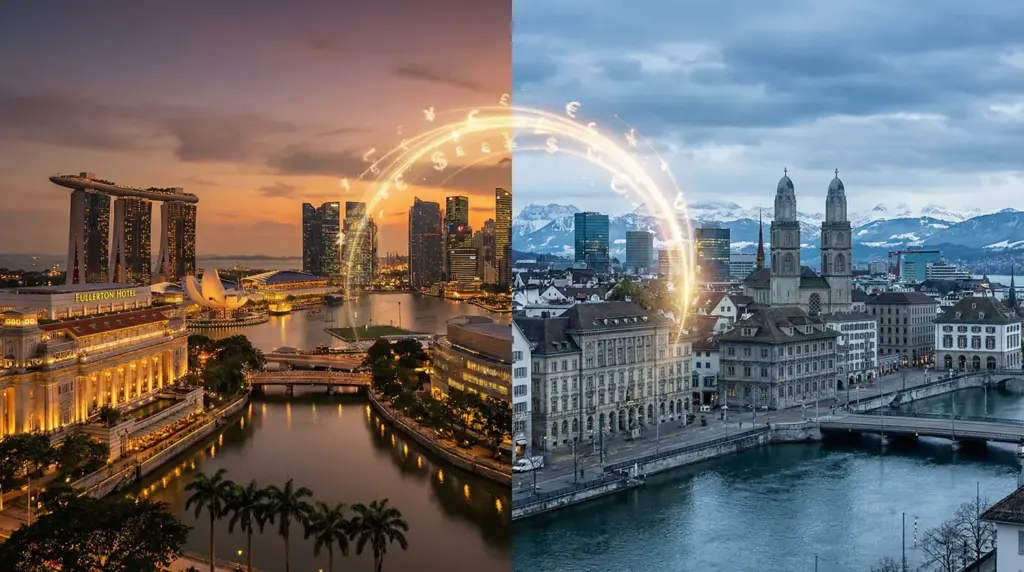
Herein lies the most profound difference between the two countries. Politically speaking, Switzerland is the antithesis of an authoritarian state: direct democracy, strong cantons, a consensus system that integrates all major parties into government, and a deep historical distrust of centralized power. The Swiss state intervenes little in the lives of its citizens.
Singapore, on the other hand, has been governed by a single party since its founding: the People’s Action Party (PAP), which has held power continuously since 1959. In the 2020 parliamentary elections, the PAP secured 83 out of 93 seats and garnered 61 percent of the vote – down from 70 percent five years earlier. This means the PAP has won all 13 parliamentary elections in the history of independent Singapore. After the communist ruling parties in China and North Korea, it is among the parties with the longest continuous reign in the world.
Political scientists describe this system as a managed democracy or soft authoritarianism. Elections do take place, but are generally considered unfair: the prime minister can determine the election date, influence the boundaries of electoral districts, and the opposition has drastically fewer resources. The principle of legitimacy underlying this system is not democratic participation, but rather the exchange of political influence for good policies: whoever delivers retains the mandate – even without genuine competition. The PAP advocates for a meritocracy and rejects both liberal democracy in the Western sense and socialism, but supports maximum economic freedom, East Asian values, and law and order.
Press freedom suffers considerably under this system. Reporters Without Borders ranks Singapore 151st out of 180 in its global Press Freedom Index. Critical reporting is virtually nonexistent; the media are either state-controlled or owned by government-affiliated holding companies. The 2019 law on protection against online misrepresentation and manipulation—euphemistically called the Fake News Law—allows the government to have articles removed from the internet, force platforms like Facebook, Google, and Twitter to publish correction notices, and, in extreme cases, impose fines exceeding €450,000 and up to ten years in prison. Critics see this as a tool for suppressing political opposition that goes far beyond combating genuine disinformation.
Forced austerity instead of a social safety net – Singapore’s social system
Another fundamental difference lies in the social system. Switzerland has a well-developed European welfare state model with unemployment insurance, old-age and survivors’ insurance (AHV), strong health insurance coverage, and a robust social safety net for those who fail. Singapore relies on a completely different paradigm: the model of enforced austerity combined with individual responsibility.
The centerpiece of this model is the Central Provident Fund (CPF), a government-mandated savings contribution introduced on July 1, 1955, which requires both employers and employees to pay monthly contributions. The CPF covers retirement savings, healthcare, homeownership, family protection, and wealth accumulation. It is a completely individually funded system without intergenerational support: everyone saves for themselves; the government only subsidizes the less fortunate through targeted grants such as the workfare program for low-income earners or the Silver Support Scheme for poorer seniors.
Particularly noteworthy is the state-run Housing and Development Board (HDB) program, established in 1960 to eliminate slums and create affordable housing for all Singaporeans. Today, around 79 to 80 percent of Singaporeans live in state-funded housing. HDB apartments are condominiums that can be financed through the Capital Purchase Fund (CPF), are subsidized by the government, and are exclusively available to Singaporean citizens. The result is paradoxical: in one of the world’s most expensive cities, around 90 percent of the population owns their own home – one of the highest homeownership rates globally. In 2008, the United Nations recognized Singapore as the only slum-free city in the world.
This system works for those who work and earn a living. However, it offers far less of a social safety net for those who fall out of the workforce due to illness, structural changes, or personal misfortune. Those who fail in Singapore face significantly greater difficulties than in Switzerland, because the safety net is more tightly woven and provides less of a cushion.
Multilingualism and multiculturalism – peaceful diversity as a state project
Both Switzerland and Singapore have turned the necessity of diversity into a virtue. Switzerland unites four language communities (German, French, Italian, and Romansh) under the umbrella of a consensual political system. Singapore has four official languages (English, Mandarin, Malay, and Tamil) and unites three main ethnic groups—Chinese (around 75 percent), Malays (around 13 percent), and Indians (around 9 percent)—within a city area of only about 733 square kilometers.
In Singapore, this diversity is not an organic, historical growth process as in Switzerland, but a deliberate state project that is actively managed. The HDB housing program, for example, stipulates ethnic quotas in housing complexes to prevent segregation and enforce integration. National identity is actively constructed and promoted through educational programs, shared holidays, and the concept of multiracialism. The bourgeois philosophy of Confucianism, which prioritizes order, education, and community over individual rights, shapes the political thinking of the ruling class.
The question of whether multicultural coexistence in Singapore is truly organic or state-imposed remains a central point of discussion in political analysis. What is clear is that Singapore has managed, over several decades, to largely control ethnic tensions—which in the past had led to bloody unrest—and to create a functioning multi-ethnic society. This is a remarkable achievement, regardless of the means employed.
Law, punishment, and state power – where the similarities end
Perhaps the most significant difference between Singapore and Switzerland lies in the areas of justice and state repression. Switzerland follows a liberal European legal system with a strong focus on human rights, proportionality, and rehabilitation. Singapore relies on a model that takes deterrence radically seriously.
The death penalty remains in effect in Singapore and is actively carried out, primarily for drug offenses. In November 2024 alone, four people were executed in Singapore for drug crimes in a single month. The legislation provides for the death penalty not only for heroin trafficking but also for possession of more than 500 grams of cannabis. This practice is in clear violation of international law, which permits the death penalty only for the most serious crimes—generally premeditated homicide. Amnesty International regularly criticizes Singapore for applying the death penalty to offenses that are not internationally recognized as capital crimes.
Besides the death penalty, Singapore is known for its caning, which can be imposed for a wide range of offenses – from vandalism and serious burglary to drug possession. Strict fines for everyday infractions such as littering (the sale of chewing gum has been banned since 1992), smoking in public areas, or crossing the street in unauthorized locations are further hallmarks of a state that insists uncompromisingly on order and discipline in public spaces. Critics describe these measures as paternalistic and authoritarian; supporters see them as the price of having one of the cleanest and safest cities in the world.
The neutral stage between world powers – Singapore’s geopolitical role
In their international positioning, Singapore and Switzerland are once again remarkably similar. Both countries strive to maintain geopolitical neutrality and present themselves as credible mediators and neutral platforms. Switzerland has been renowned for its neutrality for centuries and hosts numerous international organizations, negotiating bodies, and diplomatic institutions in Geneva and Bern.
Singapore plays a similar role in Southeast Asia. The most prominent example was the historic summit between US President Donald Trump and North Korean leader Kim Jong-un on June 12, 2018, at the Capella Hotel on Sentosa Island. It was the first meeting between a US president and a North Korean leader since North Korea’s founding in 1948. Singapore’s selection as the venue was no coincidence: it is the only place in the region that both superpowers trust simultaneously.
This balancing act between Washington and Beijing is one of the most delicate tasks facing Singapore’s new generation of leaders. Prime Minister Lawrence Wong, who succeeded Lee Hsien Loong in 2024, faces the challenge of maintaining strong economic ties with both the US and China. Singapore has free trade agreements with both China (CSFTA) and the US (USSFTA) and acts as a neutral partner with good relations on both sides. The Germany-Singapore meeting in February 2024 underscored how much the city-state is perceived by its European partners as a reliable bridge-builder in the Indo-Pacific.
This neutral stance is not a given in a region marked by increasing tensions between the US and China. In the South China Sea – through which roughly 20 percent of global trade is conducted – the interests of the two superpowers directly collide. For Singapore, this means that neutrality is not merely a diplomatic virtue, but an economic necessity for survival. A Singapore that chooses sides risks losing its function as a global hub.
Tax and business location – a competition on equal terms
Both Singapore and Switzerland are among the most attractive business locations in the world. Their tax policies both pursue a model of low corporate taxes combined with political stability and efficient administration.
In Switzerland, the average ordinary corporate income tax rate has been around 14.4 percent since 2024. Leading Swiss cantons such as Zug and Nidwalden offer significantly lower effective tax burdens. In the BAK Taxation Index, leading Swiss cantons sometimes even perform better than Ireland, Singapore, and Hong Kong. Singapore, in turn, combines its competitive corporate tax rate with enormous networking power: Companies based in Singapore, as a gateway to ASEAN, China, India, and the entire Indo-Pacific region, have direct market access to more than four billion people.
German direct investment in Singapore has now reached over US$26 billion, underscoring Singapore’s importance as a German business hub in Asia. Numerous multinational corporations use Singapore as a regional headquarters for their Asian activities – not despite, but because of the combination of tax advantages, legal certainty, language proficiency (English as the primary business language), and geographical location.
Two models, one ambition – what remains of the comparison?
The comparison between Singapore and Switzerland is as tempting as it is in need of nuance. It holds true on an economic level: as safe havens for capital and businesses, in terms of security, cleanliness, anti-corruption, and prosperity, the parallels are undeniable and profound. Both countries have demonstrated that a lack of natural resources is not inevitable, but rather a challenge that can be transformed into a strength with the right institutional responses.
But as soon as one shifts from the economic level to the political and social level, the comparison collapses. Switzerland is a democracy in the sense that Western political philosophy understands by the term: with genuine competition, separation of powers, protection of fundamental rights, freedom of the press, and civil society oversight. Singapore is something else entirely: a meritocratic, paternalistic state that delivers prosperity and order and expects acceptance in return—but no active democratic participation. The PAP has won all 13 parliamentary elections since independence, not because of electoral fraud, but because it delivers—and because genuine political competition is structurally hampered.
Singapore, to put it bluntly, is an experiment proving that prosperity and authoritarianism are not mutually exclusive. On the contrary, Singapore’s success could be misused to argue that democracy is unnecessary or even detrimental to economic growth. This is a message that must be treated with great caution in a time of global democratic decline.
At the same time, it would be dishonest not to acknowledge what Singapore has truly achieved: transforming an impoverished, ethnically fractious colonial relic into one of the wealthiest, cleanest, safest, and most functional societies on earth in less than a generation – that is one of the most astonishing success stories in modern economic history. And for many people worldwide living in poverty, instability, or corruption, Singapore is not a nightmare, but a role model – even if it is one with deep shadows.
The comparison with Switzerland therefore remains useful as long as it doesn’t obscure the fundamental character of both countries: Switzerland has created prosperity through the principle of citizen sovereignty. Singapore has created prosperity through the principle of state excellence. Both work – but they are two very different conceptions of what constitutes a good state.