
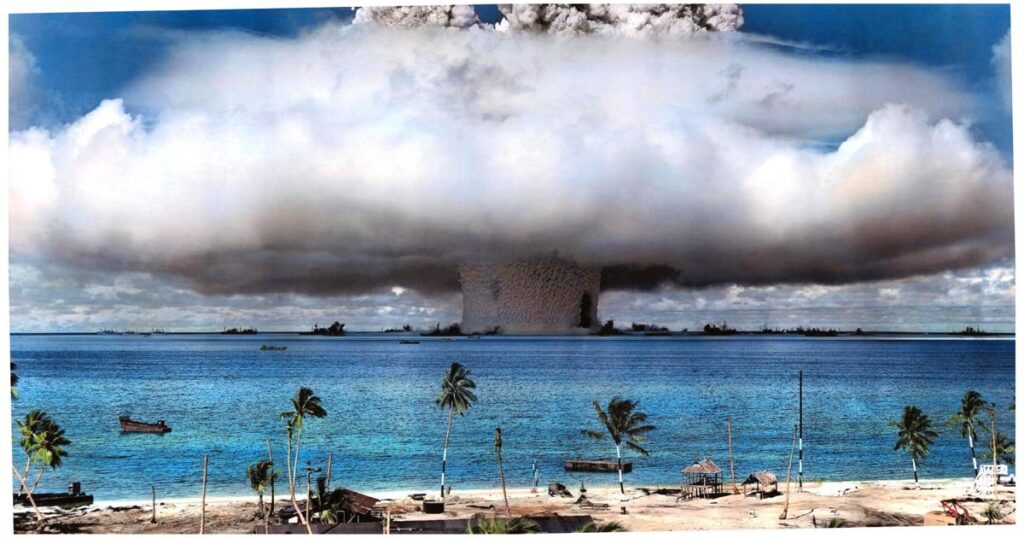
The threat of a global nuclear war is growing, and Micronesia and especially Guam are in the crosshairs more than ever, according to one nuclear strategy analyst.
Nuclear weapons are back at the center of global competition between the U.S., Russia, and China, in a way unseen since the Cold War ended in 1991, wrote Ankit Panda, senior fellow with the Nuclear Policy Program at the Carnegie Endowment for International Peace.
This time, it’s the Western Pacific, not the North Atlantic, that lies at the “center of gravity” in global nuclear competition, according to Panda.
His analysis appeared in the 2025 Micronesia Security Outlook, released by Guam-based think tank Pacific Center for Island Security last month.
Micronesia and much of the world remain generally unaware of the increasing nuclear risks, Panda wrote.
Strategists in the U.S., China, and Russia are seeing nuclear weapons planning as more relevant than ever in global competition, as the world enters what has been called a “new nuclear age,” he wrote.
The situation is driven by a growing arms race and shrinking incentives for superpowers to refrain from using nukes in a crisis, according to Panda.
Relations between Washington and Moscow are at their lowest point since 1990, due to the Ukraine war, he wrote.
Meanwhile, the over decade-long competition between Washington and Beijing took a turn in 2021, Panda wrote, when it was revealed China was rapidly growing its nuclear arsenal.
U.S. intelligence assessments have China growing its stockpile of nuclear warheads from the low-200s in 2019 to as high as 1,500 by the mid-2030s, according to the analyst.
In Washington, military planners are increasingly concerned about nuclear missile attacks in the case of a U.S.-China conflict over Taiwan.
Post-1990 international norms like refraining from nuclear weapons testing and nuclear threat-making now “bow under stress,” Panda wrote.
Moscow may grow more reliant on its “substantial arsenal” of nuclear forces after major setbacks to “conventional” non-nuclear forces in the over three-year-long Ukraine war, he added.
“Meanwhile, the United States, concerned about deterring two nuclear near-peers in a more dangerous world may be more likely to reach into its own nuclear quiver, as its ability to maintain conventional dominance simultaneously in the Indo-Pacific and the Euro-Atlantic diminishes,” Panda wrote.
On the arms-racing front, both the U.S. and Russia find themselves “unencumbered” by limits on their nuclear forces following the expiration of the 2011 Strategic Arms Reduction Treaty in February 2026, Panda stated.
Russia and China may further advance their nuclear forces to overcome better U.S. defenses, he wrote, namely President Donald Trumps’ plans for anti-missile systems across the states, the so-called “Golden Dome.”
The planned 360-degree anti-missile system for the island, dubbed the Guam Defense System, has been called a miniature Golden Dome by U.S. defense officials.
Panda wrote that Russia and China have already taken steps to advance their nuclear attack systems, developing hypersonic weapons and underwater autonomous nuclear torpedoes.
“Arms-racing between the three powers is likely to accelerate,” he stated.
‘Limited’ nuclear strikes, Guam
U.S. planners are increasingly concerned about “limited” nuclear use by China in a war, though Beijing has yet to break off from its “no first use” policy on nukes, according to Panda.
Increasing non-nuclear strength in China’s Peoples Liberation Army could increase the odds of major losses for U.S. forces in a war or crisis, he wrote.
“As a result, these setbacks could prompt an American president to be presented with potential limited nuclear options in turn, putting the onus for nuclear escalation—or potentially capitulation—on Washington,” Panda stated.
Guam and to a lesser extent the Commonwealth of the Northern Mariana Islands are both key in various U.S.-China conflict scenarios, the analyst wrote.
According to Panda, the presence of U.S. Air Force, Marine Corps, and Navy facilities on Guam concentrate military targets unlike any other area in Europe during the Cold War.
“Guam’s value and vulnerability all but assure that a U.S.-China war will spread to Micronesia, should it occur,” he wrote.
Lack of Micronesia input
Despite Guam and Micronesia’s place at the center of a potential nuclear conflict, awareness of the growing risk is limited, according to Panda.
That situation is not unique to the islands, he wrote.
It is incumbent on Micronesian governments and civil society groups to raise awareness about the “increasingly challenging nuclear environment in the Pacific,” Panda wrote.
Nuclear history in the Pacific, to include weapons testing in the Republic of the Marshall Islands, and the launch from Tinian of the plane that delivered a nuclear bomb to Hiroshima, Japan during World War II could help anchor interest in the modern nuclear risk, according to the analyst.
Micronesian perspectives must be asserted into strategic debates happening in Washington, Beijing, Moscow, and elsewhere, like U.S. allies in Japan, the Philippines, and Australia.
“Micronesian governments and civil society groups should seek to find ways to better engage officials and nongovernmental opinion-leaders and strategists in the United States, China, and even Russia to seed awareness of regional perspectives and voices,” Panda wrote.
Other avenues to engage the globe on the nuclear threat to Micronesia include the United Nations General Assembly’s First Committee on Disarmament and International Security, according to Panda.
Entry into the Conference on Disarmament in Geneva, Switzerland, is another route.
“The growing risk of conventional war—the most likely antecedent to a possible nuclear war—cannot be wished away, unfortunately,” Panda wrote.
But he stated that Micronesia can still engage in global forums and elites in Washington, Beijing, and Moscow, where debates on the nuclear issue are “far from reaching their conclusion.”