
Slovenia is heading into what is expected to be a difficult and potentially lengthy government formation process after Prime Minister Robert Golob’s Freedom Movement secured a razor-thin parliamentary election victory, leaving the 90-seat National Assembly deeply fragmented and no obvious governing majority in sight.
According to the current results as of 30 March, Golob’s ruling Freedom Movement (GS) has won around 28.6% of the vote and 29 seats, narrowly ahead of Janez Janša’s Slovenian Democratic Party (SDS), which is on roughly 28% and 28 seats. The gap between the two leading parties amounts to only a few thousand votes, keeping the political landscape in an effective photo-finish phase. Janša is recognized for his Eurosceptic outlook and populist rhetoric.
The remaining seats are distributed among smaller parties, with the NSi/SLS coalition taking 9 seats, the Social Democrats 6, the Democrats 6, The Left 5 and Resni.ca 5, alongside the parliament’s two constitutionally reserved minority seats.
The result leaves both political camps well short of the 46 MPs required for a parliamentary majority, making coalition negotiations unavoidable and placing smaller parties firmly in the role of kingmakers.
In purely mathematical terms, Golob’s 29-seat bloc still needs at least 17 additional MPs to secure a governing majority, while Janša’s SDS, with 28 seats, faces an equally difficult path that would also require support from multiple smaller parties and potentially the backing of forces outside its immediate political orbit.
That arithmetic helps explain why Golob has increasingly framed the challenge less as a simple numbers game and more as a test of political trust.
After consultations with President Nataša Pirc Musar, Golob openly acknowledged that he does not expect quick solutions, arguing that the country’s looming crisis requires broader cooperation among parties.
“For me, more important than the mathematics of how to reach 46 votes is the cooperation of all parties within a coalition of national unity in preparing crisis measures,” Golob said.
His remarks suggest that the government formation process may move beyond classic coalition bargaining toward a wider arrangement, potentially involving either a formal centrist or centre-left coalition or a looser crisis-driven parliamentary alignment.
The difficulty lies in translating that appeal for unity into stable majority support in a chamber where neither major party, nor their natural allies, currently reach the governing threshold.
Slovenia faces a defining election: Janša’s eurosceptic revival vs. Golob’s reform gamble
A count still in motion
The uncertainty is compounded by the fact that the final allocation of seats may still shift.
Because the race remains so close, the remaining ballots – particularly postal votes from Slovenian citizens abroad, could still influence the final seat distribution. Domestic mail-in ballots were largely counted in the days immediately after the 22 March vote, but ballots arriving from abroad are being counted on 30 March, with the official final result expected in early April.
Even a marginal swing in diaspora voting could alter the balance by one seat, potentially affecting coalition leverage and strengthening one side’s negotiating hand.
This helps explain why Janša and SDS have made clear that they are waiting for the completion of the overseas count before deciding on their full coalition strategy or formally accepting the final outcome.
The opposition party has also raised allegations of irregularities linked to voting abroad, ballot distribution and early voting procedures, and has indicated that it intends to challenge certain aspects of the process through legal channels.
Institutional deadlines raise the pressure
President Pirc Musar has now placed the coalition process under clear constitutional deadlines, confirming that the inaugural session of the newly elected parliament will take place on 10 April.
That sitting is expected to provide the first major political test of any emerging majority through the vote for speaker, which Golob himself has described as an early indicator of whether a workable governing coalition can take shape.
Under the constitution, the president must nominate a prime minister-designate within 30 days of parliament’s constitutive sitting, meaning the deadline falls in early May.
She has already made clear that the mandate will go to the candidate capable of demonstrating the support of at least 46 MPs, while warning that the current balance between the two blocs suggests that several rounds of consultations may be required before a viable majority emerges.
The process now hinges on smaller parties whose combined seats can make or break either bloc.
Janša, for his part, has already signalled that SDS will not support what he described as a weak or unstable government.
“We will not compromise on weak governments. We can wait; the question is whether the country can afford it,” he said after election day.
Regional analyst Zijad Bećirović, director of the International Institute for Middle Eastern and Balkan Studies, also expects the government formation process to be difficult, but ultimately successful.
In comments to N1 Bosnia and Herzegovina, he said Golob had not only defeated Janša in the parliamentary election, but had also prevailed against a range of external and political interests that allegedly favoured a different outcome.
Bećirović argued that despite the close result, the elections are unlikely to be repeated and that Golob retains enough negotiating space to build a governing majority.
In his assessment, the Freedom Movement leader has sufficient room to strike agreements with certain parties that could command broader acceptance than any arrangement centred on Janša.
The analyst explicitly ruled out the need for dramatic parliamentary defections similar to the 1996 case in which a single MP, Ciril Pucko, crossed the floor to give Janez Drnovšek the majority needed to form a government.
Instead, he said Golob’s negotiating potential should allow him to secure support through agreements acceptable to multiple parties.
Bećirović nevertheless drew a historical parallel with Drnovšek, noting that Golob is the first Slovenian prime minister since him to win parliamentary elections again after a first term.
Slovenia’s rightward turn? Trumpist-Orbán-inspired Janša poised for comeback
Sources: Siol.net, BGNES, Euronews.com
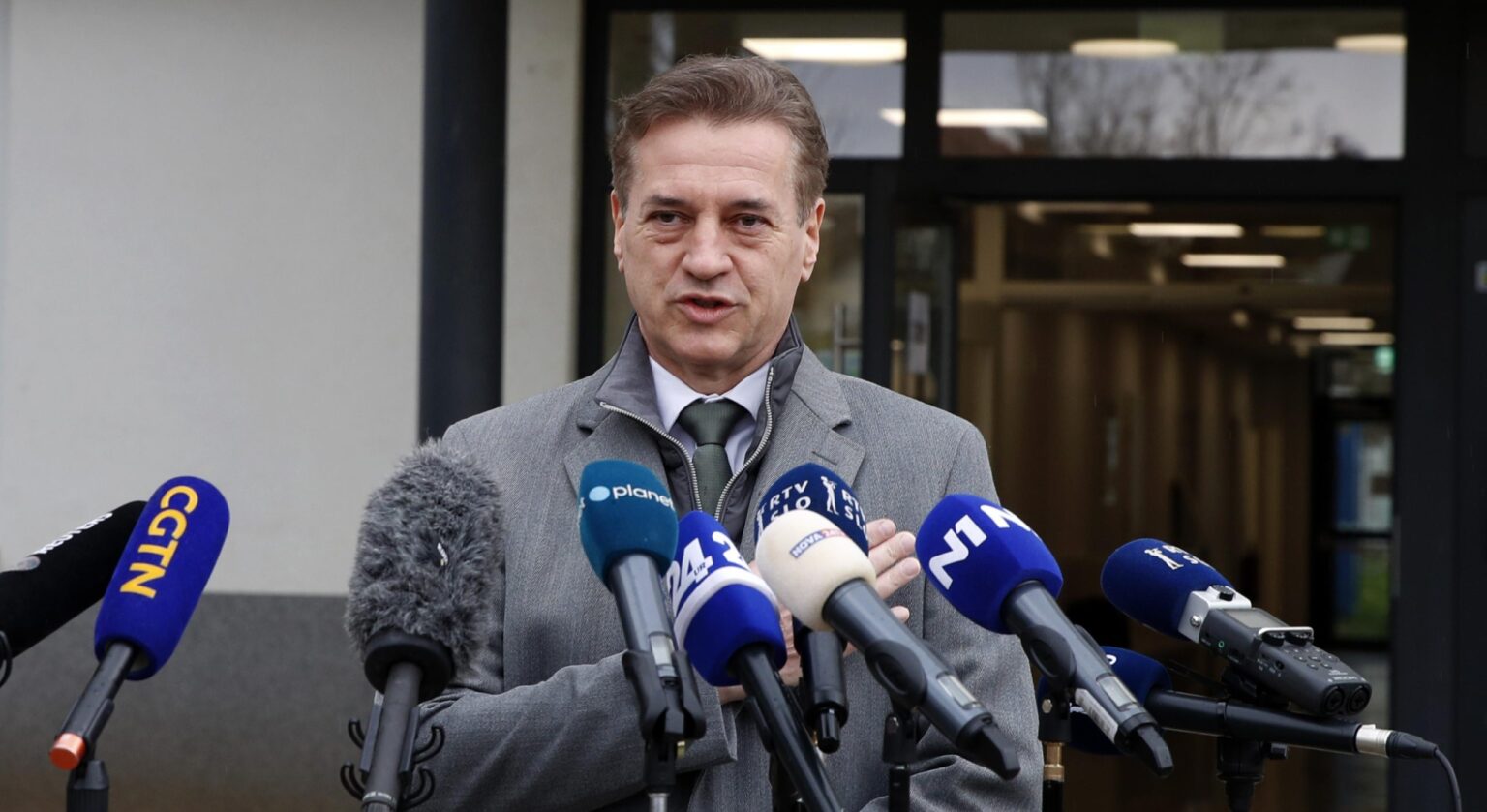
Caption: Slovenian incumbent Prime Minister and leader of the ‘Gibanje Svoboda’ party, Robert Golob, gives a statement to the media after voting during the parliamentary election at a polling station in Ljubljana, Slovenia, 22 March 2026. The 22 March 2026 parliamentary election follows reports of an alleged covert operation by the Israeli intelligence firm Black Cube to influence the vote. EPA/ANTONIO BAT
Updated: March 31, 2026 – 05:05