
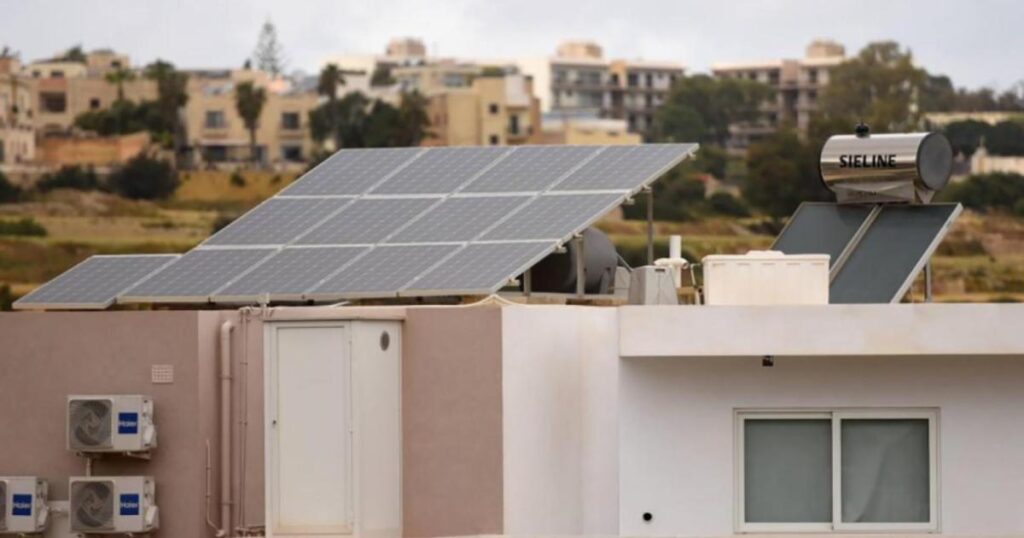
Families living in apartments or urban areas without roof access will soon be able to invest in renewable energy by purchasing solar panels to be installed on state-owned buildings, Times of Malta can confirm.
Sources close to the government said the upcoming scheme, which will be launched in the coming weeks, will allow around 400 households to buy solar infrastructure that is then installed on state properties, with the generated energy being deducted from their utility bills through a feed-in tariff.
Prime Minister Robert Abela hinted at the launch of the scheme during his address at the Freedom Day rally in Vittoriosa on March 30.
“It’s now time to give everyone the chance to generate their own renewable, clean energy, even if they don’t have access to roofs where they can install solar panels,” he said.
“The goal is to have a quarter of all the country’s energy generated through renewable sources from the sun and wind by 2030.”
He gave no further details about the scheme but government sources said the initiative targets residents in densely populated areas who have been locked out of renewable energy investments due to a lack of private roof space.
Under the plan, the State will manage the installation and maintenance of the panels on public roofs, while the families will provide the capital investment.
The feed-in tariff then acts like a virtual credit system for their electricity bill. The energy produced by their panels on the government building is fed directly into the national grid.
The units of power are then measured and converted into a monetary value based on an agreed rate. This total amount is then automatically deducted from their ARMS bill.
But the scheme will be limited to just a few hundred families, at least for now – a small fraction of the growing population living in multi-storey developments.
‘Clean energy production increased ten-fold’
During his speech on March 30, Abela claimed that since 2013, renewable energy production in Malta has increased “ten-fold”, rising from less than 3% when the PN was still in power to 17% in 2024.
Whereas the PN government invested in oil “that was not the clean kind”, this government helps families and businesses to generate renewable energy that pollutes less, he said.
This is misleading, however, because the PN government had been rolling out schemes for families to install solar panels on their homes from as early as 2009.
On March 30, Abela pledged to have a quarter of the country’s energy generated through solar and wind technologies within the next four years.
He said the move comes alongside existing “generous” battery schemes for homeowners and other schemes for businesses.