
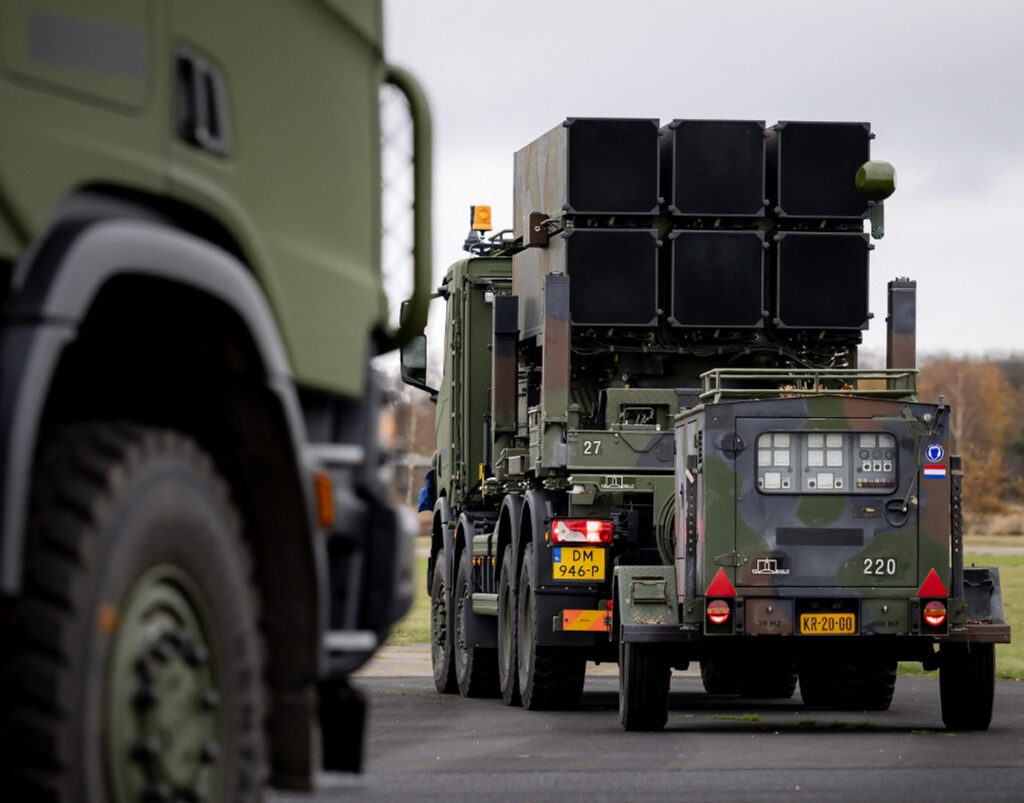
On March 31, 2026, Poland’s Defense Minister Władysław Kosiniak-Kamysz posted on X: “Our Patriot batteries and their armaments serve to protect Polish skies and NATO’s eastern flank. Nothing is changing in this regard and we are not planning to relocate them anywhere.”
His deputy Cezary Tomczyk followed within hours: “Polish Patriots stay in Poland. They have their task in the country.” Two ministers with the same message on the same morning underlined how rattled Warsaw was.
Follow our coverage of the war on the @Kyivpost_official.
The daily Rzeczpospolita had just reported that Washington had informally sounded out Poland about sending one of its two Patriot batteries, along with its PAC-3 MSE interceptors, to the Middle East.
Poland had only achieved full operational readiness on both batteries a few months earlier, as part of its Wisła medium-range air defense program.
Europe thought buying American weapons bought security; it is now discovering that it also buys vulnerability to American choices.
The Poland episode reveals a hierarchy in which the United States reserves the right to put its own wars, its own forces and its own regional priorities first.
Europe may still get the weapons, but later, in smaller numbers, on altered terms or with more political strings than expected.
Always read the small print
The striking thing about the Poland episode is that nothing Washington did required it to break any rules. The power to reprioritize, delay and redirect is not something the US seized in a crisis; it is written into the contracts that European governments sign.
Other Topics of Interest
Zelensky Hints at Potential Patriot Missile Alternatives
The Ukrainian president remains tight-lipped on details but said Kyiv is negotiating with two unnamed countries to source alternatives to the US-made PAC-3 Patriot air defense missiles.
Under the Foreign Military Sales (FMS) program, European governments do not negotiate contracts with Lockheed Martin or Raytheon; they negotiate with the US government, which controls timing, pricing, prioritization, and the future scope of deliveries.
Washington is simultaneously the seller and the logistics manager, and it retains broad discretion over what happens when circumstances change.
Switzerland found this out the hard way. Delivery of its Patriot systems under the Air2030 program has been pushed back by an estimated four to five years relative to earlier expectations, after the US reprioritized shipments to Ukraine and other partners.
At the same time, rising costs in the F‑35A program forced Bern to plan for around 30 jets instead of the originally envisaged 36, with the government citing the need for additional funding of several hundred million Swiss francs to maintain the larger fleet. Bern is now examining complementary or alternative European air‑defense options.
The month that changed the calculations
The Iran war, launched on February 28, 2026, made these risks real. Gulf states and US forces have fired roughly 2,400 interceptor missiles in a single month, consuming almost all of the Gulf countries’ pre‑war stockpile, with the majority consisting of Patriot PAC‑3 and GEM‑T rounds.
In that period, the US and its Gulf allies have burned through several times more interceptors than Ukraine used in three years of defending against Russian missile and drone attacks, underlining the scale of demand.
Lockheed Martin currently produces on the order of 650 PAC‑3 MSE missiles per year, and even ambitious expansion plans will not quickly close the gap between output and wartime consumption.
Against this backdrop, the Washington Post reported on March 26 that the Pentagon had informed Congress it intended to redirect roughly $750 million that NATO countries had paid into the PURL mechanism—Europe’s scheme for buying US weapons for Ukraine – to replenish American stocks instead, with one US official saying it was unclear whether all the European participants fully understood how their money was being used.
Guarantee becomes a negotiation
The same supply‑chain pressure also helps explain recent language from Washington. On March 30, Secretary of State Marco Rubio told Al Jazeera: “If NATO is just about us defending Europe if they’re attacked, but them denying us basing rights when we need them, that’s not a very good arrangement. The president and our country will have to re‑examine all of this after this operation is over.”
The following day, Defense Secretary Pete Hegseth declined to explicitly restate the US commitment to Article 5 collective defense at a Pentagon briefing, saying that decisions about future responses would ultimately rest with the president.
Trump told European allies to “build up some delayed courage” and fight for themselves, while Rubio warned NATO faced a post-war reassessment. Photo by Chip Somodevilla/Getty Images
Trump told European allies to “build up some delayed courage” and fight for themselves, while Rubio warned NATO faced a post-war reassessment. Photo by Chip Somodevilla/Getty Images
On Truth Social, President Donald Trump urged European allies facing fuel shortages due to the Iranian blockade of the Strait of Hormuz to “go to the Strait, and just TAKE IT,” adding that “the U.S.A. won’t be there to help you anymore,” and telling them they would have to secure their own energy.
This rhetoric and the supply‑chain behavior make essentially the same argument: the FMS clauses that allow Washington to redirect deliveries and the social‑media posts telling Europe to fend for itself both reflect the position that American commitments are instruments of American strategy, not unconditional obligations.
Testing the doctrine
This is a lot for Poland to swallow. Since 2022, Warsaw has committed more than $50 billion – $55 billion to US military equipment – around 30% of all European FMS demand—and now spends roughly 4.7% of GDP on defense, the highest share in NATO.
That spending reflects a doctrine with strong backing from Poland’s main opposition party, Law and Justice, and from President Karol Nawrocki: that purchasing American weapons is the most reliable way to bind Washington to Poland’s defense, and that investing in European alternatives risks diluting that relationship.
Buying Patriot was never simply a procurement decision for much of the Polish right; it was an act of political faith.
The US request to borrow one of those batteries for a war that Poland neither endorsed nor was consulted on poses a direct challenge to the doctrine that justified the purchase. The current silence from the Presidential Palace is, for now, the loudest answer available to him.
Building the alternative
Europe cannot simply stop buying American systems. In high‑end ballistic‑missile defense batteries and interceptors—crucial against the kinds of threats Russia has demonstrated in Ukraine—there is no near‑term European substitute at comparable scale and readiness.
Denmark, however, has canceled its Patriot order and signed a multibillion‑dollar contract with a French‑Italian consortium for the SAMP/T‑NG system, but Denmark remains an exception. For Poland, the Baltic states, and Finland, dependence on US capabilities is real and will persist for years.
The longer‑term answer is strategic autonomy: a European defense‑industrial base capable of producing at scale, financed by European capital, governed by common procurement standards, and not subject to US export controls or reprioritization.
What has been missing is the political will to do what this actually requires, including deeper integration of procurement across national industries that jealously guard their contracts, and reforms to capital markets to support long‑cycle defense investment.
None of this is technically out of reach, but all of it is politically painful, and European governments have repeatedly chosen to postpone it.
On March 31, the same day Kosiniak‑Kamysz was posting his defiant statement, Poland quietly signed a contract for a CAMM‑ER missile maintenance and production center at its Military Electronics Works, expanding cooperation with European partners and slowly building domestic capacity.
This is the slow, expensive, unglamorous work of building an alternative –and Russia has not paused to allow the time it requires.
See the original of this analysis by Stuart Dowell, a political writer at TVP World, here.