
When University of Arizona student Kian Sadat handed a flyer to one of his W.A. Franke Honors College classmates last fall, he was actually meeting his future business partner for the first time. Receiving that flyer was Safiya Tarazi, who alongside Sadat now leads Ampira, a technology startup developing a hearing aid intended to provide under-served communities around the world with access to life-changing health care.
Safiya Tarazi and Kian Sadat
Chris Richards/University Communications
The firm combines each student’s individual academic pursuits with a shared interest in health care: Sadat studies electrical and computer engineering in the College of Engineering, while Tarazi studies neuroscience and cognitive science in the College of Science.
The wearable – which is not yet developed – would allow experts to remotely calibrate the technology using hearing‑test data collected by the device, allowing rural populations to connect with experts without potentially travelling hundreds of miles.
“We’re not interested in reusing old hearing aids from the ’80s and ’90s,” Sadat said. “Our goal is to create a new, basic product that incorporates aspects of modern technology like automatic calibration and remote fitting. If you live in places like Phoenix, L.A. or New York and you have hearing issues, you can immediately see an audiologist. That kind of health care system isn’t always available throughout the world, and we want to develop a product for those communities.”
Ampira first debuted in early February when the duo won the campus qualifier for the Hult Prize hosted by the Franke Honors College. The overall contest is supported by international education firm, EF Education First, and challenges college students to solve pressing global issues with viable business ideas that address one of the United Nation’s Sustainable Development Goals. The contest culminates at a global final in September, the winner of which will win $1 million to launch and scale their startup.
Facing off against dozens of other up-and-coming Wildcat entrepreneurs during the competition’s first round, Sadat and Tarazi impressed a panel of university faculty and entrepreneurs to secure a spot in the national competition. Luckily, the duo won’t travel far for the next stage of the Hult Prize, because the U of A is hosting the inaugural western regional finals on April 17 and 18.
The university’s Hult Prize ambitions are driven by The Venture Studio, an entrepreneurial program hosted by the Franke Honors College to provide its students with guidance and support for their potential business ideas. Leading the effort is Scott Hessell, strategic partnership and innovation officer for the college.
Hessell said the Hult Prize perfectly fits with his vision of providing students with the support they need to accomplish the entrepreneurial goals they develop associated with their traditional academic pursuits.
“One of the things I appreciate most about the Hult competition is that students can use the 17 sustainability goals as starting points for their own ideas,” he said. “I have taught entrepreneurship for many years, and almost every student says to me, ‘I just don’t have a good idea, how do I come up with one?’ These goals provide real, tangible problems that need to be solved.”
Preparing for nationals
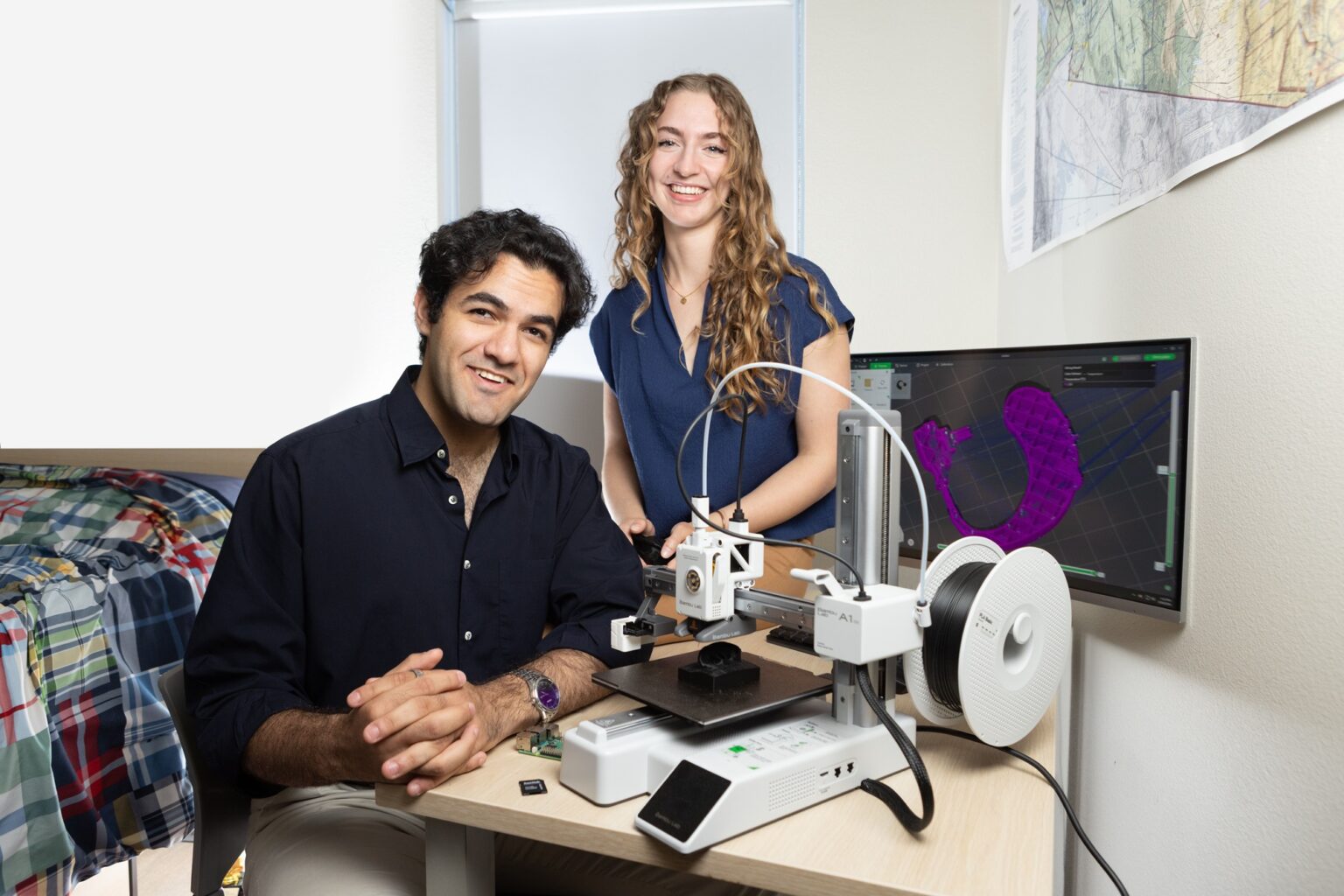
With the campus qualifier behind them and long to-do lists ahead of the upcoming regional competition, the team behind Ampira is focused on what it needs to deliver next: an updated business model and proof of concept. That work falls heavily on Sadat, who spends much of his free time in his dorm room tinkering with his 3D printer, creating plastic ears and rudimentary designs for their device.
Kian Sadat spends much of his free time 3D printing ears and prototypes parts for Ampira’s low-cost hearing aid.
Chris Richards/University Communications
Sadat expects connectivity and calibration to present the greatest challenges to their design process given the low technological standards of the communities in which they plan to work. To overcome those hurdles, he and Tarazi are looking at existing devices and health care programs for guidance. They have also met with speech, language and hearing scientists as well as audiologists to further develop the structure of remote appointments and are interested in ultimately developing a teleaudiology platform to support their device.
The duo is also investigating potential logistics and support networks for their future device, including partnerships with nongovernmental organizations and nonprofit organizations already operating in under-served communities. The ultimate goal is selling the hearing aid in bulk to those organizations, which would supply the devices to people in need, and contract with Ampira to provide ongoing support.
“Ampira is not just about addressing one individual person’s hearing abilities,” Tarazi said. “It’s about providing access to education and participation in the workforce, improvements in mental health and the sense of community that comes from that.”