
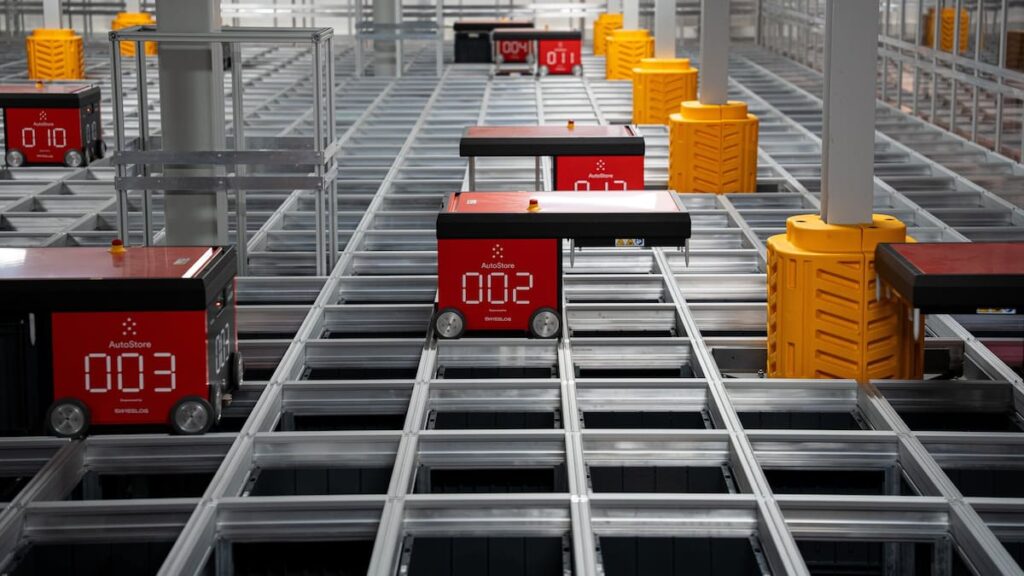
The solution holds between 2500-3000 items from Ikea’s market hall section, which features predominantly small items weighing less than 20kg each including throws, dinnerware and lamps.
Each item is sorted into one of 10,000 bins or “totes”, which are then stacked on top of each other in a three-dimensional grid-like system roughly one storey tall.
A fleet of 12 automated robots then sort through the system on a complex network of rails, picking orders from the stacked totes depending on what items are required for customer orders.
The robot fleet delivers the required totes to racking on the ground floor where an Ikea employee can then grab the necessary items to be boxed and shipped.
Pidgeon said that around 50% of orders will come out of the machine complete and can go direct to the customer’s home, with the other 50% to be merged with other larger flatpacks found on the retailer’s shelving in store.
Although other industries, including pharmaceuticals, have implemented the technology in the past, it’s a first for a retailer in New Zealand.
But it’s also a first for Ikea in the region, as this technology has been installed in New Zealand before its stores in Australia.
Pidgeon explained there was a good reason for implementing the multi-million dollar tech in New Zealand first.
“We knew we were launching New Zealand with e-commerce from day one, so in line with the store we knew this solution and this type of technology was what was going to be required.
“The beauty of it was we had a blank canvas when we were building the store so we could do this from scratch, whereas in Australia we need to look at different solutions to retrofit an existing unit, so it made total sense for us to do it in this way for this market.”
It’s not the first time Ikea as a company has implemented the solution, with sites in Korea, Japan and Croatia using different integrations within their operations.
Pidgeon said the solution was planned with capacity for five years in advance, purposely integrating growth into the system.
Should the business reach that upper limit, the system is modular, allowing more structure and totes to be added to meet the need.
The need to plan for unprecedented demand was required learning for Ikea, which was overwhelmed by demand during the stores’ first few months of opening, with online orders paused and stock levels depleted on several occasions.
Former Ingka Group (Ikea’s parent) chief executive Jesper Brodin acknowledged the overwhelming demand in January, noting that orders from customers were magnitudes higher than the company’s highest expectations.
Pidgeon, who has worked in fulfilment for Ikea for more than 25 years, said the technology had advanced at scale over the past five to six years, but wouldn’t comment on whether it set Ikea apart from its competitors.
He did comment on the company’s monitoring of the conflict in Iran and its affect on the business.
Pidgeon said Ikea holds roughly eight weeks of storage for its products in New Zealand, giving them two months’ worth of stock at any time.
Ikea has a six-week lead time for any stock it imports into the country, the majority from China and Malaysia.
He said the company was still considering the implications for the business, including possible surcharges on containers and higher costs for fuel for freight, but that any potential changes in pricing or stock availability would be considered further down the line.
Tom Raynel is a multimedia business journalist for the Herald, covering small business, retail and tourism.
- Stay ahead with the latest market moves, corporate updates, and economic insights by subscribing to our Business newsletter – your essential weekly round-up of all the business news you need.