
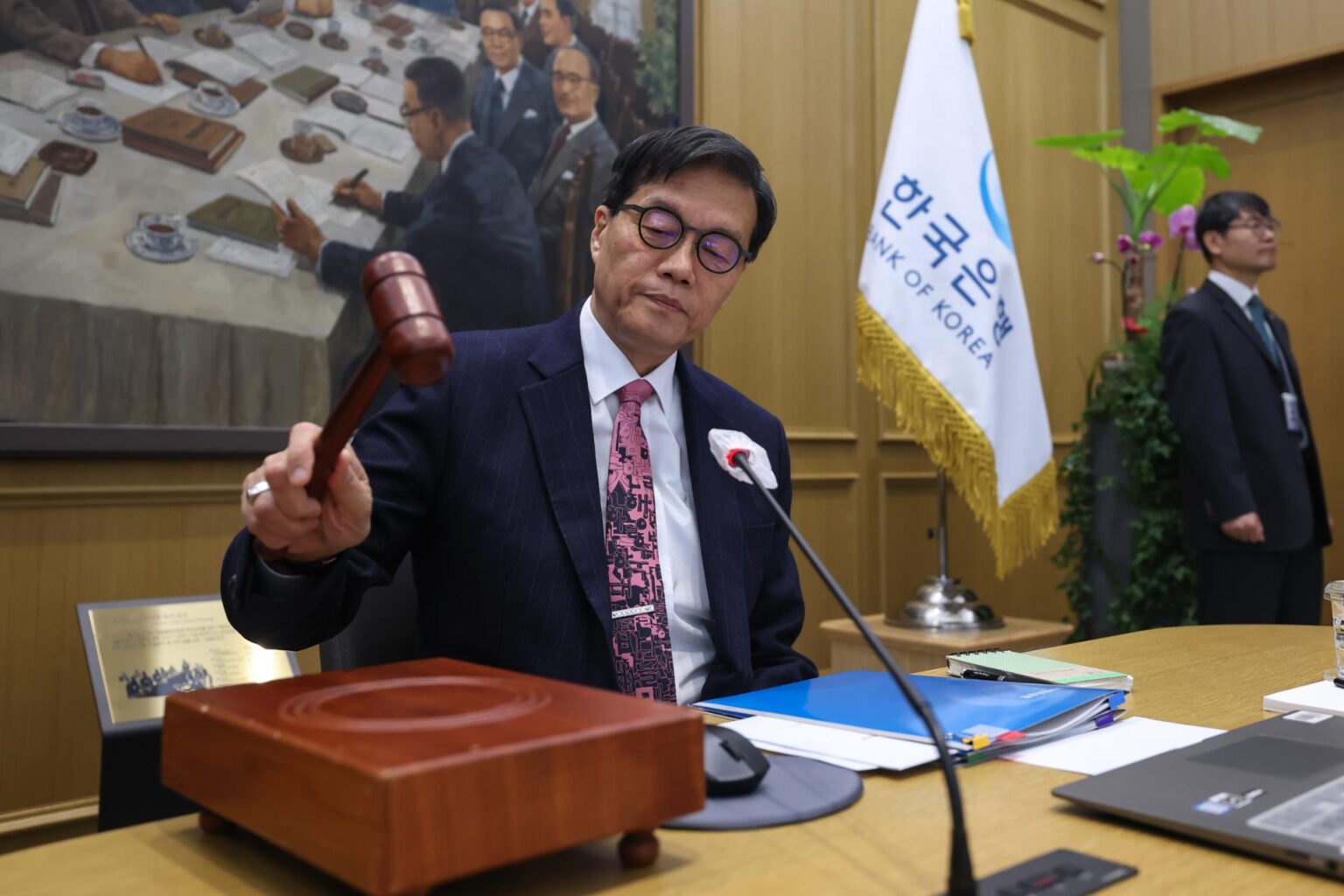
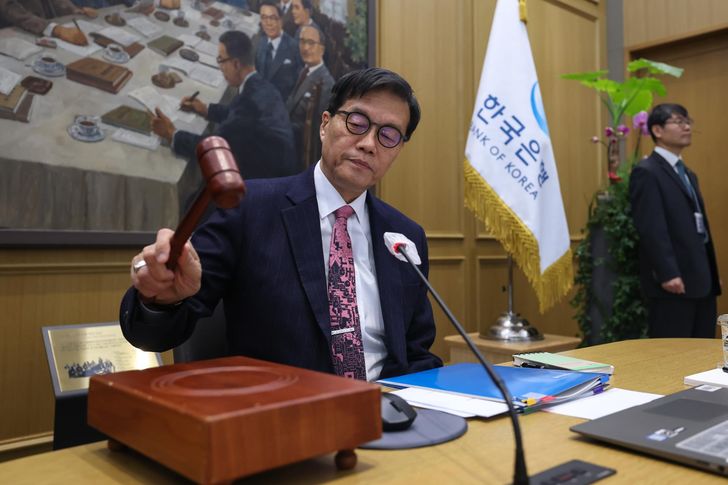
Bank of Korea Gov. Rhee Chang-yong bangs the gavel to open a Monetary Policy Committee meeting at the central bank in Seoul, Feb. 26. Joint Press Corps
The Bank of Korea (BOK) is widely expected to keep its interest rate unchanged at 2.5 percent at Friday’s monetary policy board meeting, market watchers said Tuesday, as rising Middle East tensions add to inflation and foreign exchange risks.
The central bank has held the benchmark interest rate steady for six consecutive meetings, and analysts view the current economic backdrop as leaving little room for a policy shift.
With inflation and foreign exchange volatility rising amid increasingly prolonged conflict in Iran, the BOK faces a policy dilemma. A rate cut could fuel inflationary pressures, while a hike risks deepening the economic slowdown and clashing with the government’s expansionary fiscal policy, including a planned 26.2 trillion won ($17.3 billion) supplementary budget.
Joo Won, a senior researcher at the Hyundai Research Institute, said the six members of the monetary policy board are likely to unanimously hold rates at Friday’s meeting.
“With liquidity expected to be injected through the supplementary budget, a rate cut could further fuel inflationary pressures,” Joo said.
He added that while the possibility of a rate hike later this year remains open depending on inflation trends, it would be difficult for the central bank to move toward a rate change in the near term.
“In particular, if oil supply disruptions and broader raw material shortages continue, inflationary pressures are likely to increase further,” he added.
A Goldman Sachs report issued Monday also said the BOK is expected to hold its rate steady, noting that its focus remains on financial stability, particularly risks related to the overheated housing market and currency weakness.
Volatility in the foreign exchange market has intensified, with the Korean won hovering around the 1,500 level against the U.S. dollar in recent trading sessions, reflecting concerns over prolonged high oil prices and slowing economic growth.
The won-dollar exchange rate has hit the 1,500 won range for the first time since the 2008 global financial crisis.
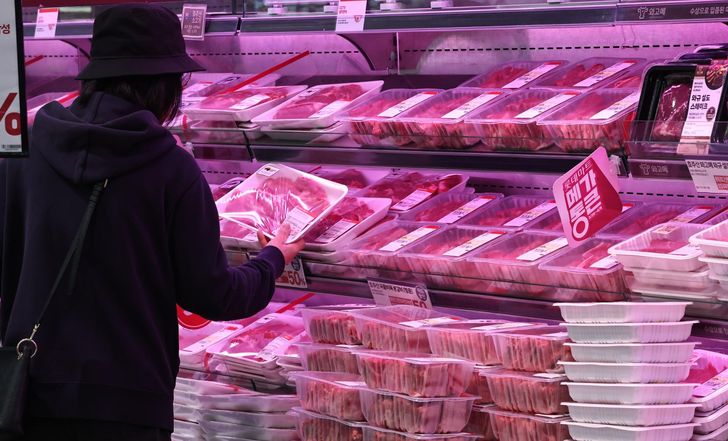
Meat is displayed at a supermarket in Seoul, Thursday. According to the Ministry of Data and Statistics, the consumer price index stood at 118.80 in March, up 2.2 percent from a year earlier. Yonhap
The BOK has recently signaled a cautious stance on monetary policy.
In its monetary policy report released March 12, the central bank said volatility has increased significantly since March, with interest rates and the exchange rate rising sharply and stock prices undergoing a substantial correction.
“Maintaining a cautious and neutral policy stance for the time being would be appropriate,” the report said.
Some analysts expect BOK Gov. Rhee Chang-yong to deliver a relatively hawkish message, even if the rate is left unchanged, as the upcoming monetary policy meeting will be his last before his term ends on April 20.
“While a major shift in policy direction is unlikely, the governor’s remarks may lean hawkish, given rising oil prices and weakening currency,” said Kim Ji-na, an analyst at Eugene Investment & Securities. “Considering the current volatility in the bond market, even broadly framed remarks from the governor could trigger a market reaction.”
Meanwhile, Rhee’s potential successor, Shin Hyun-song, is set to undergo a parliamentary confirmation hearing on April 15.
Market watchers are also closely monitoring signals from the incoming leadership on the future path of interest rates. Though often described as a “pragmatic hawk,” Shin has recently emphasized flexibility in monetary policy.
Speaking to reporters on March 31, Shin said, “What matters more is to accurately assess overall economic conditions and understand how the financial system interacts with the real economy, and then respond flexibly depending on the situation.”