
The discovery contributes to a growing body of research that questions earlier assumptions about the scale and complexity of communities in this area during the late pre-Roman Iron Age.
– Advertisement –
The site, known as Köstrimägi, was hidden in thick vegetation until recently. Although 19th-century archival sources and regional oral traditions refer to a fortified location in the vicinity, its location and extent had not yet been established.
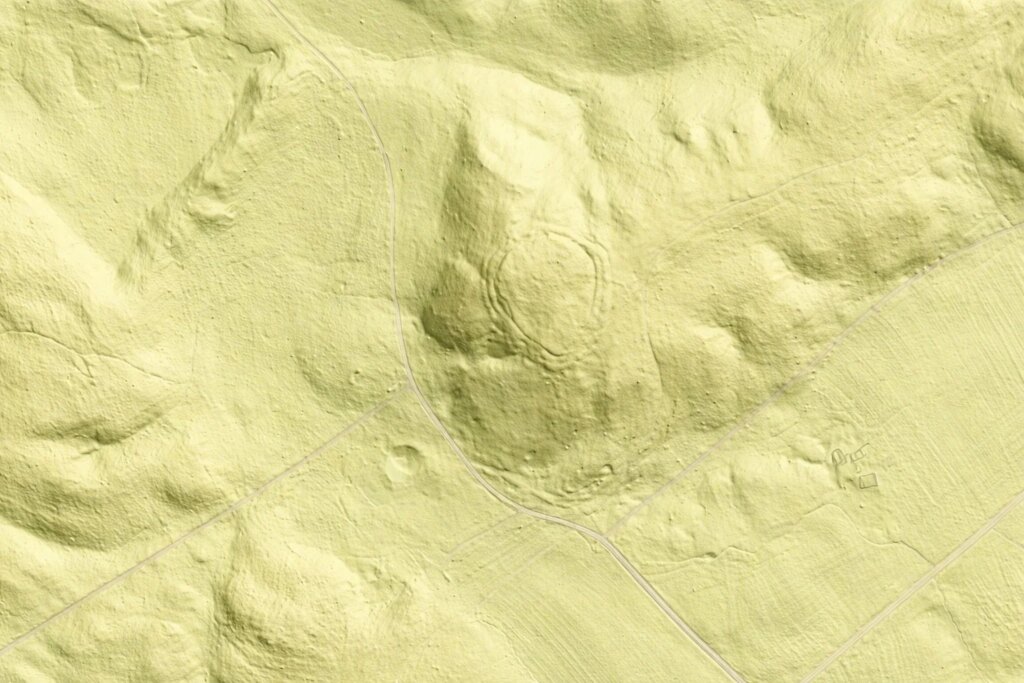
The application of high-resolution digital terrain modelling enabled researchers to detect subtle topographic anomalies, which were confirmed on the ground as a large structure of about 4,800 square metres.
Preliminary excavation has revealed a multi-tiered defensive configuration. The fortification consists of a sequence of low, stepped platforms arranged concentrically, rising from a surrounding ditch.
This arrangement suggests a controlled way of entering and leaving the site, and the defensive system is based on elevation differences rather than the existence of vertical walls. The height variation that survives seems to be modest, but may have been more pronounced before erosion and sedimentation had become an issue.
– Advertisement –
According to Professor Heiki Valk, the structural characteristics of Köstrimägi diverge from typical Estonian fortification forms of the period. Instead, they exhibit closer parallels with sites identified in present-day Latvia, suggesting shared construction practices or broader regional interaction networks.
A chronological assessment based on radiocarbon dating, supported by ceramic typology, places the site’s occupation between 41 BC and AD 9. The archaeological record indicates a relatively brief period of use, with no substantial evidence for long-term habitation or repeated phases of reconstruction. Artefactual assemblages suggest a limited but functionally diverse occupation, potentially encompassing both defensive and domestic activities.
Evidence of burning is present across multiple excavation areas. The distribution of charred material implies a destructive event, although the specific context—whether conflict-related or otherwise—remains unresolved.
In sum, Köstrimägi provides important insights into fortification strategies and settlement organisation in the eastern Baltic during the late Iron Age. The site is currently under protection, and ongoing research aims to refine its chronology, functional interpretation, and broader cultural significance.
Sources : egealternatif
– Advertisement –