
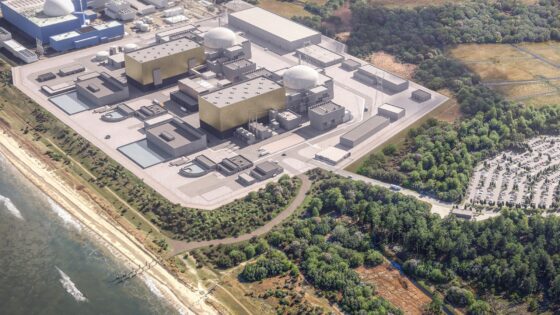
The UK is once again finding its feet as a pioneer in nuclear power and we need to match that with an equally innovative approach to delivery.
Alan Sinclair, director and UK head of energy and natural resources at Turner & Townsend
Energy security is currently at the top of the national agenda due to the conflict in the Middle East. However, a resurgent nuclear industry has deeper roots – and bigger aims – that go beyond energy security and resilience.
The sector’s ambition is to create the scalable power needed to support new industries that underpin the government’s Modern Industrial Strategy. This goes beyond simply fixing today’s demand, but looking at how we feed innovative but power-intensive assets from data centres to gigafactories and arc furnaces.
In doing so, the objective is to drive growth across the UK – creating social value and addressing deprivation.
A look back at the past 12 months alone shows how momentum has been building in nuclear. We’ve seen the establishment of nuclear oversight within Great British Energy – Nuclear (GBE-N), fresh funding for the main reactor programme at Sizewell C (main image above) and the commitment this month of £2.5b to developing fusion technology through the STEP programme.
Amongst these milestones, however, the most significant initiative is in small modular reactors (SMRs). In November 2025, GBE-N announced that Wylfa, on Anglesey in Wales, would be the first reactor site – not simply a one-off project, but the vanguard of a fleet of reactors that can collectively work to unlock growth across the UK.
Designed with speed of delivery and repeatability in mind, SMRs present a unique opportunity to shift how we think about UK energy generation – supporting power-intensive modern industries, while acting as a catalyst for wider social impact, encouraging regional investment and creating value for local communities.
Achieving these aims hinges not simply on the technology, but on the mindset that we adopt as an industry in delivery.
Looking to other markets
The principle of a smaller-scale reactor itself isn’t new – it has long been used on ships and submarines – but the ambition to deploy SMRs as a fleet of their own is.
Success relies on industrialising the process, putting in place delivery models for first of a kind technology in a way that is repeatable and predictable.
There are of course lessons that can be taken from the UK’s existing expertise – and in particular to eliminate the risk of jeopardising the UK’s excellent nuclear safety record. Major schemes like Hinkley Point C and Sizewell C are seeing successful knowledge transfer and can be instructive for SMRs.
However, we then need to match that nuclear expertise up with an industrialised mindset – and for that we should look to other markets where repeatability is already the norm, including advanced industries like data centres and offshore wind.
Serial manufacturing – using modern methods of construction (MMC) to build components in a factory and transport them to site – not only improves safety, but also allows for design for manufacturing (DfMa) and repeatable production, speeding up programme delivery.
This mix of heritage and innovation is also essential for investor confidence. As SMR fleets will operate over decades, delivery models must withstand political cycles and demonstrate commercial viability. Standardised designs and scalability can shift perceptions of SMRs from a ‘new’ technology to trusted assets with predictable performance.
Setting up supply chains for success
Strong relationships and resilient partnerships must underpin such an innovative approach to delivery against an ambitious timetable that will see the first SMRs online by the mid 2030s. Ongoing communication across the value chain and between delivery teams will be important to keeping the programme joined up and on track.
SMR delivery also requires particularly keen attention on the supply chain to keep projects moving. The reliance on off-site construction means it will be even more important to treat manufacturers as true partners, not just suppliers and delivery models should reflect this in how they share accountability and rewards.
In this the government – and the SMR programme specifically – can play a key role to accelerate capability in UK industry. By pinpointing where existing material and manufacturing supply chains are strong, or where nascent sectors have potential, interventions can be targeted in a way that helps build the UK’s domestic capacity and drive wider economic impact.
An engine for skills, social and economic impact
Approaching delivery in this way comes back to the fundamental objectives behind the SMR programme – not only building a fleet of reactors, but doing so in a way that unlocks industrial growth and propels investment. This can ensure the programme drives better economic and social outcomes across the UK.
The immediate benefits must first be felt by those closest to sites, in the form of long term, well paid jobs during the build and operations but also community investment. In this the UK has an existing legacy in examples such as Sellafield Ltd’s Social Value Multiplied programme to ensure that decommissioning at that site supports jobs, charities and local communities across Cumbria.
Development also enables industrial growth close to sites, laying the foundations for clusters of industries that draw on the reactor’s power and establish the area as an economic hub. Equally, it presents the opportunity for strategic supply chain investment in related jobs and expertise.
Together, all this supports overall nuclear skills in the UK as a high value industry that will support future fleets and further innovation. Younger talent is increasingly drawn to clean-energy careers and SMRs provide a long-term route to help them deliver the UK’s next wave of low-carbon power.
As countries worldwide race to scale SMRs, the UK has a head start.
If we get delivery right, we can strengthen our energy mix, drive economic growth and social value and export our expertise globally – securing the UK’s leadership position in a new era for nuclear.
Alan Sinclair, director and UK head of energy and natural resources at Turner & Townsend.
Like what you’ve read? To receive New Civil Engineer’s daily and weekly newsletters click here.