
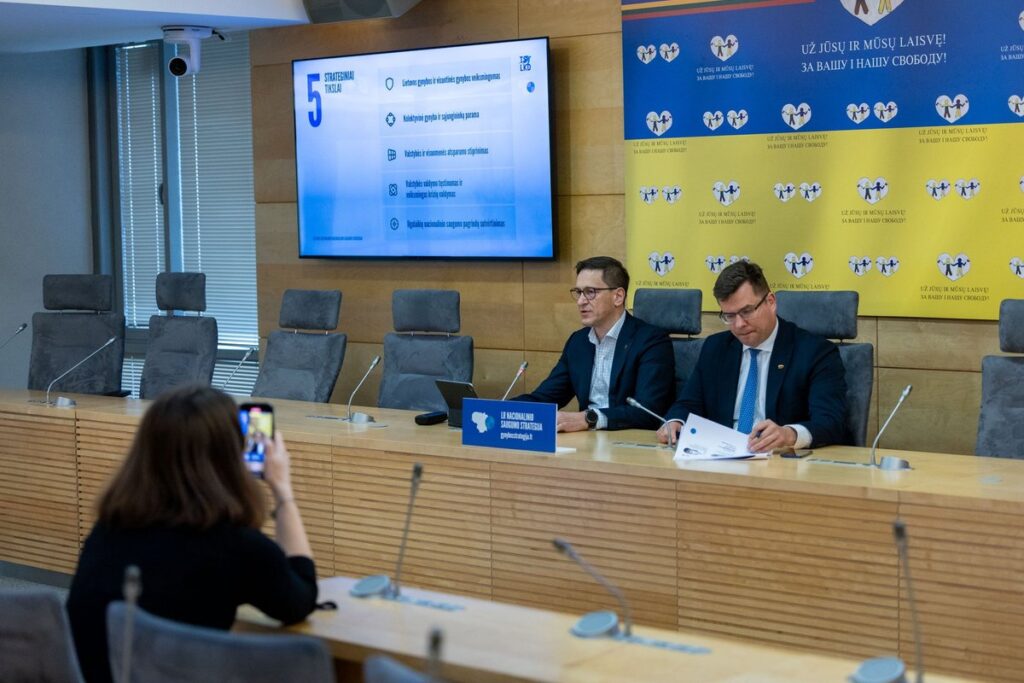
MP Laurynas Kasčiūnas, TS-LKD chairman, says that the strategy presented by the Government is overly bureaucratic and does not reflect the key essence of Lithuania’s defence.
“It is no longer enough to say that we are allocating a record budget for defence. One must explain how the state will function on day X. […] There must be answers how the state will organise its defence and what would be the idea of Lithuania’s defence. The idea which Finland has, which Israel has,” Kasčiūnas said at a press conference on Wednesday.
“In terms of its defence capabilities, Lithuania must become like a thorny hedgehog that would be too uncomfortable and hard to crack even for the much stronger Russian bear,” said the Conservative leader.
The TS-LKD defence strategy identifies five strategic goals:
1) reliable and effective defence based on the principle of total defence;
2) reliable collective defence and allied support;
3) strengthening state and public resilience to pressure in the areas of information, cyber security, infrastructure, healthcare, economy and energy;
4) the continuity of state governance in case of a crisis or war;
5) strengthening the long-term foundations of national security.
The strategy states that Lithuania must be ready to react to all kinds of security threats and describes different types of risks.
According to the TS-LKD, the key aspect is deterrence capabilities to prevent a large-scale crisis or open aggression. This involves the principle of total defence, development of military capabilities, the “national defence line“ and a “drone wall”, and multi-layered air defence.
According to MP Dainius Kreivys, the Armed Forces cannot be the only one responsible for defence as effective deterrence is based on readiness to act in a crisis or armed conflict, which requires cooperation of state and municipal bodies, civil protection, logistics, healthcare system, protection of critical infrastructure, and citizens who know their role in the defence system.
Moreover, the TS-LKD notes that the Armed Forces must be ready and armed according to the realities of modern war. Lithuania must develop its division-sized unit, increase firepower, introduce robotic systems, develop drone capabilities and apply modern technologies at a faster pace.