
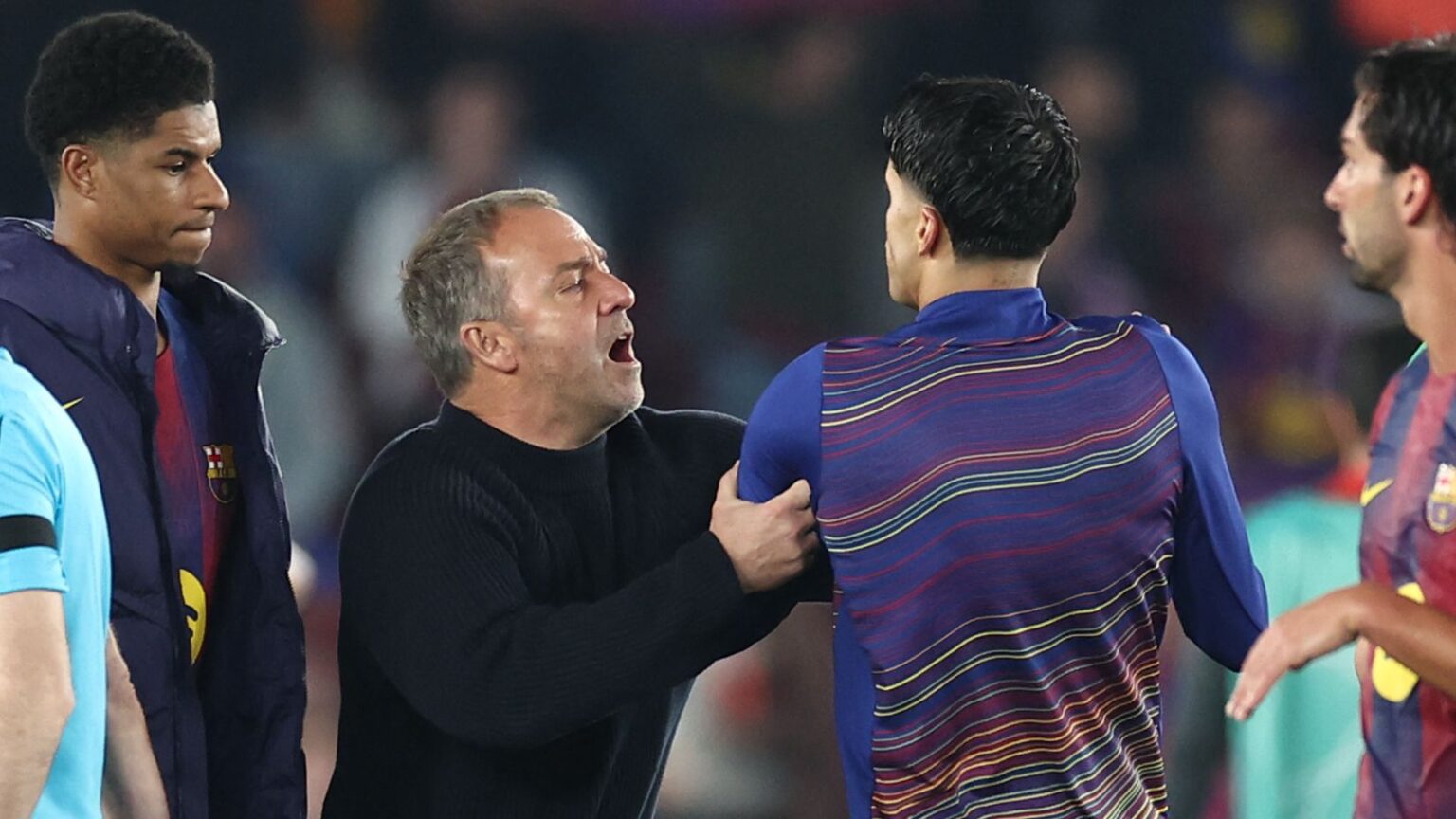
Barcelona manager Hans Flick delivered a measured but firm critique of the officiating after his side’s 2-0 home loss to Atlético Madrid in Wednesday’s Champions League quarter-final first leg at the Spotify Camp Nou. In his post-match remarks, the German coach argued that several key decisions had altered the match’s trajectory.
Regarding the sending-off of his player Pau Cubarsi, Flick said: “I don’t know, it may have been deserved or it may not have been… I’m not sure if there was enough contact, because the ball was behind him.”
Read also
Atlético Madrid player turns into a goalkeeper… Did Barcelona deserve a penalty?
After a heated row, Arbeloa forces Real Madrid star to apologise to his team-mates.
Meanwhile, in a separate development, former U.S. president Donald Trump has renewed his call to bar transgender athletes from participating in international football competitions, a stance that has sparked fresh debate about inclusion and fairness in sport.
Meanwhile, Egypt’s World Cup group opponents Iran have unveiled an alternative contingency plan should the tournament go ahead as scheduled.
The German coach continued in his post-match press conference: “There were several incidents, for example when their player clearly handled the ball inside the penalty area and the referee didn’t blow his whistle… To me it’s very clear; I don’t know why VAR didn’t intervene!”
He then queried the point of VAR: “We all make mistakes, but why does this system even exist? I cannot comprehend it… That was a penalty and a second yellow card for Atlético’s Marc Pobel.”
He added sarcastically: “The VAR was very focused today; that’s just how it is… The referee is German—specifically, video assistant referee Christian Dingert—so thanks to Germany for that! I still don’t understand the other incident: the goalkeeper, Juan Musso, played the ball, the defender clearly stopped it with his hand, and play carried on. For me, that is a very clear red card and another penalty.”
Flick added that such decisions could have “completely changed the game”, yet he acknowledged that officials alone decide how such moments are judged and that his side must ultimately accept the result. His frustration underscores a wider debate about VAR’s role in high-stakes matches: supporters argue the technology protects integrity, while critics claim inconsistent application can swing tournaments. For Iran, the semi-final exit means they will now focus on securing a berth in the next edition of the competition, hoping that future rule interpretations prove more favourable.