
Lawmakers rejected on 7 April 8 a proposal by the pro-Serbian Democratic People’s Party (DNP) to introduce the historical red-blue-white tricolor as an official “people’s flag” alongside the current state flag. Montenegro’s parliament has once again become the stage for deep-seated identity disputes that threaten the country’s stability and its long-term goal of joining the European Union.
The vote ended with 21 deputies in favor, 23 against, and 13 abstentions, highlighting sharp divisions even within the ruling coalition.
The tricolor, with its three horizontal Pan-Slavic stripes, is closely associated with Montenegro’s pre-independence union with Serbia and the Yugoslav era. Proponents, led by DNP head Milan Knežević, present it as a symbol of historical continuity and national heritage. Critics from Montenegrin-oriented parties see it as an emblem of Serbian influence that undermines the distinct state identity established after Montenegro’s 2006 independence referendum. The current official flag, a red banner with a golden border and the national coat of arms, was adopted in 2004 precisely to emphasize that separate identity.
Heated debate exposes coalition cracks
The proposal to amend the Law on State Symbols and Statehood Day failed to gain enough support to even advance to a full debate on the changes. Knežević argued passionately that the tricolor was not a personal invention but a standardised symbol from the 1905 Constitution drafted by legal expert Valtazar Bogišić. He accused the Europe Now Movement (PES), the centrist party of Prime Minister Milojko Spajić, of bad faith, claiming they had been consulted in government but later distanced themselves publicly.
Knežević framed the flag issue as central to his party’s earlier withdrawal of support from Spajić’s government. In a sharp rhetorical flourish, he declared he would choose the 1905 flag over the recent granting of citizenship to Ethereum co-founder Vitalik Buterin, whom he called a “Montenegrin son-in-law,” and labeled the government a “crypto-thief-porn government,” referencing explicit videos involving a former official.
PES deputy Marković pushed back strongly, asking Assembly President Andrija Mandić (a prominent pro-Serbian figure from New Serbian Democracy, considered by diplonats as the most powerful figure in the country) to curb such inflammatory language. Marković, who described himself as Serbian-oriented and a member of the Serbian Orthodox Church, defended the government’s inclusivity and rejected accusations of betrayal. He noted that identity questions like flags, language, and citizenship could be revisited upon EU entry, echoing Spajić’s position. The exchange grew personal, with Knežević referencing 2015 protests and Marković insisting she had never hidden her face during demonstrations.
Opposition DPS deputy Andrija Nikolić described the scene as a “divorce case” within the pro-Serbian bloc of the For the Future of Montenegro coalition. He portrayed it as a conflict between those clinging to power (“armchair people”) and those adhering to principles, urging citizens to take note of the contradictions: some coalition partners calling the government “criminal and thieving” while others remained part of it.
Mandić responded calmly, reminding critics that different paths could lead to the same goals and noting that the tricolor had flown proudly outside his home for 20 years.
A strategy aimed at slowing EU progress
This flag debate is not an isolated symbolic spat. It fits into a recurring pattern of identity-driven initiatives pushed by pro-Serbian parties inside the governing structures. Analysts see these moves as part of a broader effort linked to Belgrade’s “Serbian World” concept, which seeks to preserve cultural, political, and strategic influence over Serb populations in neighboring countries. The apparent goal is to generate enough internal friction to delay or complicate Montenegro’s EU accession, which would turn the Serbia-Montenegro border into an external EU frontier.
Montenegrin journalist Jovo Martinović has described a network involving pro-Serbian parties, segments of the Serbian Orthodox Church, Belgrade-aligned media, and ties to Serbia’s security structures, with Russia offering additional political and informational backing. Tensions have intensified following Montenegro’s receipt of final EU benchmarks in mid-2024 and its progress under the “Barometer 26” reform platform, which aims to wrap up accession talks by 2026.
Previous flashpoints include a controversial resolution on the Jasenovac concentration camp that soured relations with Croatia and blocked a key negotiation chapter. Disputes over language status and national symbols continue to resurface. At the local level, municipalities governed by pro-Serbian parties have promoted Serbian holidays and symbols, further polarizing public space.
Knežević has openly aligned himself with Serbian President Aleksandar Vučić, stating he would rather be Vučić’s friend than a “poodle” of Croatian Prime Minister Andrej Plenković. He has rejected what he terms “Serbophobia and Russophobia” and maintained ties with Russian political structures.
Risks to stability and European future
Prime Minister Spajić’s Europe Now Movement insists that identity issues must not derail core EU-related reforms. The party argues that topics like symbols and language require broad societal consensus rather than short-term parliamentary maneuvering.
Yet the repeated injection of these questions into the political agenda creates a self-reinforcing cycle of instability. Each crisis slows reform momentum, erodes coalition trust, and opens space for greater external influence. While some voices within pro-Serbian circles and the Serbian Orthodox Church have shown unease with tactics perceived as overtly anti-EU, the overall dynamic remains fragile.
Montenegro stands at a decisive moment in its European integration. The country has made measurable progress on reforms and enjoys broad public support for EU membership. However, persistent identity conflicts, amplified by actors within the governing coalition, risk undermining both political stability and the strategic objective of joining the Union.
The latest parliamentary clash over the tricolor serves as a reminder that identity politics, when wielded tactically, can test the resilience of even the most determined reform efforts.
Sources: Antena-M, BGNES, Vijesti, AntenaM, Center for Western Balkans Studies
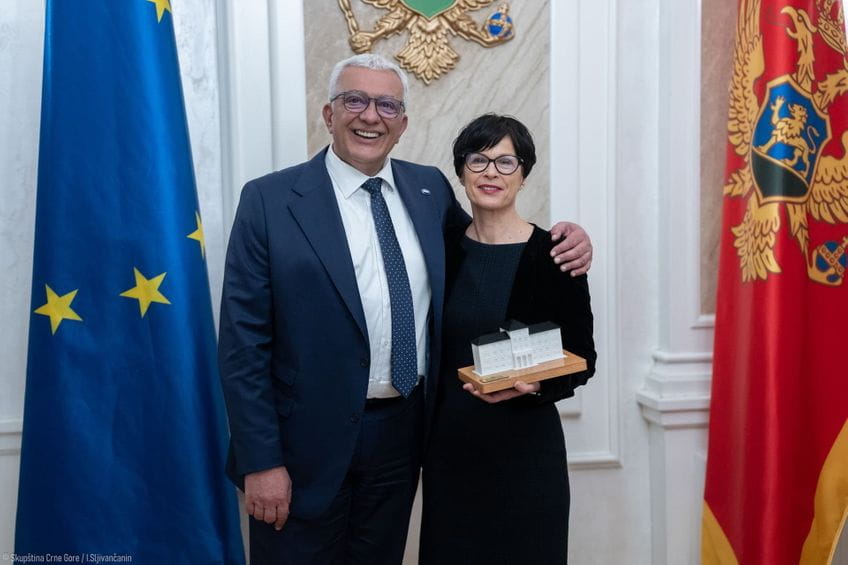
Caption: President of the Parliament of Montenegro Andrija Mandić met on 26 March in the Parliament with Marta Kos, European Commissioner for Enlargement. (Parliament of Montenegro)
Updated: April 8, 2026 – 11:41