
Part 3 of 4: The day Lithuanians could no longer murder Jews with impunity
In Part 1, I exposed the formula — Nazis, Soviets, and collaborators — that Lithuania deploys before Jewish audiences to conceal Lithuanian agency in the murder of Jews. In Part 2, I presented what the yiskor books and the Koniuchowsky testimony collection document: the specific Lithuanian murders the formula was designed to hide. This installment addresses the date that brought those murders to an end, and the prosecution Lithuania launched against the Jew who marked it.
What May 9 Stopped
May 9, 1945, is the date on which Nazi Germany’s unconditional surrender took effect on the Eastern Front. For Jews with Lithuanian roots, the date carries a meaning Lithuania would prefer to suppress: it marked the definitive end of the conditions under which Lithuanians could murder Jews with impunity. As documented in Parts 1 and 2, Lithuanian murder of Jews did not begin with German orders and did not end with the German retreat. After the Nazis left, Lithuanians continued to murder Jews who returned home. The consolidation of Soviet control — whatever its own crimes — imposed a constraint that Lithuanian society had never imposed on itself: it became dangerous for Lithuanians to murder Jews.
Lithuania mourns May 9 because Soviet occupation was confirmed. Jews mark May 9 because the murder of Jews by Lithuanians ended. These are the same historical fact observed from different positions in the killing field.
Jews Have No Love for the Soviet Union
Nothing in this analysis should be misread as affection for the Soviet regime. The Soviet Union was a criminal state. It is reprehensible to deny or minimize Soviet crimes, Nazi crimes, or Lithuanian crimes — I reject all three. The Soviet Union’s own record on Jews is a catalog of persecution. Stalin’s regime liquidated the Jewish Anti-Fascist Committee in 1948, executing its chairman Solomon Mikhoels. In 1952, Stalin launched the Doctors’ Plot — a fabricated conspiracy accusing predominantly Jewish physicians of plotting to poison Soviet leaders, designed to justify mass deportation of Soviet Jews to Siberia. Stalin died in March 1953 before the plan was fully executed. Soviet antisemitism was institutional, pervasive, and lethal. Jews who mark May 9 are not celebrating Soviet ideology. They are marking the date on which an external force stopped Lithuanians from murdering the last tattered remnants of Jewish life.
What Fridman Did and What Lithuania Did to Him
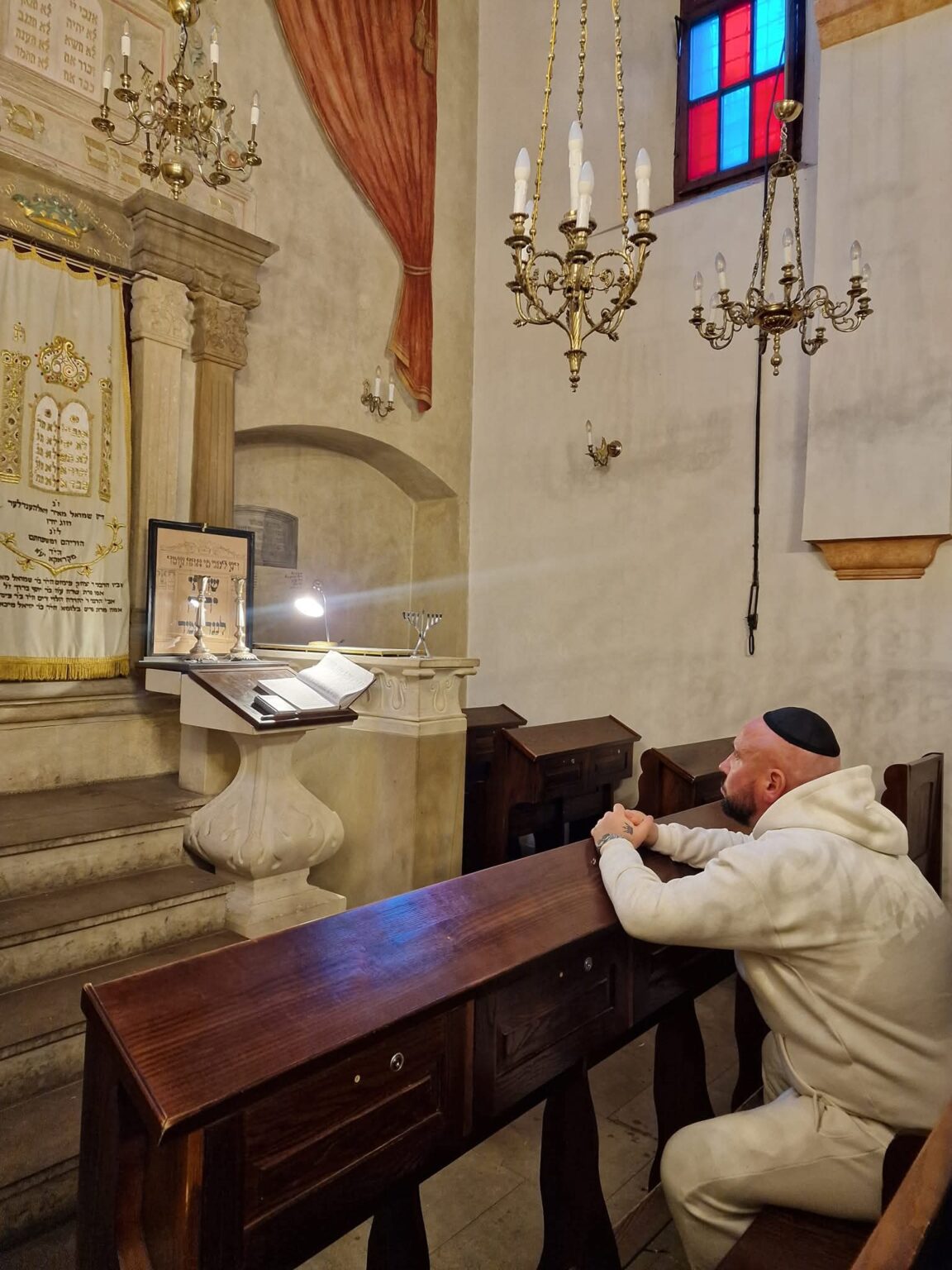
On May 9, 2024, Artur Fridman visited Antakalnis Cemetery in Vilnius to honor his grandfather — a Jew who fought against Nazi Germany. He posted a message on Facebook. Lithuania responded with two criminal charges under Articles 170-2 §1 and 313 §2, a travel restriction, and a 220-page criminal indictment. A Jewish grandson honoring a Jewish grandfather who fought the regime that enabled Lithuanian murder of Jews, on the date that murder ended. Lithuania prosecuted him for it.
Consider the disproportion. Lithuania refused to hear approximately thirty legal actions asking its own courts to intervene and stop the Lithuanian government from committing Holocaust fraud. Every case was blocked — not on the merits, but on procedural grounds. Lithuanian courts ruled that the LGGRTC’s historical conclusions were “informational acts” not subject to judicial review. The state refused to examine a single document, a single testimony, a single piece of evidence that contradicted its protected narrative. But for Artur Fridman — one ordinary Jewish citizen with no institutional backing — Lithuania deployed language experts to perform forensic analysis of his Facebook post, studying how to interpret his words to extract anti-Lithuanian intent. Thirty legal actions seeking accountability for Holocaust fraud: blocked. One Facebook post by a Jew: two criminal charges and a 220-page indictment. This is not a justice system. This is bullying on a national scale. Lithuania murdered 96.4% of its Jewish population, lies about it institutionally, refuses to examine any evidence that contradicts the lie, and then moves the entire weight of the state against one single Jew to make an example of him. The intent is not ambiguous. It is documented.
Lithuania’s Defining Pattern: Attack Only the Defenseless
Lithuania’s targeting of Fridman is not courageous. It is predatory. And it is not new. It is Lithuania’s defining pattern — documented from 1941 to 2026: attack only those who cannot fight back.
Lithuania’s celebrated 1941 “uprising” — the foundational event from which the state derives its moral capital — was not an uprising. It was vacuum occupation. Lithuanian armed activity became visible only after Soviet forces were already in retreat under German assault. There is no documented record of sustained Lithuanian engagement against intact Soviet command structures. Action followed collapse. Proclamation followed retreat. Risk was structurally avoided. The “uprising” involved no confrontation with functioning military power, no autonomous initiation, and no resistance to occupation. What Lithuania commemorates as an insurrection was the seizure of authority that had already been abandoned. Lithuania’s “heroes” waited until the powerful had left, then turned on the powerless.
Once the vacuum was secured, the documented operational sequence was consistent across dozens of towns. Jewish men of fighting age were separated and murdered first — eliminating any possibility of resistance. At the Seventh Fort in Kovno, prisoners were confined, starved, and then shot by Lithuanians: 2,930 men and 47 women in the first wave. In town after town, men were removed and shot. Only after the men were eliminated were women, children, and the elderly marched to pits — because women could not fight back, and Lithuanian perpetrators were free to rape and commit sadism without consequence. The operational sequence was not incidental. It was designed. Remove the men who might resist. Then do whatever you want to the women and children. The Koniuchowsky testimonies document this sequence across dozens of towns — separation, murder of men, then systematic violence against the defenseless remainder. In Luknik, Jews were denied food and water, a Lithuanian guard posted at the well, the survivors forced to drink from a swamp — weakened systematically before the murder that followed. In Telzh, every man had broken bones and torn muscles from beatings — none was physically capable of running. This was not warfare. This was the methodical destruction of people who had been deliberately reduced to a state in which they could not resist.
At every stage, looting accompanied murder. Jews were forced to remove their clothing at the pits before they were shot. Wallets, shoes, umbrellas, baby carriages — taken. Rings were pulled from the fingers of corpses. Fillings were extracted from teeth. Money and jewelry not seized by the Germans were extorted by Lithuanian townsfolk. Lithuania’s “heroes” were armed men who robbed the dead and boasted about it to approving neighbors.
Lithuania was in full alignment with Nazi Germany. Škirpa’s own document to a Reich official stated that the Provisional Government “is based on the Lithuanian Activist Front, which is very close to the noble ideas of National Socialism.” The sole operational distinction between Lithuanians and Nazis was that Lithuanians were more brutal. At Slutsk, Nazis formally protested Lithuanian savagery. At Telzh, Germans would not permit Lithuanians to use knives on victims. At the Lietūkis garage in central Kovno, Lithuanians beat Jews to death with iron bars in broad daylight. Lithuanian women lifted their children onto their shoulders to give them a better view of the spectacle. Wehrmacht soldiers watched. They did not participate. They did not need to. Lithuanians did it all on their own — voluntarily, publicly, and with the atmosphere of a civic event. Across the Koniuchowsky record, Lithuanian partisans broke children on their knees and smashed their heads against trees before throwing them into pits. The historical record does not contain a single documented instance of a Lithuanian firing on a German soldier during the occupation. Not one. Lithuania never confronted power. It aligned with power, served power, and directed its own violence exclusively against defenseless Jewish civilians.
Lithuania knows whom it can attack and whom it cannot. Lithuania’s former Minister of Defense, Arvydas Anušauskas — a documented Holocaust revisionist — publicly described me as “trash” and an “enemy of the state” for documenting what Lithuania’s national heroes did to Jews. Lithuanian officials explored prosecuting me criminally and constitutionally for exposing Holocaust perpetration by state-honored figures. They did not follow through. I am a prominent American citizen with political visibility, diplomatic standing, and documented relationships with members of the United States Congress. I present a threat Lithuania cannot afford to provoke. Lithuania did not prosecute Silvia Foti, the granddaughter of national hero Jonas Noreika, who published an entire book documenting her grandfather’s role in the murder of Jews. Foti is an American citizen. Lithuania did not prosecute Dr. Efraim Zuroff of the Simon Wiesenthal Center, who earned the distinction of being called “the most hated man in Lithuania” for decades of Holocaust accountability work. Zuroff operates under the protection of an international institution. Lithuania chose Artur Fridman. A Jewish Lithuanian citizen. Living inside Lithuania. Without American citizenship. Without diplomatic protection. Without institutional backing. Without a public profile. Lithuania calculated that it could make an example of one isolated Jew and that nobody would ever know or care. Lithuania was wrong. Fridman’s case is now before the international Jewish community, before Congress, before the media, and before every institution that Lithuania depends on for credibility. Lithuania has been caught. Lithuania is exposed. And the contemptible opportunism of selecting the most vulnerable available Jewish target — while leaving every protected critic untouched — tells the world exactly what kind of state Lithuania was, remains, and what it always will be. Lithuania has shown us that any pretense of change is a shallow false veneer, as duplicitous as its Holocaust sorrow performance.
In Part 4, I will apply Lithuania’s own interpretive standard symmetrically, expose the structural hypocrisy of a state that prosecutes Jewish speech while operating a government department dedicated to Holocaust fraud, and ask the Jewish organizations that continue to platform Lithuania’s diplomats a question they will not be able to avoid answering.
Grant Arthur Gochin is a diplomat, journalist, and wealth advisor focused on historical accountability, Jewish continuity, and recognition doctrine. He serves as Honorary Consul for the Republic of Togo and is the Emeritus Special Envoy for Diaspora Affairs of the African Union, representing all fifty-five AU member states. He is also Emeritus Dean of the Los Angeles Consular Corps.
Gochin is Advisor on Recognition Doctrine and Sovereignty to the Mthwakazi Republic Party, Office of the President, providing advisory guidance on international recognition, sovereignty theory, and comparative precedent relating to remedial self-determination.
His philanthropic work in Togo led to his investiture as Chief of the Village of Babade. Over several decades, Gochin has documented and restored Jewish heritage in Lithuania, including leading the Maceva Project, which mapped and preserved dozens of abandoned and desecrated Jewish cemeteries. His work exposed state-sponsored Holocaust revisionism and contributed to international recognition of systematic manipulation of historical memory.
Gochin is the author of *Malice, Murder and Manipulation* (2013), which traces the destruction of his family in Lithuania and examines postwar historical distortion. A consistent advocate against antisemitism, antizionism, and other forms of bigotry, he writes and speaks internationally on the political uses of history and the necessity of historical integrity for Jewish survival. His journalism confronts governmental misinformation and disinformation campaigns and maintains a firm position on Israel’s legitimacy and security grounded in historical evidence and collective survival.
Professionally, Gochin is a Certified Financial Planner™ and wealth advisor based in California. He holds an MBA earned with academic distinction and leads Grant Arthur & Associates Wealth Services. He lives in Los Angeles with his husband, son, and dog, Kelev.
https://www.grantgochin.com