

On EU Confidential: Sarah digs into the Hungarian opposition’s campaign in the country’s rural heartlands — while Nick weighs in on the pros and cons of ditching EU countries’ veto on foreign policy.

DZIEŃ DOBRY — Today marks the 16th anniversary of the 2010 Smolensk air disaster, which claimed the lives of Polish President Lech Kaczyński and 95 other top Polish officials, military officers and others, who had been en route to commemorate the 1940 Katyn massacre committed by the Soviet Union.
I’m Gabriel Gavin, bringing you this Friday edition of Brussels Playbook with everything you need to know about this weekend’s Hungarian election, the crisis in the Middle East and more.
**A message from Amazon: Organisations across Europe are growing with the AWS Cloud. For ONCE, in Madrid, that meant deploying applications that improve accessibility, navigation, and usability of digital services for people with visual impairments. With the AWS Cloud, ONCE can enable practical accessibility tools for its community. Hear from more AWS customers across Europe.**
DRIVING THE DAY 


BIG BALLOT: Viktor Orbán will lose Sunday’s parliamentary elections, if the most recent polls are to be believed. After 16 years in office, the Hungarian prime minister’s departure would send shockwaves through the EU. But his surprise return would be equally seismic, both allies and critics are warning.
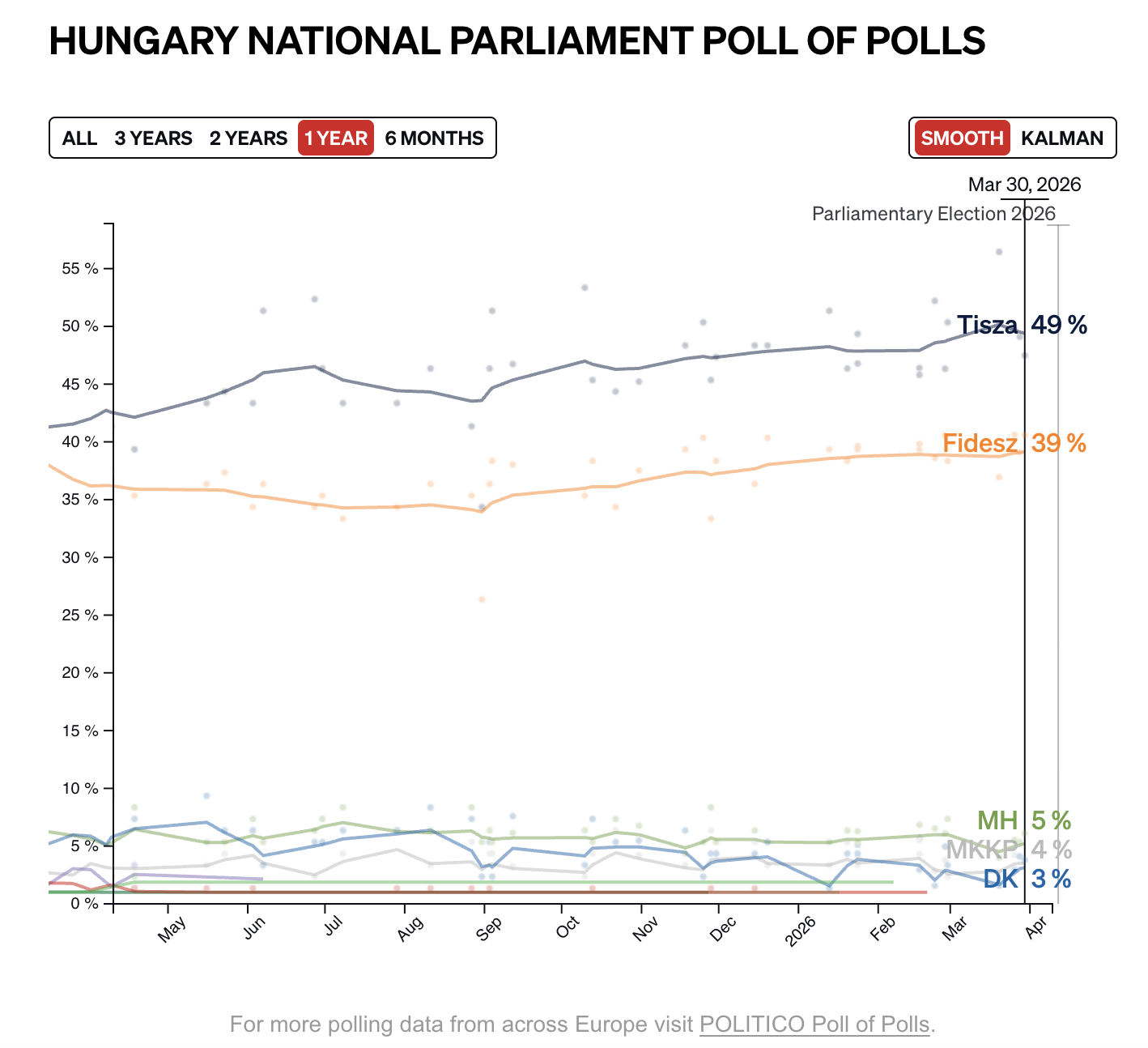
Orbán’s Fidesz Party is lagging 10 points behind the Tisza movement of center-right challenger and European People’s Party MEP Péter Magyar, according to POLITICO’s Poll of Polls. But that lead doesn’t automatically translate into more seats in Hungary’s complicated electoral system, Hanne Cokelaere and Júlia Vadler explain in their guide to the election.
What’s going to happen? Júlia Pőcze, a Hungarian political expert and researcher at CEPS, says the polls, even the government ones, suggest Magyar is set to win. “The question is only whether he is going to have an absolute majority, which I see as the most likely outcome, or a two-thirds majority, which is less likely,” she said.
Systemic resistance: “If Magyar doesn’t get the two thirds, he will be unable to change the system too much — and the system will serve Orbán until it is dismantled,” Pőcze says.
Electoral math: Frank Füredi, executive director of the Fidesz-backed MCC Brussels think tank — which Magyar has suggested he would shutter — says the campaign “is very, very close” and it could see a “substantial silent group of people who have not been active in the voting process” turning up to cast ballots against Orbán. That could make this election unlike previous ones.
Be careful what you wish for: An Orbán defeat could spell the end of a critical veto on key issues like Russian sanctions and the €90 billion loan for Ukraine. But the EU could also come to miss its antagonist’s unifying effect, according to Füredi. “If Orbán didn’t exist, they’d have to invent him,” he says.
The man they love to hate: “For the anti-Orbán lot, he has provided a focus of cohesion. [They say] ‘OK, maybe we have differences on the environment, the Green Deal, on farming, on everything else — but we all hate Orbán,’” Füredi says.
Worst-case scenario: Another prospect is an inconclusive result or a bitter legal challenge. “If there’s no obvious winner and we have Trump and Vance tweeting that the election has been stolen, we’re in for problems,” said one EU official, granted anonymity to speak frankly.
On the other hand … If Orbán wins a fifth term in office, the EU is preparing for a showdown. Officials told POLITICO there will be serious discussions about further cutting the government off from sensitive intel, following reports Budapest shared EU information with Moscow. Commission President Ursula von der Leyen will confront Orbán about the claims, her spokesperson confirmed.
Talking tough: “The alleged revelations … highlight [the] alarming possibility of a member state’s government coordinating with Russia, thus actively working against the security and the interests of the EU and all its citizens,” Commission spokesperson Paula Pinho said Thursday. “It is for the member state’s government to explain itself as a matter of urgency.”
“Hungary is playing with fire,” said an EU diplomat, adding that there’s a growing consensus to deploy the bloc’s Article 7 tools and curtail Budapest’s rights, in response to violations of the EU’s core values. If Fidesz wins, “there will be a serious discussion at a high level.”
Time for tough talk: But Orbán and his allies are planning a showdown of their own if they win. “It is bizarre to hear my EU colleagues lecturing me about trust and sincere cooperation while their agents are running clandestine operations to undermine our government and interfere in the election process,” Hungary’s Europe Minister János Bóka told Playbook.
Need for a reckoning: “After the elections we need to have a frank and open discussion about this. But before we do, I must ask them whether they are recording those conversations as well” — a reference to recent damaging revelations about Hungary’s dealings with Moscow.
War of words: The Commission denies any allegation that the EU has tried to influence the result, insisting national elections are a matter for citizens alone. Meanwhile, Fidesz is also accusing Facebook of interfering in its election campaign, Max Griera writes today. And a cross-party group of MEPS is urging the Commission to investigate alleged Russian influence and voter manipulation in favor of the ruling party.
Meanwhile, in Orbán’s hometown of Felcsút, there’s a whitewashed, peasant-style cottage that belongs to the prime minister, which speaks to the leader’s humble origins. But just four kilometers away, the Orbán family has a sprawling manor house and farm estate once owned in the 19th Century by Archduke Joseph of Austria. Jamie Dettmer has the story from on the ground.
MIDDLE EAST CONFLICT
IRAN CRISIS: European nations are scrambling to work out whether to step up their presence in the Middle East over fears U.S. President Donald Trump’s much-vaunted ceasefire won’t hold, with Iran threatening to continue the blockade the Strait of Hormuz over Israeli strikes in Lebanon.
Leave us alone, for now: “We are prepared to help after a peace agreement is reached,” German Chancellor Friedrich Merz said last night. This opens the door to a potential intervention — but only with a mandate from the U.N. Security Council, which has so far proven hard to come by. “You shouldn’t expect any decisions from us within the next few days.”
Troubled waters: The issue is expected to come to a head when EU leaders meet in sunny Cyprus for an informal summit in two weeks’ time. With security and logistical challenges looming large, the conflict also threatens to overshadow discussions over the budget and competitiveness. “There are 10 topics on the table and we don’t have time to speak about all of them,” a European official told Playbook.
A second EU official confirmed the topics for discussion are flexible and still being worked out. “Given the context, it is clear that a big part of the agenda will be dedicated to the situation in the Middle East,” the official said, citing issues that need resolving, like energy security. Key questions about the budget, the official went on, will also need to be covered.
RUTTE FACES WRATH: NATO Secretary-General Mark Rutte described his Wednesday encounter with Trump as a “frank and open discussion.” But it was more like an evisceration, according to more recent reports, in which a bad-tempered Trump unloaded his frustration with U.S. allies and indicated he was considering reprisals.
Reasons for a rant: According to three people familiar with the meeting, Trump felt he had been betrayed by allies who barred U.S. operations from military bases that exist — in the president’s view — thanks to American largesse. However, Trump made no specific demands, nor did he indicate the U.S. would reduce its commitments to the alliance.
CIVILIZATIONAL ERASURE: Von der Leyen’s coalition partners, the center-left Socialists and Democrats, have written to her and Council President António Costa to complain about what they describe as the silence on Trump’s rhetoric about “erasing a civilization” in Iran, according to a letter obtained by Max Griera.
“The European Union cannot remain a bystander. A strong, proactive diplomatic stance is urgently needed for the people of Iran, the wider region and European citizens alike,” the group’s leader, Iratxe García Pérez, wrote. The socialists also want to see an “affordability shield” deployed to “protect citizens against the rising cost of living.”

NEIGHBORHOOD WATCH
MIGRATION SYSTEM: The EU is today fully rolling out its long-delayed Entry-Exit System (EES), replacing passport stamping with biometric data and facial scans from those crossing the border, in a bid to block illicit entries.
World leaders: “Strong external borders are an essential part of an effective migration management system and the security of the union as a whole,” Migration Commissioner Magnus Brunner told Playbook. “With the full implementation of the Entry/Exit System, we are putting in place the most advanced border management system in the world, enabling us to better detect and prevent security threats from entering the European Union.”
The rules affect all non-EU citizens, with Brits facing delays as a result of technical issues, U.K. media reports.
CASH TO BELGRADE IN QUESTION: The EU is assessing whether to cut Serbia off from hundreds of millions of euros worth of funding over concerns the Balkan country is backsliding on democracy and human rights. Enlargement Commissioner Marta Kos told Sebastian Starcevic and me that the EU executive is assessing whether Serbia still fulfills the conditions for “payments under the EU’s financial instruments.”
LET US IN: Joining the EU has gone from being about “fiscal support for your infrastructure” to a matter of war and peace. That’s the message from Montenegro Prime Minister Milojko Spajić, who told POLITICO’s European Pulse Forum on Thursday that his country hopes to join by 2028 and stay safe in an increasingly uncertain world.
WHAT EUROPE THINKS
POLLS APART: Citizens across Europe are increasingly concerned about climate change, the harmful effects of social media and American foreign policy, according to a new POLITICO Pulse poll of almost 7,000 people across Spain, Germany, France, Italy, Poland and Belgium.
Yes to green: As many as 60 percent of respondents back speeding up the green transition, despite the political backlash from the right, and 39 percent want more renewables, even if it means higher energy bills.
No to screen: Three in four Europeans want minimum online age restrictions, with half calling for the cutoff to be set at 16.
On Trump, not so keen: Only 12 percent of respondents now see the U.S. as a close ally, with more than one in three saying the country has become a threat — higher than percentage of those worried about China.
Watch this space: Top decision-makers from across Europe will face questions about the biggest worries facing the public today at The European Pulse Forum 2026 in Barcelona. The initiative from POLITICO and beBartlet brings together guests including Spanish Prime Minister Pedro Sánchez, European Commission Executive Vice President Teresa Ribera and EU Defense Commissioner Andrius Kubilius.
Follow it through the day on our live blog.
OTHER NEWS
MELANIA’S EPSTEIN COMMENTS: The first lady of the United States, the Slovenian-born Melania Trump, has come out fighting against suggestions she associated with the late sex offender Jeffrey Epstein, describing as “lies” claims to the contrary. President Trump told MSNow that he “did not know anything” about the first lady’s statement ahead of time.
BARDELLA’S LOVE LIFE: The front-runner to become France’s next president, Jordan Bardella, is dating Maria Carolina de Bourbon des Deux-Siciles, if photos taken by French gossip magazine Paris Match are anything to go by. What this means for the president of the National Rally is unclear. But it could mark the return of a Naples-based Bourbon lineage, defenestrated in 1861.
FRIDAY FUNNY: If Orbán loses this weekend’s election, EU will lose its only head of government to own a private zoo. The relationship between European leaders and exotic animals — including tigers, lions and sharks — is a long and complex one, as Paul Dallison explains in this week’s Declassified column.
AGENDA
— Bilderberg meeting in Washington D.C. (April 10-12) with NATO Secretary-General Mark Rutte attending.
— Executive Vice-President Stéphane Séjourné meets Spanish Prime Minister Pedro Sánchez in Barcelona.
— Financial Services Commissioner Maria Luís Albuquerque meets Finnish Prime Minister Petteri Orpo in Helsinki.
— Agriculture Commissioner Christophe Hansen meets Sven Schulze, premier of Saxony-Anhalt, in Lutherstadt Wittenberg, Germany.
**Follow the European Pulse Forum live from Barcelona from 9.40 a.m. With a stellar speaker line-up, we present exciting panels, interviews and debates, centered around the results of the European Pulse Poll. Watch it here. The European Pulse Forum is organized in partnership with beBartlet.**
BRUSSELS (AND BARCELONA) CORNER
BRUSSELS WEATHER: Mostly overcast, high of 14C.
SPOTTED AT POLITICO’s European Pulse Forum in Barcelona: Google’s Secretary General for Southern Europe Benoît Tabaka; Farmaindustria President Fina Lladós; Redeia Chairwoman Beatriz Corredor Sierra; Moeve CEO Maarten Wetselaar; beBartlet’s Adrián Jofre Bosch and Nacho Corredor; MEPs Javi López, Borja Giménez Larraz, Michal Szczerba and Dolors Montserrat; European Commission Executive Vice-President Teresa Ribera; Spanish Ministers Jordi Hereu and Mónica García; former Spanish Foreign Minister Ana Palacio; Secretary of State for Industry Jordi Garcia; former German Minister Wolfgang Schmidt; Prime Minister of Montenegro Milojko Spajić; Estonian Education Minister Kristina Kallas; Estonia’s Deputy Secretary of State Sander Salmu; Barcelona Mayor Jaume Collboni; Catalonia Government Ministers Albert Dalmau, Núria Montserrat andJaume Duch; Josep Rull, president of the Catalonian parliament; former Catalonia President Artur Mas; Ukraine’s Ambassador to the European UnionVsevolod Chentsov; former U.S. Ambassador to NATO Ivo Daalder; POLITICO’s Jamil Anderlini and Kate Day.
BRUSSELS AUSTERITY MEASURES PROTEST: Around 10,000 people from the education, childcare and youth sectors protested Thursday against austerity measures affecting the French-speaking sector. Demonstrators marched from Midi to the French-speaking government headquarters at Place Surlet de Chokier, causing some traffic disruptions.
JAIL BREAK: Belgian prison staff are going on strike for 24 hours starting Sunday 10 p.m. to protest the privatization of public services.
U.S. EMBASSY ARREST: Two Belgian police officers received minor injuries while detaining a suspect, who reportedly refused to leave the U.S. Embassy premises in Brussels on Thursday, Belga reports.
BIRTHDAYS: MEP Magdalena Adamowicz; former MEPs Antony Hook, Geoffrey Van Orden, Luis Garicano, Florent Marcellesi and Lorenzo Fontana; Chris Heron from E-Mobility Europe; European Commission’s David Knight; Moldova’s former PM Pavel Filip; Ukrainian Ambassador to the EU Vsevolod Chentsov; Orthodox Good Friday.
Celebrating Saturday: Former MEP, Belgian PM and POLITICO 28 alum Guy Verhofstadt; Dutch Foreign Minister and Former MEP Tom Berendsen; the European Commission’s Eva Hrnčířová; former MEP Zdzisław Krasnodębski; Paul Adamson of Encompass; Rasmussen Global’s Daniel Puglisi.
Celebrating Sunday: MEP Lara Wolters; former MEPs Geoffroy Didier, Jarosław Kalinowski, João Pimenta Lopes, Teuvo Hakkarainen and Hugues Bayet; George Robertson, former secretary general of NATO; Woody Johnson, former U.S. ambassador to the United Kingdom; EEAS’ Filippo Cristini; Tobias Gehrke of the European Council on Foreign Relations; Ceemet’s Delphine Rudelli; Orthodox Easter.
THANKS TO: Max Griera, Nick Vinocur, Eliza Gritski, Hanne Cokelaere and Sebastian Starcevic; Playbook reporter Ferdinand Knapp; editor James Panichi; and producer Dean Southwell.
**A message from Amazon: From advancing accessibility to enabling digital innovation, ONCE is using technology to help remove barriers for people who are blind or visually impaired. As a leading Spanish social organisation, ONCE works to promote inclusion, independence, and equal access through innovative services and solutions. ONCE uses the AWS Cloud to support digital initiatives that apply cloud and AI technologies to improve accessibility experiences, including tools that transform visual content into enriched audio formats. By leveraging the AWS Cloud, ONCE can experiment, innovate, and deploy solutions securely and at scale. ONCE is one of many European social organisations using the AWS Cloud technology to innovate responsibly, strengthen digital capabilities, and extend their impact across Europe. Learn more about how organisations across Europe are innovating with the AWS Cloud at AWS.eu.**
SUBSCRIBE to the POLITICO newsletter family: Brussels Playbook | London Playbook | London Playbook PM | Playbook Paris | Berlin Playbook | POLITICO Confidential | Sunday Crunch | EU Influence | London Influence | Berlin Bulletin | D.C. Playbook | D.C. Influence | Canada Playbook | POLITICO Forecast | All our POLITICO Pro policy morning newsletters