
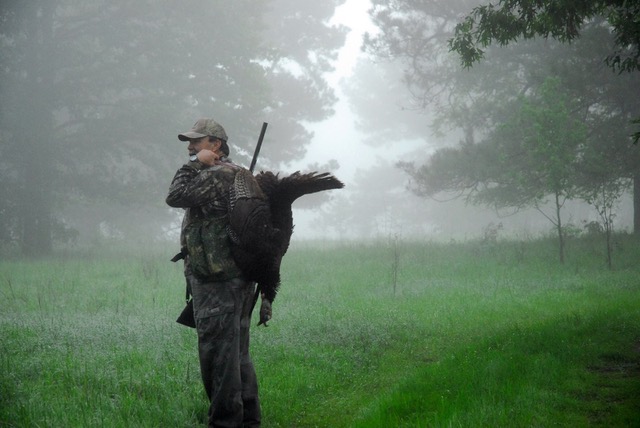
Turkeys now inhabit 223 of the 254 counties in Texas. Wild turkeys are found in almost 90 percent of Texas’ 254 counties, and while the vast majority are Rio Grande turkeys, there are eastern turkeys in a handful of counties east of the Trinity River, and maybe an even smaller number of Merriam’s in the Trans Pecos region of far West Texas.
There was a time, prior to the first half of the 1900s that eastern wild turkeys were found in large numbers throughout the 30 million acres of habitat in eastern Texas, but market and unlimited subsistence hunting and the loss of first-generation timber stands resulted in the species completely disappearing by the 1950s.
The Texas Parks and Wildlife Department started efforts to return eastern turkeys to their native grounds in 1980, which led to hunting in a limited number of counties in 1995.
I was lucky enough to hunt the birds that first year in Red River County and was immediately hooked. Through the years I had called up numerous Rios on ranches around the state, but nothing compared to the sights and sounds of working an old boss tom in the woods. They do not gobble as much as rattle the woods, and they are often not seen until the last minute. On my first hunt I had one of those magic mornings and was able to bring a mature bird within shotgun range.
It was the first of two eastern turkeys I took over several years, but the opportunity to hunt more played out as bird numbers declined. When TPWD initially restocked the birds, they did it at a rate of five toms to 10 hens at scattered sites around the Pineywoods and Post Oak regions. Unfortunately, islands of stockings and small stocking rates did not account for early natural mortality which meant that the efforts did not work as planned in many instances.
This forced the department back to the drawing board and in 2007 the agency rolled out plan B, a super stocking of 75 birds, including 25 toms, with additional stocking sites within proximity so populations could expand and overlap. After a successful two-year research project that included stocking four sites the program was expanded.
“In 2014, TPWD began restocking eastern wild turkeys. Since that time, TPWD has released 1,177 eastern wild turkeys at 14 sites in three focal landscapes including the Neches River, Sulphur River, and Trinity River Focal Landscapes. Restocking efforts using eastern wild turkeys have occurred in Anderson, Angelina, Camp, Cherokee, Franklin, Henderson, Hopkins, Jasper, Rusk, Titus, and Trinity counties,” explained Jason Hardin, the department’s turkey program leader.
While the reboot has not resulted in a population explosion, it has also not been a failure.
“It’s hard to say where they are doing best, but I would say the White Oak Creek and Sulphur River populations are doing well. We restocked the Neches River in Anderson County 20 years ago (2007) and those birds are still holding their own,” Hardin said.
He added, “No populations have boomed, but I don’t think anyone expected them to. All restocking sites have observed good survival and recruitment. An ultimate measure of success will be a hunting season in these restocked landscapes.”
An unexpected problem faced by the project is obtaining birds from other states. When Texas first started releasing eastern turkeys they partnered with multiple states willing to trap the birds during the winter months for relocation to Texas. Now, the number of cooperative states has declined to a trickle.
“A lot of states that provided Texas with brood stock in the past in the Southeast and Midwest have observed declining turkey numbers, forcing them to adjust bag limits, and/or altered season dates. Those declines made sending birds to Texas untenable in many circumstances,” Hardin said.
This year only 28 birds were relocated to Texas, and those came from Rhode Island.
However, those birds allowed TPWD to complete three years of releases near Sulphur Bluff in Hopkins County.
While a spring season still exists in some of the originally restocked counties, none has opened in the super-stocked counties. That could change if the Texas Legislature goes along with the idea.
“We have discussed developing Turkey Management Units to provide some limited hunting opportunities at sites that have shown larger habitat occupation and sustainability. Unfortunately, TPWD needs to obtain legislative authority to take this approach. TPWD’s Wildlife Division leadership has made this a legislative priority for the next session,” Hardin said.
He added the plan would be to open the season in micro areas smaller than an entire county to allow a limited harvest that can sustain a small level of hunting.
“This leaves other areas within a county open to restocking and expansion of local populations. I consider sustainable hunting opportunities to be the ultimate definition of a successful wild turkey restoration effort,” Hardin said.
The spring season in Bowie (north of U.S. 82), Cass, Fannin (north of U.S. 82), Grayson, Jasper (other than the Angelina National Forest), Lamar (north of U.S. 82), Marion, Nacogdoches, Newton, Polk, Red River (north of U.S. 82), and Sabine counties will be open April 22-May 14. Limit is one gobbler, and hunting is restricted to shotgun or legal archery equipment.
As for the Merriam’s turkeys in the Trans Pecos, they also disappeared in the late 1800s and early 1900s. Historically found in the Guadalupe Mountains near the Texas/New Mexico border, an attempt at a restocking project in Jeff Davis County in the 1980s may be the only location where pure Merriam’s still exist.
In the 1990s TPWD began stocking Rio Grande turkeys in other portions of the region and those birds have dominated, possibly crossbreeding with Merriam’s outside of Jeff Davis County where an April season is the only spring season for turkeys in the region.
— Contact Steve Knight at outdoor@tylerpaper.com