
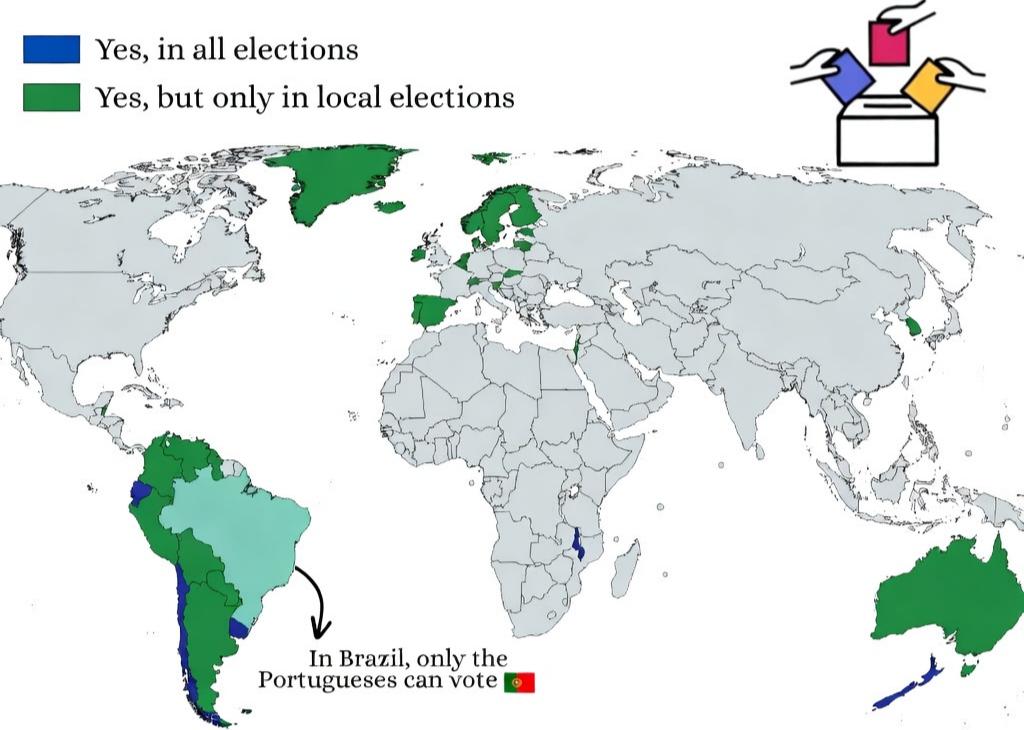
In Brazil, Portuguese citizens can vote, just as Brazilians can vote in Portugal. This is possible through the Brazil-Portugal Equality Statute, which guarantees citizens of both countries, provided they legally reside in the other, equivalent rights and duties, including the right to vote. In some cases, it is also possible to run for political office.
There are exceptions: in Brazil, for example, the office of President of the Republic is exclusive to native-born Brazilians – not even naturalized Brazilians can run.
It is important to note that this right is not automatic: it is necessary to apply for the statute and go through a formal process for its granting.
Posted by Beautiful-Rough2310
35 Comments
Very interesting.
In South Korea, under the Public Official Election Act, foreign nationals aged 18 or older who have held permanent residency status, or an F-5 visa, for at least three years are granted voting rights in municipal elections.
As of January 2025, more than 140,000 foreign residents had qualified to vote for local government heads and council members.
Foreigners can’t vote for president in Argentina. They can vote on all other categories as long as they’re residents.
In the UK, if I’m not wrong there are certain agreements that allow foreign citizens to vote depending on where they’re from. I think especially the Irish are basically treated practically as citizens when it comes to things like this, due to the bilateral agreements in place.
In Germany foreigners are allowed to vote in the local Kommunalwahlen
EU citizens can vote in local elections of other EU countries
Uh – this map is garbage.
The most prominent example of non-citizen voting is the UK, where any Commonwealth or Irish citizen can vote in all elections and referenda.
UK citizens can vote in Irish parliamentary and local elections.
EU and UK citizens can vote in one another’s local elections.
In Portugal Brazilians can vote in all elections even the European elections.
The same restriction applies, Brazilians can’t run for president of Portugal.
The rule exists so no one can be the president of both countries and tries a reunification.
EU citizens can vote in EU elections in whatever member state they live in. British and Irish citizens can vote in one another’s national elections, though UK citizens can’t vote in presidential elections or referenda.
Commonwealth citizens are allowed to vote in UK elections
[Not a thing for Estonia anymore](https://www.loc.gov/item/global-legal-monitor/2025-08-04/estonia-country-amends-constitution-to-restrict-local-voting-rights-of-noncitizens), unless you count citizens of EU.
Pretty sure in the case of the Schengen zone, any citizen of a Schengen country can vote in another Schengen country, provided they have lived in said country a set amount of years and fulfill the conditions to vote in said country.
Irish people can vote in UK parliamentary elections if they’re living in the UK, and vice versa.
Also afaik EU citizens can vote in a European parliament elections wherever they’re living, and in a lot of cases (I know for sure in the Netherlands) they can vote in local elections too.
Portugueses? I think you mean Portugeese.
All EU citizens can vote in local elections where they reside, including every other EU state
In Sweden you have to have been a registered resident for at least 3 years before you can vote. If you are a citizen of an EU-country + Norway and a few others I believe, you can vote as long as you are a registered resident, no need to wait the three years.
In Sweden we have 3 elections at the same time. 1 for more or less the city you live in (kommunval), 1 for the region you live in (regionval) and one for who will lead the country (riksdagsval). The two first you are allowed to vote in if you meet the requirements but the big and important election, riksdagsvalet, you will only be allowed to vote in if you are a citizen.
I think that’s a fair rule. It does affect you, but only quite minor things.
I don’t think Australia or New Zealand are correct. Both are citizens only.
Can EU citizens not vote in local elections in all other EU countries? I thought that was a EU wide thing?
EU foreigners can also vote in local elections in Germany.
In Argentina naturalized foreigners can vote on national election after a period of time, like 10 years IIRC, of living in the country. But they can vote on local government elections right away
There are municipalities in the US where foreigners can vote in local elections.
r/mapswithnewzealandbut
You can vote in all elections in Iceland before you become a citizen. You just need to have residency, which you get after just about a year or living/working here.
Edit: I Googled it. Turns out it’s 3 years for non-nordic immigrants before they can get a permanent residency and vote in national elections. Typically takes 7 years of legal residency before you can apply for citizenship (unless of course you get married to a citizen). It can also be sped up if you have a child here. However, birthright citizenship isn’t a thing. But you do get extra support tho and citizenship can come sooner, as I said.
ah so basically the political version of being besties
Wtf happened to NZ?
Greenland? Uh oh
How should I read this map? In Uruguay foreigners can vote after they become citizens (there are a few very specific exceptions). I understand that this is the same in the US, yet they are in different colors.
What the heck happened to New Zealand?!
I think it was Zizek who said this, but US Presidential elections should be voted on by everyone _but_ Americans.
According to Trump this map is fake news 😂
What happened to New Zealand on this cursed map?
NZ is kinda misleading. Citizens and permanent residents can vote.
This map is wrong. E.g. Irish people can vote in UK elections.
Commonwealth citizens who are residents can vote in the UK, I think.
r/mapswithnewzealandbut