
The Republic of Georgia sits at the intersection of Eastern Europe and Western Asia and was one of the first countries in the world to make Christianity a state religion. According to recent data from the Association of Religion Data Archives, around 83 percent of Georgians identify as Orthodox Christians. Georgian tradition holds that the Apostle Andrew first brought the gospel to the nation.
But it was a woman named Nino, believed to be from the Turkish region of Cappadocia, who Christianized the nation during the fourth century.
As chronicled by Rufinus of Aquileia, a Roman priest and writer of that era, Nino baptized the queen and later shared the gospel with the king even while she was in captivity. Both witnessed Nino perform miracles. She later sought to have an envoy sent to Emperor Constantine to request priests to come to Georgia so they could administer the Eucharist and catechize the people.
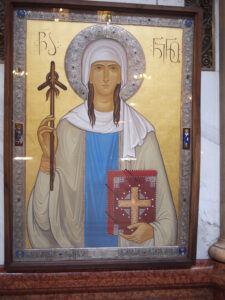 An icon of Saint Nino, Equal of the Apostles, Enlightener of Georgia | Wikimedia Commons
In the Orthodox tradition, Nino has become one of the most venerated saints and is known as Equal to the Apostles and Enlightener of Georgia. The Episcopal Church celebrates the feast of Saint Nino on December 15.
“While many of the historical details remain sketchy, Georgia is highly unusual in its claim to have been evangelized by a female slave rather than by a famous apostle and evangelist,” noted a reflection on the saint by Forward Movement.
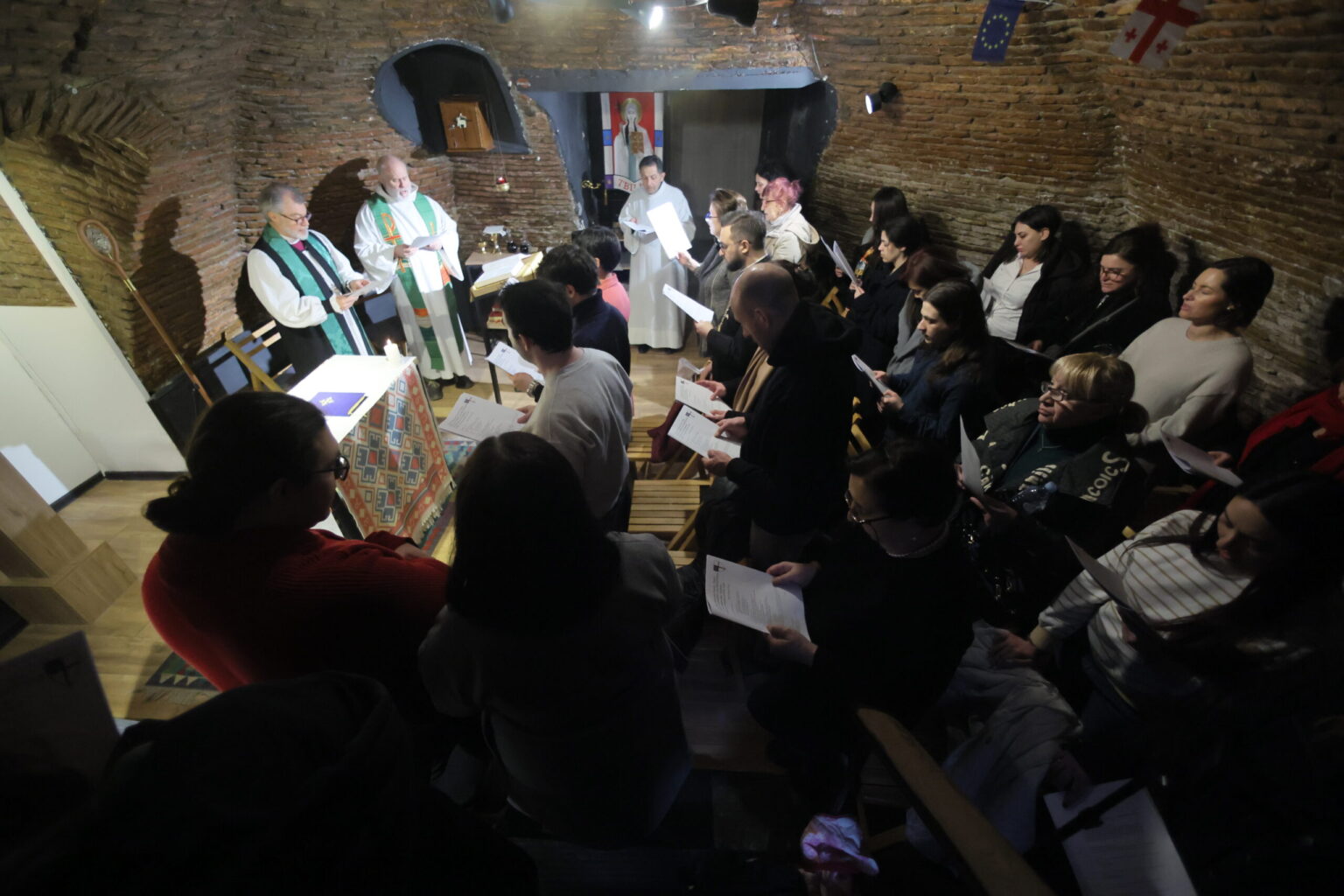
On Easter Sunday, inside a former wine cellar turned chapel in the Georgian capital, Tbilisi, dozens of people celebrated the Easter liturgy at the Episcopal Mission of Saint Nino. Nana Abuladze, an award-winning writer and literary scholar, has been worshipping with the congregation since July 2024.
She was invited to the congregation by Thoma Lipartiani, who was received into the Episcopal Church in 2019 during the annual convention of the Convocation of Episcopal Churches in Europe in Geneva, Switzerland. During his reception, he was also licensed to minister. Lipartiani founded the Tbilisi-based congregation of around 100 people.
When he was received into the Episcopal Church, the mission was also received into the convocation.
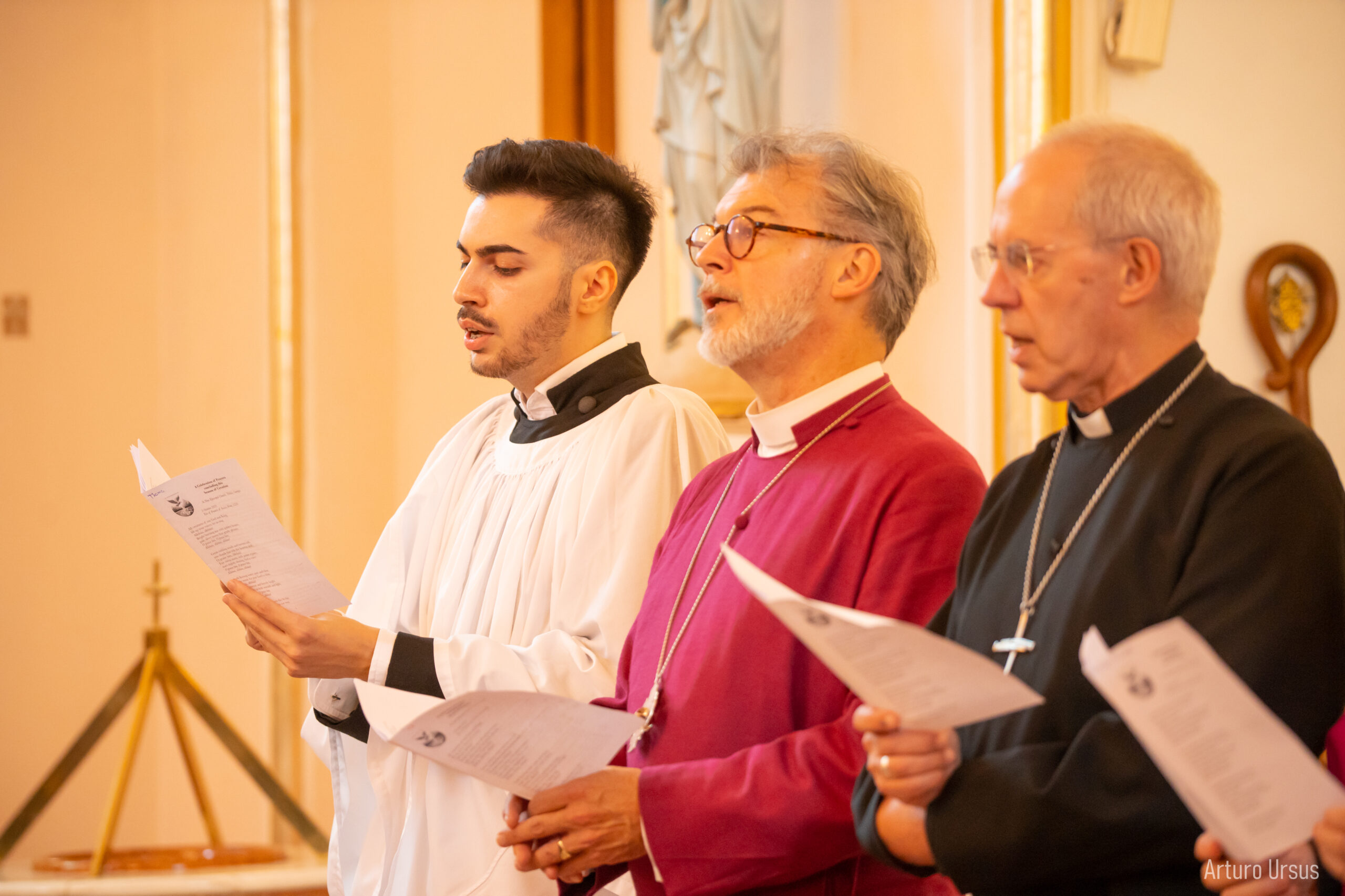 From left: Thoma Lipartiani, Bishop Mark Edington of the Convocation of Episcopal Churches in Europe, and Justin Welby, former Archbishop of Canterbury | Arturo Ursus via Thoma Lipartiani
A Prayer Group Turned Congregation
It was in 2018 when Lipartiani began a prayer group while still at Caucasus University in Tbilisi. It was mostly composed of students. He wasn’t an Anglican yet, but the liturgy they were using was. He already had a vision of turning the group into a congregation.
A Roman Catholic, Lipartiani served as an acolyte during the 2016 visit of Pope Francis to Georgia. He was eight years old when he first told his grandmother that he wanted to become a priest. He has also long loved reading about religion, Christianity, and the Bible. He first learned about Anglicanism while reading a dictionary of religions that included a definition of the American Episcopal Church.
“It was saying [that] it is a Christian socialist denomination,” he remembers, which piqued his interest. But he clarified that it wasn’t the reason he became Episcopalian—“absolutely not”—especially since the dictionary turned out to be Soviet propaganda.
Lipartiani observed that the predominant Christian tradition in his country was no longer answering the pressing questions of young Georgians, who have become well-traveled and more progressive.
“I realized that we need a church with orthodox doctrine, traditional liturgical worship, and progressive social teachings,” he said, noting that all three criteria were significant and necessary. In learning about Christian denominations, he found the Episcopal Church to be the right fit for the group he had gathered.
Zaal Jugeli was one of the original members of the prayer group. He grew up in the Georgian Orthodox Church but felt that something was missing in his formation. “All the sermons were full of nationalism and fundamentalist sentiments, therefore I knew that I was spiritually thirsty,” he said. He had also worshipped in Roman Catholic and Baptist churches but still longed for something else.
A graduate of the Tbilisi Theological Academy and Seminary, he was 38 years old when he met Lipartiani in 2018, who was 21 at the time. He has been part of the Saint Nino Mission since it began and now serves the congregation as a lay leader.
“St. Nino’s Episcopal congregation gives me what I was looking for: Gospel preached in its fullness, sacraments and apostolic succession, liturgical worship and orthodox doctrine, progressive understanding of social matters, and also—friends who are now my family,” he told TLC in a WhatsApp message. “I think God answered my prayer.”
Abuladze first met Lipartiani in the summer of 2024 by chance. Lipartiani had earlier added her on Facebook after seeing that she had liked posts from the Episcopal Church’s page.
She attended a movie screening at the Caucasian House, a well-known nongovernmental organization. The film was about Christian denominations in Georgia, and with the Episcopal Church being one of them, it featured interviews with Lipartiani and other members of Saint Nino. The two then spoke, with Abuladze telling the young lay leader that she was baptized Orthodox and was considering moving to Catholicism.
“He said, ‘You know, our church is very close to the Catholic Church in terms of its liturgical tradition,’” Abuladze remembers Lipartiani saying. He then gave her more information about the mission and invited her to attend a service. Although a bit hesitant at first, she attended one Sunday. “And then the Sunday after that, and then I stayed in the parish,” she said.
“There was this sense of unity that amazed me from the very first Sunday. And I saw that these people actually have what Christians should have among themselves. They have love of their neighbor.”
Restoring a Lost Presence
A priest from a different part of Europe visits Saint Nino once a month to celebrate the Eucharist. Other Sundays are led by lay leaders Jugeli, Abuladze, and Nino Bajelidze. Lipartiani is now in his second year at Virginia Theological Seminary in Alexandria, pursuing a Master of Divinity degree, and is a postulant of the convocation. He had already applied for the priesthood.
In 2023, former Archbishop of Canterbury Justin Welby visited the mission. Bishop Mark Edington of the convocation has visited Saint Nino several times.
According to the seminarian, the mission has one of the highest confirmation rates in the European jurisdiction of the Episcopal Church.
Lipartiani has translated the 1979 Book of Common Prayer into Georgian, as they wanted to worship in their own language. He also wrote a pamphlet about the Rev. Leo Malania, who was born in Tbilisi in 1911 and later moved to the United States, becoming an Episcopal priest and serving as a coordinator for the revision that resulted in the current Book of Common Prayer.
“I wish us to be more known by wider society because in many cases our churches in Europe are churches of expats,” he said of his hope for the Episcopal Church in Europe. The convocation, which has existed for over two centuries, was initially designed to serve English-speaking people in the region, many of whom were American expatriates. But it has since expanded to serve people for whom English is not their first language.
Lipartiani said the Episcopal Church offers positive elements for European Christianity, citing the three criteria he noted about the kind of church he, as a young Georgian, was seeking. He believes many young Europeans are longing for the same: orthodox doctrine, traditional liturgical worship, and progressive social teachings.
“Most people don’t have an idea that this church exists in their cities, in their countries, and I wish this to be more widely known,” he said.
Historical records show there was an Anglican presence in Georgia in the 19th century, with missionaries working mainly among Georgia’s Jewish community and German Protestants. Anglican churches established there were part what is now the Church of England’s Diocese in Europe. The churches were all closed in 1921, when Soviet rule was established in Georgia.
Lipartiani and his fellow congregants thought they were the first to establish an Anglican mission in the area, discovering only after further research that instead, they were restoring a presence destroyed and lost for over a century.

Caleb Maglaya Galaraga is The Living Church’s Episcopal Church reporter. His work has also appeared in Christianity Today, Broadview Magazine, and Presbyterian Outlook, among other publications.