
Show summary Hide summary
In late 2024, divers and archaeologists drew back a curtain on a 2,000-year-old cargo that had been sleeping beneath the black mirror of Lake Neuchâtel. The find — pottery, metalwork, tools and parts of a horse-drawn vehicle — reads like a short story of everyday life in Roman-era Switzerland, a snapshot of trade and military supply frozen in time.
The discovery began with aerial reconnaissance and ended with painstaking underwater recovery. Though the ship itself has not been found, the recovered goods are remarkable both for their preservation and for the window they offer into long-distance commerce and the logistics of Rome’s northern frontier.
How the underwater discovery unfolded and why it mattered
The site was pinpointed during systematic drone surveys that mapped large swaths of the lakebed. Once sonar and imagery suggested intact material on the bottom, regional authorities moved quickly. The Octopus Foundation, working alongside the Cantonal Archaeology Office of Neuchâtel, coordinated dives to secure the site before artifacts could be disturbed or looted.
Excavation dives began in March following the 2024 detection and continued in carefully controlled campaigns. Archaeologists ultimately brought up roughly 1,200 objects, a mix of fragile ceramics and sturdier metal items. Conservators emphasized the urgency: exposed, these waterlogged items can deteriorate rapidly, so recovery and stabilization had to come first.
Tools and techniques used underwater
- Drone and sonar mapping to locate promising anomalies across the lake bottom
- Targeted diver excavations for controlled retrieval of fragile objects
- Immediate conservation steps to prevent decay of wet wood, leather and ceramics
What was in the cargo: a trader’s load for Rome’s northern forces
The assortment of finds points to a civilian merchant load intended for military supply. Among the standout items were:
- Numerous ceramic vessels — plates, bowls, cups — produced across the Swiss Plateau
- Olive oil amphorae imported from Spain, demonstrating long-distance trade links
- Three swords, with one preserved inside a leather scabbard
- Metal tools including a pickaxe
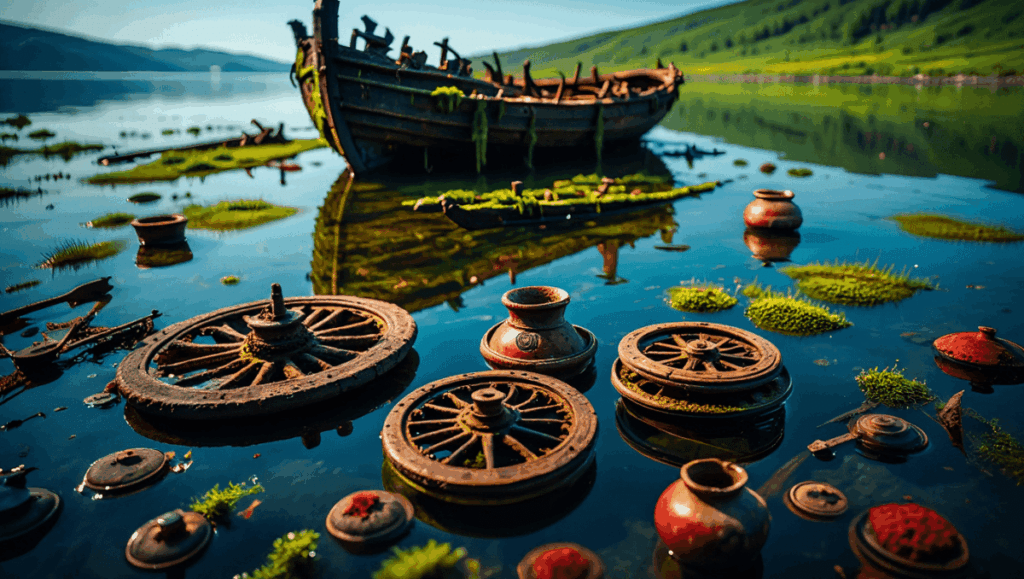
- Components of a horse cart or chariot, notably including wheels
- A fibula brooch typical of the Roman Imperial period
- A waterlogged plank of wood used to help date the find
These objects together form a practical cargo: domestic tableware, foodstuffs in amphorae, tools and transport parts likely needed to keep animals and wagons on the move.
Linking the cargo to Rome’s northern frontier and ancient ports
Archaeologists working the site estimate the delivery was likely bound for the Roman garrison at Vindonissa along the Aare River, the base of the 13th Legion. Radiocarbon dating of organic materials and typological analysis of the brooch and pottery point to an early first-century CE date, roughly between 16 and 45 CE.
Vindonissa’s role was strategic: its legionnaires patrolled the frontier and guarded against incursions from Germanic groups to the north. The southern shore of Lake Neuchâtel likely hosted a bustling local port in antiquity — Eburodunum, today’s Yverdon-les-Bains — which could have been the vessel’s point of departure. The amphorae from Spain underline how connected Alpine and transalpine communities were to Mediterranean supply chains.
Conservation priorities and the open questions that remain
The Cantonal authorities described the haul as an “exceptional discovery,” rare for inland waters north of the Alps. Next steps include specialized conservation: stabilizing organic materials, desalination and slow drying protocols for wood and leather, and cleaning and consolidation of ceramics and metalwork. Once laboratories finish treatment, many items are slated for exhibition at the Museum of Archaeology of Neuchâtel.
Yet several mysteries remain unsolved:
- No hull has been identified — the absence of the boat itself complicates efforts to reconstruct the sinking event.
- The precise cause of the wreck is unknown. A sudden squall — Alpine lakes are notorious for rapid winds — could have capsized or overwhelmed the vessel, spilling its goods before the crew could salvage them.
- Questions about provenance and the full extent of the cargo linger; further surveys may reveal additional material nearby.
Conservators and archaeologists are continuing work both in the lab and on the lake, balancing quick action to protect artifacts with careful study to interpret the story they tell about trade, transport and military logistics in Roman-era Switzerland.
You might also like:

Michael Thompson is an experienced journalist covering U.S. and global news. With ten years on the front lines, he breaks down political and economic stories that matter. His precise writing and keen attention to detail help you grasp the real‑world impact of every event.
★★★★★
Be the first to rate this post
or leave a detailed review