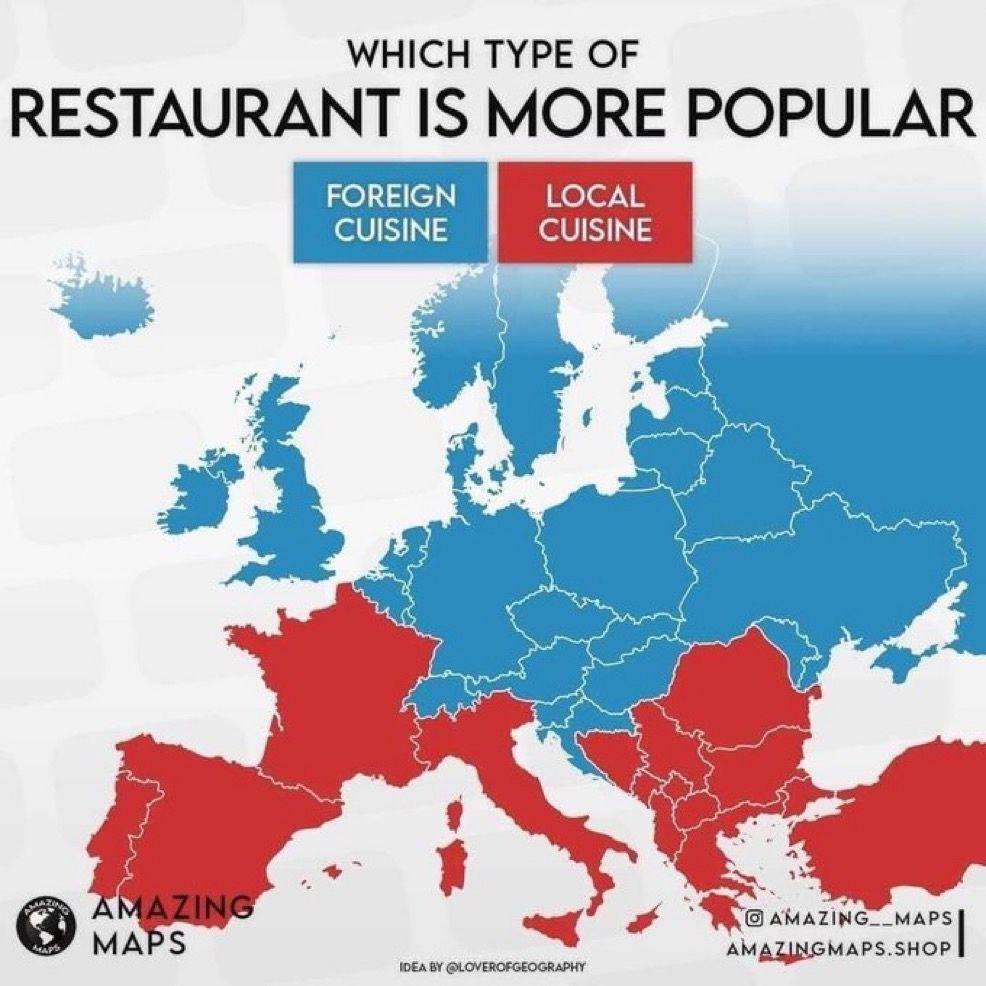
I’m from the North/blue part, and as much as I like home made Northern European (mostly root vegetable) dishes, they are awful to serve in restaurants and other eateries. I’ll take my Italian and run with it.
Neither_Ticket3829 on
As a French-Turkish person, I’d say snail kebab with raki mixed with wine would be interesting.
SnooCapers938 on
The UK has a very vibrant restaurant culture but it’s international, and has been for generations. Indian, Chinese and Italian restaurants are very popular here and most cities and larger towns will also have restaurants serving Thai, Turkish, Greek, French, Spanish food as well . The line between what is ‘local’ and ‘international’ is pretty blurred though, because a lot of dishes that those restaurants serve (especially the ‘Indian’ ones) were developed in the U.K.
No-Age-1044 on
That should be stated any time anybody discusses politics, even about power lines, railroads, color of signs…
Ashamed_Eye_6496 on
What’s happening with UK? We have a long and proud history of accepting and absorbing other countries food culture into ours, and long may it continue as we have such great choice over here.
icyu on
Source? This is just false information imho.
Woodnot on
Getting from this..being Roman makes you good at cooking!
TheKingMonkey on
Aren’t almost European food maps split along the lines of “Do you have a Mediterranean coast? (Y/N)”
Neozetare on
I doubt this map is accurate for my country
And the fact that there are no sources kind of confirm my suspicions
gingermalteser on
Not only is the source terrible, but so is the map. Look at where they put Cyprus.
GloomiWhisp on
this map is basically just “do you have good weather” mapped onto restaurant preferences
HaggisPope on
Czechs are big into their own food so I’m not sure if this map is just vibes.
Also, there’s pubs all do traditional food in the UK and those are very popular to eat in. People seem to have a hard time seeing bangers and mash or steak and ale pie as British though (Mac and cheese as well btw). There’s tons of local food varieties in different places as well, and Scotlands got a heap of our own stuff
task_machine on
Never heard of a blue country’s restaurant here in Italy, I haven’t seen French or Spanish too, so for us is true
Risenwatys on
Tourism
Spute2008 on
What you’re looking at right there is the “International Flavour Line”
North?
_in heavy English accent_ “Boil it some more, it’s got too much flavour!”
oneharmlesskitty on
Probably the UK counts any country that was part of the empire as local
yurious on
In Ukraine it is definitely local cuisine, not foreign.
wajdix on
I’ve just seen this extremely misleading map on twitter and lashed out on the poster.
there are No methodology, no dataset, no definition of “popular,” no time period, no sample size, just two colors and a vibe. This map could have been drawn based on Tripadvisor reviews, Google Maps categories, a travel blogger’s opinion, or someone’s gut feeling and we would have no way to know.
The red countries framing is also completely backwards from what the data would actually show if anyone bothered to collect it. France, Italy, Spain and Greece are among the most visited countries on earth, and tourists specifically go there to eat local food. A French bistro in Paris being “popular” is partly because millions of people fly across the world to sit in one. Of course local cuisine dominates the restaurant count, that’s literally the tourism pitch. Attributing that to locals preferring their own food ignores that a huge chunk of restaurant demand in those countries is foreign visitors chasing the local experience.
And then there’s the France specifically angle which kind of destroys the whole narrative: France has more McDonald’s per million inhabitants than any other country in Europe. If French people were so devoted to local cuisine over foreign options, that would be a strange market for the world’s most recognizable foreign fast food chain to absolutely thrive in.
The blue countries reading is just as shaky. Does “foreign cuisine popular” mean locals are rejecting their own food culture, or does it mean those countries have large immigrant communities, strong international trade ties, or simply define “local” differently? A kebab shop in Berlin run by a Turkish family who has lived there for 40 years, is that foreign or local?
This map should not be shared as anything other than an example of how to make something look authoritative while saying nothing verifiable.
MoltoBeni on
Almost as if better weather makes for greater agricultural diversity/better food
Zeeuwse-Kafka on
The blue eats the red cuisine most of the time.
Yoyoo12_ on
Well you should be able to cook your local cuisine really good, while for foreign cuisine it’s good to go to restaurants to learn about that cuisine.
ChampionSkips on
UK traditional food is generally served in pubs and gastro pubs. You rarely get British food restaurants. British people have embraced food from other cultures for decades. Despite it’s reputation British food, whether it be traditional or not traditional, is actually really good.
InZim on
Why are you singling out the UK and not the dozens of other countries in blue?

25 Comments
Kebab is local cuisine.
Common Balkan W
I’m from the North/blue part, and as much as I like home made Northern European (mostly root vegetable) dishes, they are awful to serve in restaurants and other eateries. I’ll take my Italian and run with it.
As a French-Turkish person, I’d say snail kebab with raki mixed with wine would be interesting.
The UK has a very vibrant restaurant culture but it’s international, and has been for generations. Indian, Chinese and Italian restaurants are very popular here and most cities and larger towns will also have restaurants serving Thai, Turkish, Greek, French, Spanish food as well . The line between what is ‘local’ and ‘international’ is pretty blurred though, because a lot of dishes that those restaurants serve (especially the ‘Indian’ ones) were developed in the U.K.
That should be stated any time anybody discusses politics, even about power lines, railroads, color of signs…
What’s happening with UK? We have a long and proud history of accepting and absorbing other countries food culture into ours, and long may it continue as we have such great choice over here.
Source? This is just false information imho.
Getting from this..being Roman makes you good at cooking!
Aren’t almost European food maps split along the lines of “Do you have a Mediterranean coast? (Y/N)”
I doubt this map is accurate for my country
And the fact that there are no sources kind of confirm my suspicions
Not only is the source terrible, but so is the map. Look at where they put Cyprus.
this map is basically just “do you have good weather” mapped onto restaurant preferences
Czechs are big into their own food so I’m not sure if this map is just vibes.
Also, there’s pubs all do traditional food in the UK and those are very popular to eat in. People seem to have a hard time seeing bangers and mash or steak and ale pie as British though (Mac and cheese as well btw). There’s tons of local food varieties in different places as well, and Scotlands got a heap of our own stuff
Never heard of a blue country’s restaurant here in Italy, I haven’t seen French or Spanish too, so for us is true
Tourism
What you’re looking at right there is the “International Flavour Line”
North?
_in heavy English accent_ “Boil it some more, it’s got too much flavour!”
Probably the UK counts any country that was part of the empire as local
In Ukraine it is definitely local cuisine, not foreign.
I’ve just seen this extremely misleading map on twitter and lashed out on the poster.
there are No methodology, no dataset, no definition of “popular,” no time period, no sample size, just two colors and a vibe. This map could have been drawn based on Tripadvisor reviews, Google Maps categories, a travel blogger’s opinion, or someone’s gut feeling and we would have no way to know.
The red countries framing is also completely backwards from what the data would actually show if anyone bothered to collect it. France, Italy, Spain and Greece are among the most visited countries on earth, and tourists specifically go there to eat local food. A French bistro in Paris being “popular” is partly because millions of people fly across the world to sit in one. Of course local cuisine dominates the restaurant count, that’s literally the tourism pitch. Attributing that to locals preferring their own food ignores that a huge chunk of restaurant demand in those countries is foreign visitors chasing the local experience.
And then there’s the France specifically angle which kind of destroys the whole narrative: France has more McDonald’s per million inhabitants than any other country in Europe. If French people were so devoted to local cuisine over foreign options, that would be a strange market for the world’s most recognizable foreign fast food chain to absolutely thrive in.
The blue countries reading is just as shaky. Does “foreign cuisine popular” mean locals are rejecting their own food culture, or does it mean those countries have large immigrant communities, strong international trade ties, or simply define “local” differently? A kebab shop in Berlin run by a Turkish family who has lived there for 40 years, is that foreign or local?
This map should not be shared as anything other than an example of how to make something look authoritative while saying nothing verifiable.
Almost as if better weather makes for greater agricultural diversity/better food
The blue eats the red cuisine most of the time.
Well you should be able to cook your local cuisine really good, while for foreign cuisine it’s good to go to restaurants to learn about that cuisine.
UK traditional food is generally served in pubs and gastro pubs. You rarely get British food restaurants. British people have embraced food from other cultures for decades. Despite it’s reputation British food, whether it be traditional or not traditional, is actually really good.
Why are you singling out the UK and not the dozens of other countries in blue?