
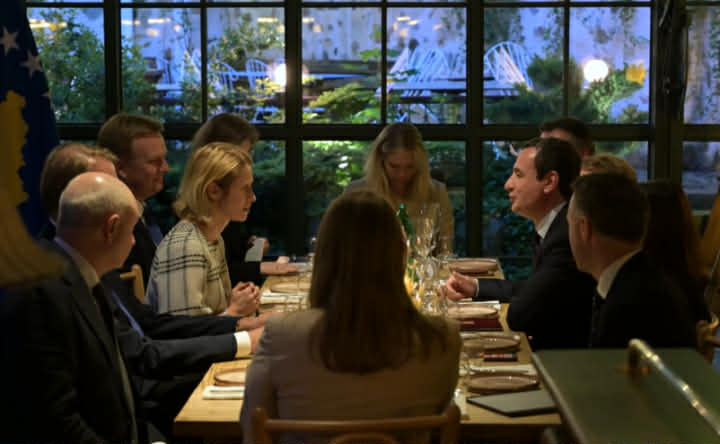
Kurti-Vučić meeting “in May or June”, Petritsch: Blocking dialogue with more “immediate” consequences for Kosovo than for Serbia

Express newspaper
12/04/2026 13:11
With two conflicts accelerating history – one in Ukraine, the other in Iran – Kosovo and Serbia seem to be at odds.
Thirteen years to implement a 15-point agreement to normalize relations were not enough, even though reconciliation and cooperation were expected.
Former Austrian diplomat Wolfgang Petritsch warns that Kosovo is at risk from the status quo and must act, as fragile states are more exposed to crises.
In 2013, as Europe saw expansion and stability, Kosovo and Serbia signed the first agreement to normalize relations in Brussels. After years of post-war tension and pain, the neighbors seemed ready for a new chapter – unusual for the region’s history.
The Brussels Agreement was signed on April 19 of that year by the then prime ministers of both countries, Hashim Thaçi and Ivica Daçić. It followed months of intensive negotiations, mediated by the EU foreign policy chief, Catherine Ashton.
“I want to congratulate them for their determination during these months and for the courage they have shown. It is very important that what we are seeing now is a step away from the past and for both countries, a step closer to Europe,” Ashton said at the time.
Quite promising for two countries that have European Union membership as a strategic goal – at least in words. This was clearly reflected by both prime ministers – with Thaçi emphasizing the potential of the agreement.
“This agreement today represents the beginning of a new era – that of reconciliation and interstate cooperation. This agreement will help us heal the grave wounds of the past, if we have the wisdom and discernment to implement it in practice,” Thaçi said at the time.
Beyond the hope created 13 years ago, developments on the ground show that much of this wisdom and understanding remains to be proven.
Although leaders in Kosovo, Serbia, and the European Union have changed over the years, progress on the key point of the agreement – the creation of the Association of Serb-majority municipalities in Kosovo – has remained limited.
This is because the Constitutional Court of Kosovo has found inconsistencies with the Constitution in several principles. Although it has left room for harmonization, there have been ongoing reservations in Pristina, due to, as has been said, the potential impact of the Association on the functionality of the state, while Brussels and Belgrade have insisted on its establishment.
In the end, despite dozens of meetings, a draft European statute, and a new agreement after ten years, the process has remained stagnant.
Serbia has been facing anti-government protests for more than a year, while Kosovo has been facing political divisions that have left it without a functioning parliament and a functioning government for months. In these circumstances, direct contact at the highest level has also been lacking – such a meeting between the leaders of the two countries, Albin Kurti in Kosovo and Aleksandar Vučić in Serbia, has not taken place since September 2023.
From the perspective of former Austrian diplomat Wolfgang Petritsch, this blockage of the Brussels process carries more immediate consequences for Kosovo than for Serbia.
Speaking on Radio Free Europe’s Expose program, he assesses that Kosovo pays a price in security, stability, and its orientation towards the future, while its policies remain largely internal and not sufficiently adapted to the broader European and geopolitical context.
“Every time I am in Pristina or talk to people there, I get the impression that there is only Kosovo and nothing else. This is a completely wrong approach. Mr. Kurti has obvious qualities, but if he does not understand that he has to act as part of a team – both domestically and in the European arena – things will not go well for the development of Kosovo,” says Petritsch.
Radio Free Europe asked the Kosovo Government whether it is open to a new phase of dialogue with Serbia and how it plans to avoid a stalemate, but received no response.
During the presentation of the new government cabinet last month, Kurti said that his government would pursue the normalization of relations with Serbia through a constructive and creative dialogue.
“As we have done in the past four years, normalization is a matter of regulating relations between two states, that is, as a bilateral and external relationship, and not intervention or meddling in internal affairs,” Kurti said on February 11.
At the UN Security Council, the US representative stated this week that President Donald Trump expects a clear commitment from Kosovo and Serbia to work together, to reduce tensions and to return to a real dialogue, not just declarative. According to Tammy Bruce, the US will only work closely with leaders who “look to the future, not to the past.”
For Petritsch, the first step must come from Pristina, which must offer the Serbs concrete cultural, linguistic and administrative responsibilities, in accordance with the Brussels Agreement. This would signal, according to him, a new cooperative approach and create the possibility of a real relationship with the Serbian representatives. Even if Serbia were to oppose it, it would come out as a blocker of the process.
Petritsch notes that guarantees from Brussels are essential in this regard.
“It has been clear from the beginning that the Europeans will not allow the creation of another Republika Srpska. We paid a high price for it in Bosnia and Herzegovina and we do not want it to be repeated in Kosovo. So, clearly, there are cultural, linguistic and administrative issues that need to be resolved,” says Petritsch.
Radio Free Europe asked the European Union if there are efforts for a new phase of the dialogue, but received no response. This week, but also last month, the EU’s special envoy for the Kosovo-Serbia dialogue, Peter Sorensen, made several visits to Kosovo and Serbia, where he stressed the importance of moving the process forward.
In March, he was also received by US State Department officials in Washington, with whom he said he had secured coordination on the next steps in the dialogue, but did not provide further details.
Rikard Jozwiak, European affairs editor at Radio Free Europe, says that the EU is actively pushing for a new meeting between Kurti and Vučić, which is expected to be held in late spring, but the exact date and its realization will depend on developments on the ground.
“There has never been more optimism for a meeting between the two leaders since Kaja Kallas took office as EU foreign policy chief. This is seen as the best chance in almost a year and a half for such a meeting to happen. When exactly, it is not known, but the hopes are for somewhere around May or June,” Jozwiak tells Exopose.
However, he is pessimistic about any substantial progress or advancement towards EU membership in the near future, because, as he says, leaders in Pristina and Belgrade benefit domestically by taking a tougher stance towards Brussels, and they do not expect concrete benefits from the EU during their political careers.
“The integration process takes time. We see how long it took Montenegro, which does not have bilateral problems like these two countries. We see how blocked North Macedonia is. We see how blocked Bosnia is. So, the EU’s promise, which was very strong in 2013 – and even from 2011 when negotiations between Kosovo and Serbia started – no longer has that weight. How many countries have joined the EU since 2011? Only Croatia, which was on the path to membership,” Jozwiak recalls.
He warns that this status quo between Kosovo and Serbia is dangerous, but adds that Europe has become indifferent to this danger, while leaders in Pristina and Belgrade have learned to live with it, and even benefit from it.
Petritsch shares the same concern, but he underlines the importance of Kosovo acting with urgency.
In an increasingly unstable world, small and politically fragile states are “the first to fall” when crises erupt, he says.
With uncertainties over NATO’s role and the future of American engagement, Petritsch warns that Kosovo “cannot afford the status quo.”
According to him, progress in the implementation of the Brussels Agreement is not simply a technical detail, but an essential condition for stabilizing the very existence of the Republic of Kosovo.
“Kosovo in 1999 was the only country in history to be liberated by an alliance that took up arms. And this, in my opinion, places a special responsibility on it: to act wisely, to cooperate, to do what is necessary and to go one step further, to become part of the family of European states,” says Petritsch.
Kosovo, which is still not recognized by five European Union countries, is the only country in the Western Balkans region that does not have candidate status for membership in this bloc.
Serbia, which until recently was considered a leader in the accession process in Brussels, has not opened any negotiation chapters since 2021, due to its refusal to adapt to EU foreign policy.
According to Jozwiak, the entire Western Balkans now occupies a low place on the EU agenda – it is important, but noticeably overshadowed by the wars in Ukraine and Iran… until some serious crisis provokes attention./Radio Free Europe