
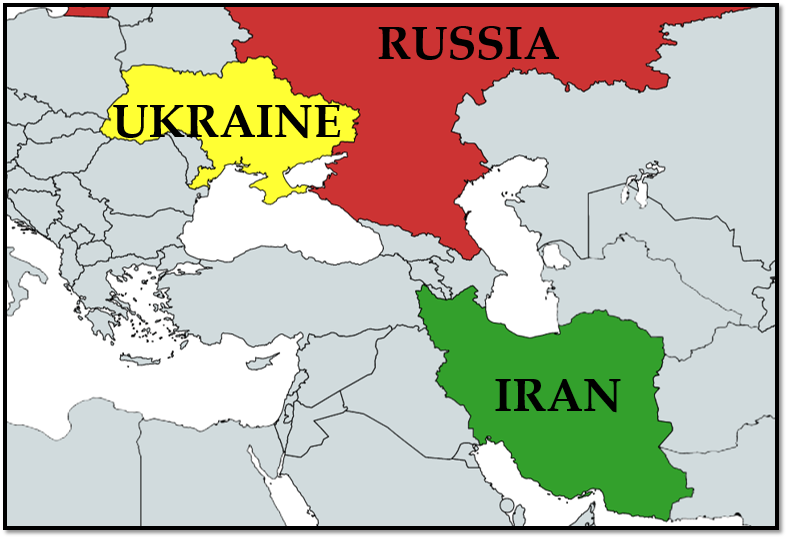
 The U.S. government spent more money attacking Iran in the first two weeks than it did on military aid to Ukraine over four years.
The United States is estimated to have spent $100 billion bombing Iran in the war’s first two weeks. Over the first four years of Russia’s full-scale invasion, Ukraine received $70 billion in U.S. military aid.
Incidentally, ninety percent of that $70 billion in aid was spent within the United States, paying for U.S. factories and workers to produce weapons that were either shipped to Ukraine or used to replenish stocks of U.S. weapons the Pentagon sent to Ukraine.
An additional $59 billion in military aid to Ukraine remains technically in the pipeline from five congressional appropriations under the Biden administration between 2022 and 2024. But the Trump administration has cut military aid deliveries to Ukraine by 99 percent since taking office.
The U.S. war on Iran hurts Ukraine and helps Russia in three ways.
- Military resources that could have aided Ukraine’s self-defense are being diverted to the war against Iran.
- Surging oil and gas prices are refilling the coffers of Russia’s war machine.
- International solidarity with Ukraine is being countered by a Kremlin geopolitical narrative that portrays Ukraine as supporting the U.S.-Israeli war on Iran.
Ukraine President Volodymyr Zelensky knows the war on Iran is not good for his country. He told Axios on March 30, “I am sure Russia wants [a] long war. They have benefits: The U.S. is focusing on the Middle East and may decrease military help to Ukraine. Sanctions are partially lifted. I see only benefits for Russia from the war with Iran continuing.”
Military Aid Diverted from Ukraine to the Middle East
The world supply of Patriot interceptor missiles that Ukraine desperately needs to shoot down incoming Russian missiles is being rapidly depleted in the Iran war. The United States, Israel, and the Gulf States fired off 800 Patriot missiles in the first three days of the Iran war. The United States produces only 750 a year. Ukraine has received only 600 over four years.
Ukraine’s air defense needs are immense. Ukraine’s military command reported in August 2025 that since its full-scale invasion started in February 2022, Russia had fired at Ukraine more than 9,600 ballistic and cruise missiles, nearly 5,200 of which were targeted at civilians and civilian infrastructure— residential buildings, hospitals, schools, power plants, transportation, and other non-military infrastructure. Over the same period, Russia hit Ukraine with nearly 14,000 kamikaze drones and 33,000 precision-guided glide bombs fired from long distance by aircraft over Russian territory. The numbers of Russian air strikes have increased at an accelerating rate over the last two years.
Military morons that they are, President Trump, Secretary of Defense Pete Hegseth, and their minions are overspending their military budget and depleting their stocks of weapons, particularly air defense missiles and precision-guided offensive munitions. They have been firing high-priced interceptor missiles — $4 million Patriots and $13 million THAADs — to shoot down cheap $20,000-$50,000 Iranian Shahed drones when much cheaper $1,000-$2,500 Ukrainian interceptor drones could do the job.
The Trump administration is asking Congress for another $200 billion supplemental appropriation for the war on Iran. On top of that, Trump is asking Congress to increase military spending by 40 percent in fiscal year 2027 to $1.5 trillion. Nothing in these proposed appropriations is for Ukraine.
The Ukrainians have developed the world’s most effective system for defending against the thousands of Iranian Shahed drones and their licensed Russian jet-powered upgrades called Gerans that have been fired at Ukraine over the last four years. This system is multi-faceted and multi-layered, with sophisticated radar detection networks, electronic warfare, command-and-control software, interceptor drones, and experienced battlefield operators who have used the system under constant attack, along with ground-level machine gun batteries for close-range low-altitude defense.
Ukraine offered to send its interceptor drones and know-how to the United States last August in exchange for more Patriot air defense missiles in a power point presentation inside the White House. Washington rejected the proposal. Ten days into the Iraq war, the United States turned around and asked for Ukraine’s help countering Iranian drones. But then a few days later, Trump, the vain fool that he is, told Fox News on March 14, “No, we don’t need [Ukraine’s] help in drone defense. We know more about drones than anybody. We have the best drones in the world, actually.” Later that day, he told NBC News, “The last person we need help from is Zelensky.”
Meanwhile, Gulf States are signing 10-year deals with Ukraine for interceptor drone systems, maritime drones to defend the Strait of Hormuz, and the expertise to use them in exchange for Patriot interceptor missiles, fossil fuels, and joint production and investments in Ukraine. With Washington showing itself to be inept and unreliable for its traditional allies in Europe and the Middle East, Gulf States are turning to Ukraine and Ukraine to the Gulf States for more reliable allies.
That no doubt irritates the hell out of Trump whose animosity toward Ukraine and Zelensky in particular has been displayed many times since Trump first ran for president. That may explain why Trump insulted Saudi Crown Prince Mohammed bin Salman (MbS) in Miami on March 28 in front of a room full of 1,500 elite Saudis, wealthy international investors, and sovereign wealth fund managers. Trump said because of the restoration of U.S. power under his reign, “[MbS] didn’t think he would be kissing my ass. He really didn’t. And now he has to be nice to me. You tell him he’d better be nice to me. He’s got to be.”
Trump did not help himself with these insults in keeping the Saudis and other Gulf States in his corner. They are furious at Trump for thoughtlessly not anticipating that his war on Iran would bring the Gulf States under Iranian bombardment and close the Strait of Hormuz, the pathway for their oil and gas to get to market.
What U.S. Military Aid to Ukraine?
One of the unintended consequences for Trump in starting the war on Iran may help Ukraine. With the drone defense deals with Gulf States, Ukraine may have acquired new extremely wealthy allies in the Middle East whose fuels and investments could replace the help Ukraine no longer gets from the Washington, as miserly and slow as that aid has been. These new allies reduce the leverage the Trump administration has had over Ukraine in negotiations where it has threatened to eliminate all support for Ukraine unless it capitulates to Russia’s demands for more Ukrainian territory, limits to size of Ukraine’s military, and no security guarantees from international allies.
The Trump administration is planning to divert weapons already bought and in the pipeline for delivery to Ukraine and redirect them to the war on Iran and replenishing the Pentagon’s depleted stocks. The United States no longer supplies military aid directly to Ukraine, but the Trump administration has agreed to sell weapons to European nations who then pass them on to Ukraine through a program called Prioritized Ukraine Requirements List (PURL). Now Trump may delay these shipments to Ukraine, divert them permanently even though they have been paid for, or kill the PURL program completely.
This is not the first time weapons intended for Ukraine were diverted to a war in the Middle East. In October 2023, when Ukrainian artillery was being outshelled by Russian artillery by a 10 to 1 margin, the Biden administration diverted tens of thousands of 155 mm artillery shells intended for Ukraine to Israel for its ground invasion of Gaza.
During the Obama, the first Trump, and the Biden administrations, Washington was slow to provide Ukraine with the weapons it requested in the quantities they needed. Biden’s policy of “escalation management” since 2022 has been seen by many analysts in the United States, Europe, and Ukraine as “giving Ukraine enough military aid to survive, but not enough to win,” as a Newsweek analysis reported. “[Washington] fears that a strategic Kremlin defeat in Ukraine could prompt chaos within Russian borders, perhaps the unseating of President Vladimir Putin, and a vicious regional struggle to fill a power vacuum littered with weapons of mass destruction.”
The reluctance to aid Ukraine goes back to the initial Russian invasion of Ukraine in 2014. The Obama/Biden administration refused to send weapons to Ukraine after Russian forces intervened to support pro-Russian coups in Crimea, Donetsk, and Luhansk and attempted coups in Kharkiv, Zaporizhzhia, Kherson, Mykolaiv, and Odesa oblasts. Obama would justify this policy with a classical imperialist spheres-of-influence rationale: “Putin acted in Ukraine in response to a client state that was about to slip out of his grasp….The fact is that Ukraine, which is a non-NATO country, is going to be vulnerable to military domination by Russia no matter what we do.” In 2019, Trump was impeached for a protection racket kind of attempt at extorting Zelensky for dirt on Biden before he would release a congressionally-mandated weapons package to Ukraine featuring shoulder-fired Javelin anti-tank missiles.
In the months leading up to Russia’s full-scale invasion in 2022, as Russian troops amassed on Ukraine’s borders, the Biden administration only provided body bags and light arms. Biden’s team anticipated a quick successful regime change operation by Russia. So it provided supplies suitable for a post-coup guerrilla resistance by Ukrainians. But popular outrage at Russia’s invasion compelled the Washington to provide heavier arms, especially after Ukraine defied both Putin’s and Biden’s expectations by defeating the Russian attack on the capital of Kyiv and stopping and substantially reversing Russian advances elsewhere. However, Biden repeatedly resisted for months or years before finally relenting on providing the advanced weapons systems requested by Ukraine, including Patriot air defense systems, Bradley infantry fighting vehicles, Abrams battle tanks, HIMARS rocket artillery, ATACMS rockets, and F-16 fighter jets. Even after finally agreeing to provide these systems. the United States was slow on delivering them. Many Ukrainian and European officials say these weapons arrived “too little too late” to enable Ukraine to defeat the Russian army in Ukraine.
While Ukraine received $79 billion in U.S. military aid in the three years from 2022 to 2024 and virtually none in 2025, Israel has received up to $34 billion for two years of its military operations between October 2023 and October 2025 against Gaza, Iran, Syria, and Lebanon. $22 billion was direct provision of U.S. weapons. Another up to $12 billion was spent supporting Israel with air strikes on the Houthis in Yemen and Iranian nuclear facilities in June 2025.
Rising Oil and Gas Prices Bail Out Russia’s War Machine
Oil and gas revenues have funded 30 to 50 percent of Russia’s national budget over the last decade. Russia is spending about 40 percent of its national budget on its military. Thus it is clear that oil and gas revenues have been funding Russia’s war on Ukraine.
In 2025, however, Russia’s oil and gas revenues dropped by 24 percent from 2024 due to low oil prices, partial international sanctions, and Ukraine’s increasingly effective “kinetic sanctions” of drone and missile strikes on Russian oil refineries, pipelines, storage tanks, depots, ports, and tankers. The decline in oil and gas revenues for the Russian petro-state accelerated as 2025 moved into 2026, with oil and gas revenues down by about 50 percent in December, January, and February year-on-year. Russia went into 2026 with a fiscal crisis in a stressed economy that jeopardized funding for its military budget. Russia’s declining oil and gas revenues combined with already deep deficit spending, inflation, and a fast-depleting sovereign wealth fund was making it harder to fund its war on Ukraine.
But since the February 28 launch of the war on Iran, oil and gas prices and Russia state revenues surged in March. They are estimated to rise to $12.8 billion in April from $5.35 billion in February. The windfall in revenues for Russia could be as much as $252 billion in 2026, far more than its $162 billion military budget for 2026, which is four times larger than it was in 2021 before its full-scale invasion of Ukraine. Russia just reversed its planned 10 percent budget cuts for 2026. Funding may not be a restraint on Russia’s war against Ukraine if the Iran war is drawn out. In an impotent attempt to lower oil prices after his war on Iran started, Trump dropped sanctions on shadow tankers at sea carrying Russian oil, making it easier for Russia to get its oil to market.
In response, Ukraine has stepped up its “kinetic sanctions” on Russia fossil fuel export revenues. On the night of March 25, long-range Ukrainian kamikaze drones struck Russia’s two major oil exporting ports on the Baltic Sea, incapacitating at least 40% of Russia’s oil export capacity.
Russia’s oil revenues from come from taxes on extraction, not oil sales. “Kinetic sanctions” on Russia’s oil export capacity immediately affects companies that ship and sell the oil, but their reduction of Russian state revenues will likely take longer to develop. To the extent Russia cannot get its oil to market, drilling may be reduced because Russia’s oil storage capacity is limited and also under Ukrainian attack.
Another factor affecting Russian oil and gas revenues is whether Western governments and energy companies use the high fossil fuel prices as an excuse to ease sanctions on Russian fossil fuels, which many of them have wanted to do all along. The European Union has spent more on fossil fuel imports from Russia than it has given in aid to Ukraine since Russia’s full-scale invasion began.
Geopolitics vs. International Solidarity
For Ukraine, Iran is an enemy aggressor that participates in Russia’s invasion. Iran provided Shahed drones to Russia and sent Islamic Revolutionary Guard Force specialists to the front lines in the southern and eastern Russian-occupied Ukrainian territories, where they participated in targeting and controlling the flight paths of drones aimed at Ukraine in the course of training Russians how to use them. It is therefore not surprising that Ukraine has agreed to provide the anti-drone systems that it has developed against Iranian drones to several Gulf States and offered them to the United States.
Sending anti-drone defense systems to the Gulf is not Ukraine’s first military action against Russia and its allies outside of Ukraine. Ukraine has already been fighting a shadow war in Africa against Russia’s mercenary Africa Corps, the nationalized and rebranded Wagner Group, the state-funded private military company that was notorious for its white-supremacist neo-Nazi leaders and units. Ukrainian special forces have fought Wagner Group/Africa Corps in Libya, Sudan, and Mali.
Russia and its defenders have jumped on these Gulf State drone deals to portray Ukraine as part of the U.S./Israeli war of aggression even though Ukraine is only providing defensive systems against Iranian drones, not supporting offensive operations against Iran. Nonetheless, the war on Iran has become a new war front for both Russia and Ukraine in their conflict using both military means and propaganda narratives.
This situation makes it difficult for Ukraine to appeal for solidarity from those who are horrified by the U.S.-backed Israeli war of genocide against Gaza, land seizures in the West Bank, Syria, and Lebanon, and the war on Iran. Despite themselves being the victims of aggression, despite their intervention in the Middle East providing only defensive systems, Ukraine finds it difficult to distinguish its values and objectives from those of the United States and Israel in this war. Ukrainian leaders are walking a tightrope diplomatically, trying not to alienate U.S. and Western support on the one side and, on the other side, appealing for the solidarity it would hope to get from the Global South that has been the victim of centuries of Western imperialism just as Ukraine has been the victim of centuries of Russian imperialism.
Trump has used the Iran war to put forward his own anti-Ukraine threats. On April 1, he demanded that European countries intervene militarily to open up the Strait of Hormuz or else he would stop selling the weapons that Europe is buying for Ukraine.
Those of us who are consistent anti-imperialists and socialist internationalists should listen to and support the popular movements and progressive forces on the ground in these conflicts. Geopolitical analyses of state interests that rationalize support for one bloc of capitalist states against another will not end imperialist wars. We should not pick sides in inter-imperialist conflicts. We should side with peoples, not states.
To counter the pro-Russian propaganda narratives we should provide concrete analyses of complex conflicts and listen to what the progressive voices on the ground want in solidarity from us, from Ukraine to Palestine to Iran. This will not be easy when so many people in the anti-war movement settle for simple timeless formulas, like the enemy of my enemy (U.S./Western/Israeli imperialism) is necessarily my friend (the militarist fascists ruling imperial Russia, the clerical fascists ruling theocratic Iran).
That simple formula often yields the correct answer on who to oppose because U.S./Western/Israeli imperialism has been so vicious in the lifetimes of living generations, from Vietnam to Iraq to Gaza. But it does not give the correct answer in every case, such as Ukraine where U.S. military aid, as limited as it was under Obama and Biden and as absent as it is under Trump, was what the progressive democratic movements in Ukraine called for. The simple formula does not give the correct answer for Iran where we should oppose the U.S./Israeli war on Iran without supporting the brutally repressive Iranian government.
An important part of countering pro-Russia propaganda will be explaining that Ukraine is not allied with Israel on Palestine or Iran. Ukraine has consistently supported UN resolutions against Israel’s occupation of Palestinian territories since its independence. Ukraine first recognized Palestine as a sovereign state in February 1992 just two months after its own independence was confirmed in a December referendum that received 92 percent support. Although President Zelensky supported Israel’s right to self-defense in the immediate aftermath of the October 7, 2023 of the Hamas attack, his message changed as the Israeli invasion of Gaza proceeded and the massive slaughter and infrastructure annihilation was clearly not self-defense. On June 2, 2024 Zelensky declared, “Ukraine recognizes two states, both Israel and Palestine, and will do everything it can to convince Israel to stop, to end this conflict and prevent the suffering of civilians.” Israel, on the other hand, took a posture of neutrality on Russia’s war on Ukraine. It never provided military aid to Ukraine and did not grant legal residency to Ukrainian war refugees. On February 24, 2025, the third anniversary of Russia’s full-scale invasion, Israel joined Russia and Trump’s USA in voting no on a UN General Assembly resolution demanding that Russia stop its military operations in Ukraine and withdraw its forces back to Russia.
We should argue for a consistent anti-imperialism that opposes both Russia’s war on Ukraine and the U.S./Israeli war on Iran. We should call for a consistent socialist internationalism that supports progressive forces in Ukraine fighting both Russian aggression and the Western-backed neoliberal policies of the Ukrainian state and that supports progressive pro-democracy movements in Iran that oppose both the U.S./Israeli bombing of Iran and the oppressive government that rules over them.
Trump has been repeatedly threatening in recent weeks to do to Iran in mere days what Putin has been trying to do to Ukraine for years, and what Israel has been doing to Gaza and now Lebanon for more than two years. Targeting civilians and civilian infrastructure are indisputably war crimes. Trump has been threatening to destroy power plants, bridges, and even desalination plants that provide life-giving water to millions of Iranians who depend on them for drinking water and crop irrigation in an arid country. Putin has been hitting power plants that are essential in Ukraine for heating to survive the cold winters as well as bombing civilian residences, schools, hospitals, buses, and passenger trains. The only difference is that Trump has much more firepower at his disposal. Ukrainian air defenses have made it too risky for Russian jet bombers to rain death from the skies directly over Ukraine while Palestinians and Lebanese people have virtually no air defenses against Israel’s war crimes that are being committed with the full backing and criminal liability of the U.S. government.
Our job is to do all we can to stop Trump, Putin, and Netanyahu from continuing their war crime sprees while giving moral, political, and material support to the progressive democratic movements in every country under assault.