
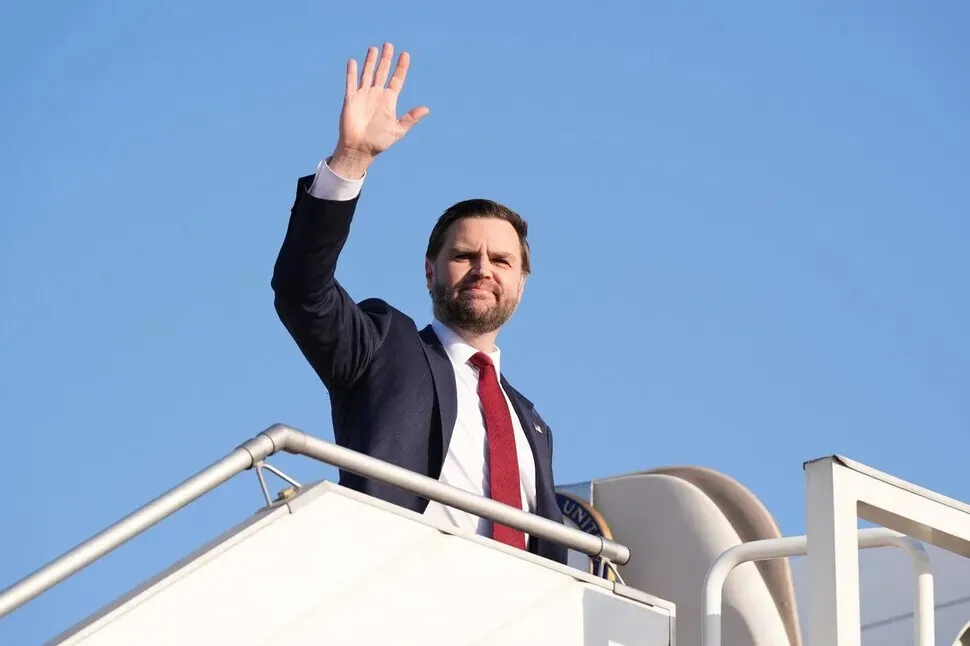
US Vice President JD Vance waves as he boards Air Force Two following negotiations with Iran in Islamabad, Pakistan, on April 12, 2026. (AFP/Yonhap)
In their first face-to-face ceasefire talks, senior officials from the US and Iran failed to narrow their differences over control of the Strait of Hormuz, the issue of Iran’s highly enriched uranium, and Iranian funds frozen overseas.
Esmail Baghaei, a spokesperson for Iran’s Ministry of Foreign Affairs, said that while the two sides had reached an understanding on several points, the talks had broken down because of a major disagreement on a few key issues.
“We need to see an affirmative commitment that they will not seek a nuclear weapon, and they will not seek the tools that would enable them to quickly achieve a nuclear weapon,” US Vice President JD Vance said while announcing the end of talks with Iran on Saturday, suggesting that Iran’s nuclear program was the main reason for the talks collapsing.
“Do we see a fundamental commitment of will for the Iranians not to develop a nuclear weapon not just now, not just two years from now but for the long term? We haven’t seen that yet,” Vance added, seeking to place more pressure on Tehran.
On Sunday The New York Times quoted two Iranian officials as saying that the US and Iran were in disagreement over Iran’s stockpile of 440 kilograms (970 pounds) of highly enriched uranium that is thought to be stored in Isfahan.
When Trump demanded that Iran hand over or sell the entire stockpile, Iran reportedly made a counteroffer, but the two sides could not reach an agreement.
Iran refuses to abandon its right to the peaceful use of nuclear power and to the enrichment of uranium for civilian purposes.
The issue of control of the Strait of Hormuz is another key stumbling block that has left the negotiations at an impasse.
While the US has demanded the immediate and total reopening of the key transportation route — through which roughly 20% of the world’s crude oil passes — Iran has reportedly maintained that such a reopening is out of the question before a final peace agreement can be reached between the two sides.
An Iranian source was quoted by the Tasnim news agency as insisting that the “situation in the Strait of Hormuz will not change until a common framework has been established.”
According to the Financial Times, the US attempted to bridge the differences by presenting a compromise plan for shared control over the strait, while Iran has rejected this and asserted its right to maintain complete control and impose costs for passage.
The New York Times reported that in addition to demanding compensation for losses due to the war, Tehran has also requested the release of around US$2.7 billion in oil revenue that is currently tied up in Iraq, Luxembourg, Bahrain, Japan, Qatar, Turkey and Germany. While Iran claimed that it would be using the funds for reconstruction, the US reportedly rejected the request.
The Iranian delegation’s leader, Iranian Speaker of the Parliament Mohammad Bagher Ghalibaf, posted in a message on X on Sunday that Iran “has good faith and commitment but no trust in the other party [the US] due to the experience of the two previous wars.”
“The Iranian delegation presented a forward-looking plan, but the other party failed to gain the delegation’s trust in this round of negotiations,” he declared.
Ghalibaf added, “The US may understand our logic and principles, but now it is time to decide whether they can gain our trust or not.”
Some observers said the negotiations may not have been entirely fruitless. While they did not produce any agreement that could immediately be signed, some raised the possibility that the two sides may have made meaningful strides in bridging the gap on certain issues.
Vance acknowledged the agreements to have failed but observed, “We’ve had a number of substantive discussions with the Iranians. That’s the good news.”
An Iranian source suggested that their delegation had shared explicit conditions, explaining that it had presented “reasonable initiatives” and agenda items in the negotiations.
Another notable outcome is the fact that the two sides both left the door open for follow-up negotiations rather than walking away completely.
The US left Iran with what Vance described as its “final and best offer.”
An Iranian source was quoted by Tasnim as leaving the possibility for additional communication, explaining that “the ball is now in the US’ court, and there is no need to rush.”
In a report, Al Jazeera emphasized the possibility of a “framework” having been formed for the next round of discussions as the two sides exchanged proposals, explaining that while the talks did not represent a breakthrough, they were not a breakdown either. In particular, it cited the robust state of the Pakistani mediation channel that arranged the encounter as a key sign that the hopes for a diplomatic resolution are still alive.
The New York Times commented that it would have been unreasonable for Vance to expect an agreement to be concluded in a single round of negotiations.
“The last major agreement between Tehran and Washington, reached during the Obama administration [in 2015], took two years to negotiate,” it observed.
The newspaper further predicted that the negotiations could end up becoming a very long process when the dispute over control over the Strait of Hormuz and the importance of the nuclear program to Iran’s national identity are taken into account.
By Kim Won-chul, Washington correspondent
Please direct questions or comments to [english@hani.co.kr]