
![[OC] 3 years of daily weigh-ins: I'm heaviest on Mondays, lightest in September, and my birthday shows up in the data.](https://www.byteseu.com/wp-content/uploads/2026/04/99seb3u0cwug1-1536x1229.png "[OC] 3 years of daily weigh-ins: I’m heaviest on Mondays, lightest in September, and my birthday shows up in the data.")
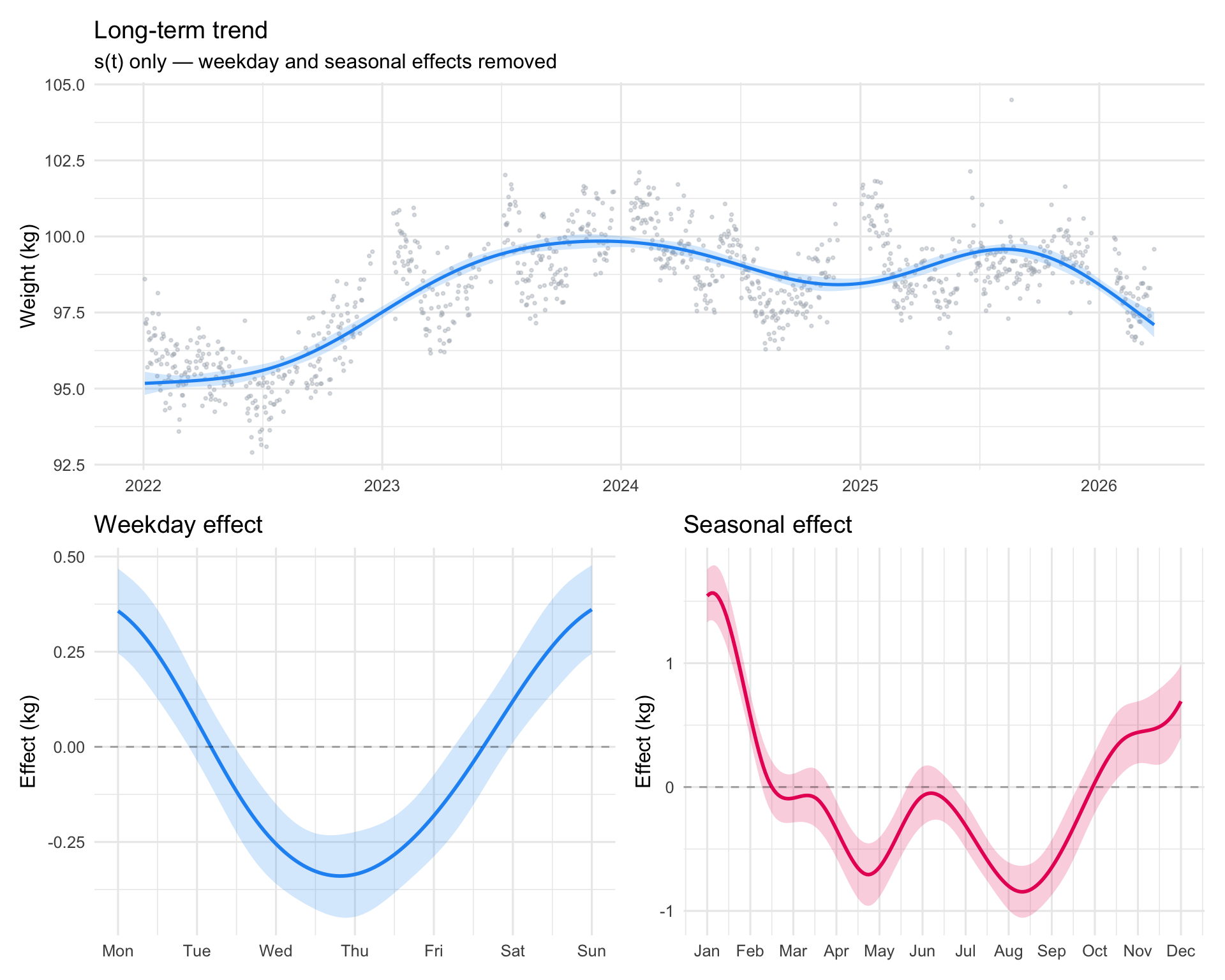
I weighed myself almost every morning for 3 years. Here's what's actually going on.
I'm heaviest on Mondays (weekend eating), lightest around Thursday, and the cycle repeats every single week like clockwork — about ±0.35 kg. Turns out this isn't just me: studies with thousands of people found the exact same pattern.
There's also a seasonal swing of about 3 kg. Heaviest in January (holidays), lightest in August–September. And if you look closely at the seasonal plot, there's a little bump in June. That's my birthday.
The long-term trend is its own story: gained about 5 kg over two years,now losing again. Not linear, more like a slow wave.
The fun part: after removing all of that, the leftover signal still has mysterious cycles at 70 and 113 days that I can't explain. Something is driving them but I have no idea what.
Method: GAMs on the irregular time series (31% of days are missing — no imputation), Lomb-Scargle periodograms to find the periods. Done in R. Full write-up with code if anyone's curious:
https://jbogomolovas2.github.io/Julius-s-Blog/posts/weight_fluctations/
Posted by rrytas
9 Comments
Great viz. If I were to guess, you’re drinking and/or eating out over the weekends, which shows up as water weight due to glycogen storage on Mondays.
If you’re showing weight fluctuations in a 2.5 kg range (5.5 pounds), that’s almost entirely dependent on when you weighed yourself in the day. Weight changes throughout the day could nullify virtually all of this research.
Timing in relation to eating or drinking beverages (including water), peeing, shitting, and sleep are significant factors affecting weight in the moment. It commonly varies as much as 3 pounds throughout a day and can be as much as 4 pounds. And there’s almost no way to control for all of these. Best case, you can always weight yourself right after waking and before excreting for *some degree* of consistency. But that will be affected by hours of sleep, length of sleep, peeing during the night, and time of eating the hours before bed and what was eaten. Those would all have to always be the same to get a reliable reading.
i would be wondering about 70 days as being hormonal
why no autoregressive term?
Exactly what this reddit is about. Your data is beautiful!
I weight in daily (or almost) for more than 1p years, but my data looks a lot more scattered than yours, which is has some smooth waves.
I often weight 0.5kg more in one day, then back to normal in the following day, which I believe mainly depends on how heavy dinner was.
Purely out of curiosity, not out of judgement: Did you write this post with AI? It feels very ChatGPT-esque and I’d be interested to know why
The holidays are always a pain to the waistline.
Tbh 70 and 113 could be just harmonics (or very close to it) of 365 days
How did you filter for long term, seasonal and weekly trends?
On first glance you seem to have gained weight all throughout 2023
Also also, could you share your script?
I got a bunch of data too and yours looks interesting