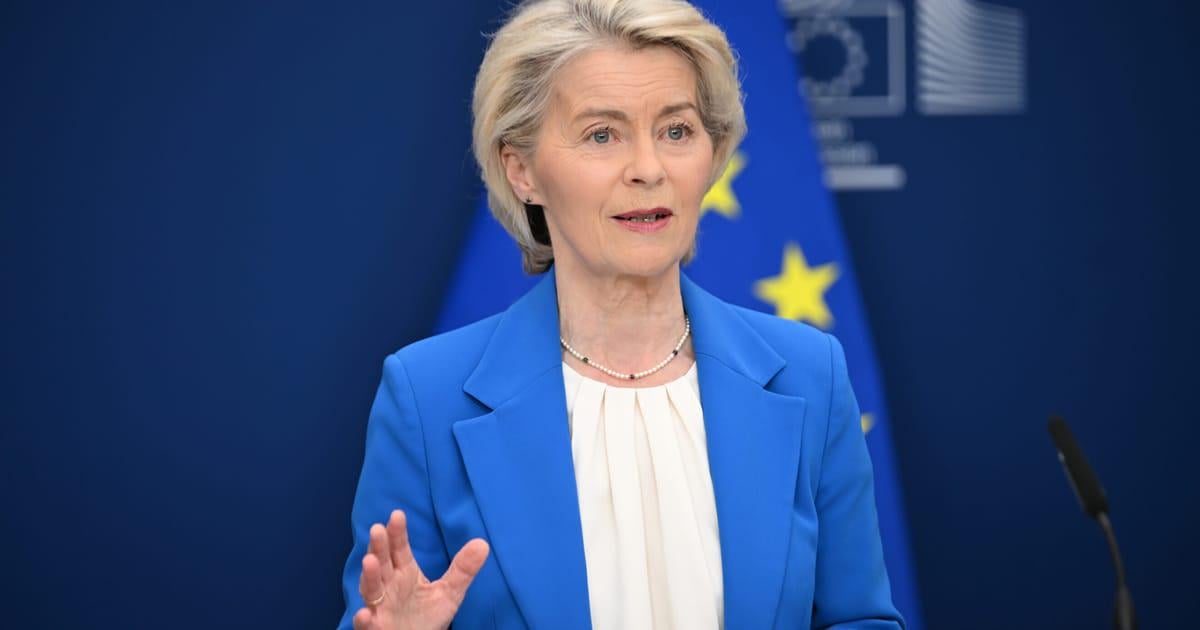
Von der Leyen uses Orbán defeat to push for end of veto in EU foreign policy
https://www.politico.eu/article/ursula-von-der-leyen-uses-hungary-viktor-orban-defeat-to-push-for-end-of-veto-in-eu-foreign-policy/
Posted by Forsaken-Medium-2436

Von der Leyen uses Orbán defeat to push for end of veto in EU foreign policy
https://www.politico.eu/article/ursula-von-der-leyen-uses-hungary-viktor-orban-defeat-to-push-for-end-of-veto-in-eu-foreign-policy/
Posted by Forsaken-Medium-2436
46 Comments
right on
im not sure many will agree with her on this
Not just foreign policy, the veto only creates troubles when there 27 different nations.
Qualified majority instead of VETO please! It’s the only way the EU and its member states can survive the upcoming turmoil!
>“Moving to qualified majority voting in foreign policy is an important way to avoid systemic blockages, as we have seen in the past,” she said. She urged governments, which would have to agree to any change, to “use the momentum now.”
Yes, we need this, now.
Before another Kremlin puppet can win control of another state and block it again.
They need 2 states to block a qualified majority change. Currently there is only FICO who could try to stop it.
THIS is THE moment to push the change through, so we are not held hostage by a Orban Hungary situation again
Veto is the main bureaucratic struggle of eu.
yeah this is the friction, veto was meant to protect states, but sometimes it just blocks the whole table. with 27 countries that brake more and more feels like damage instead of protection
PLEASE
Is this the qualified majority – 4 nays equal veto version?
Majority now ! I have enough of Putin’s puppet blocking everything.
This is a HUGE move toward removing the sovereignty of European nations. I hope they do not fall for it!
No; EU is a collection of sovereign states, majority cannot rule over any of them. We need consensus.
We absolutely need to get rid of the veto policy, a 2/3rd majority should be fine to decide on things. It’s the same principle for almost every democracy anyway.
Removing the Veto equals hollowing out member states individual power. I’m not a fan of this because this greatly favors the bigger nations and denies smaller nations of resistance. Cf. the Belgium Euroclear dossier.
We’re strong as a union but removing veto would bash against the reason why we’re a union. Through debate and discussion and extensive talks in the council we can achieve consensus on international matters. This removal would throw members under the bus and push something forward against a country’s will and create gaps. Trust gaps we can’t really afford in these times of uncertainty where we need cooperation and EU integration.
Qualified majority, in general, can be anything above simple majority but as currently practiced by the EU Council to adopt EU legislation, it means a “double-majority rule” of:
1. at least 55% of member states vote in favour = 15 of 27
*and*
2. those member states represent at least 65% of the total EU population
There are also cases where a “reinforced qualified majority” is required, which means:
1. at least 72% of member states vote in favour = 20 of 27
but retains 2. those member states represent at least 65% of the EU population
Also, under EU qualified majority rules, an abstention is considered an “against” vote.
[https://www.consilium.europa.eu/en/council-eu/how-does-the-council-vote/qualified-majority/](https://www.consilium.europa.eu/en/council-eu/how-does-the-council-vote/qualified-majority/)
They won’t get this. Not a chance Ireland, france etc will want it
What would that mean for things like chat control?
The EU has grown too big for any veto.
So unconditional support to Israel becomes the baseline?
How to make a railroad.,…
Veto won’t go away because smaller countries in the EU do not want to be at mercy from the bigger countries in the EU.
Veto would kill just as it killed commonwealth (PLC) in 18th century.
I 1000% agree on removal of the unilateral veto.
But just to play devils advocate – how will this avoid countries being able to say that the EU is controlling the without consent?
If every country besides Germany agrees to something, do we really think the everyday Germans will be okay because they know this imposition is better than allowing 1 country to hold up the entire legislative process? Just an example – I think you could replace almost any country with Germany.
This is ridiculous. Initially it was about Orban being the problem. Now that Orban is gone, it’s the right of EU member states to veto, enshrined in the EU rules. Orban was removed democratically, removing individuals veto powers of member states is the opposite. The whole idea was that agreement and participation shouldn’t be forced. Is that not the democratic norm that the EU wants to defend abroad?
When Bulgaria and Romania were not allowed in Schengen because one vote against there was not such a big tragedy compared to now, when funds can’t be given to Ukraine. That’s why I would like to keep the veto system.
No union can survive if a foreign power just needs to bribe one member.
So now that Spain started to Veto the idea of any attack on Iran suddendly the Veto is not a good thing no more.
Amazing
This would be great, althoguh probably with stricter conditions, at least maybe require the approval of 2/3 or 3/4 of all countries and of the total population, so that none of the regions (Northern, Western, Southern and Eastern Europe) can be left out.
However, I fear this will not be easy to push through, too many countries (such as French) have interest in maintaining the veto for selfish reasons.
Small countries will never agree to this even if they are currently pro eu.
So say we all.
4/5 would seem sensible to me. Enough that it’s not going to split the EU, but not so that a few rogue states can throw a tantrum whenever they want.
Veto should not be cancelled its very dangerous for the small nations and the e.u. cannot be trusted as they have fallen to the influence of cartels
When a politician says, “The problem is we need MORE powers.” One hesitates and considers, “Where have I heard that before?”
**Countries that have used (or strongly threatened) the veto**
* Hungary: Frequently used or threatened vetoes on Ukraine aid, sanctions, and EU budget issues under Viktor Orbán.
* Poland: Used veto threats on rule-of-law conditionality and climate policies to protect national interests.
* France: Blocked EU enlargement talks with North Macedonia and Albania in 2019 over reform concerns.
* Netherlands: Opposed budget and recovery fund terms, pushing for stricter fiscal conditions.
* Austria: Blocked Romania and Bulgaria from joining Schengen over migration concerns.
* Cyprus: Used veto leverage on Belarus sanctions to push for stronger action against Turkey.
* Greece: Long blocked North Macedonia’s EU/NATO path due to the name dispute.
* Italy: Threatened vetoes on migration burden-sharing and budget rules.
* Spain: Used veto leverage regarding Gibraltar in Brexit negotiations.
* Ireland: Used referendum veto power to initially reject treaties like Lisbon before concessions.
* Denmark: Opt-outs and referendum rejections (e.g., Maastricht) functioned as veto constraints.
* Sweden: Opposed euro adoption and has resisted deeper integration in some areas.
* Finland: Has taken hard lines in budget negotiations, aligning with “frugal” states.
* Belgium: Nearly blocked EU-Canada trade deal (CETA) due to Wallonia’s opposition.
* Germany: Has used strong blocking power in fiscal and bailout decisions to shape outcomes.
* Czech Republic: Delayed Lisbon Treaty ratification, effectively exercising a veto.
Another flood of posts full of “Yes please” just to prove how maga hiveminded this sub has become.
EU, former EEC, functioned well with veto powers since it’s creation, more than 50 years ago.
Sounds like y’all forgot about Brexit already.
Foreign Policy should not be a EU competency at all.
Lets get rid of one dictator so we can continue with another dictatorship 🤯
Leave to the EU to squander a historic opportunity
Hungarian here, please don’t drag us into this. There’s nothing wrong with veto at times but it shouldn’t be a default opinion.
🙌 yes 👏
Veto power has been weaponized by external rivals to undermine the union. That abomination has to be revised.
No veto and go for vote for majority!
Simply replace “100% agreement” with something like “80% of member states agree”. That is plenty to make sure that nothing truly unpopular passes while stopping one or two states deliberately sabotaging things.
The EU has likely about 1 week to do that before Rumen Radev a.k.a. Bulgarian Orban takes over. Elections here are next Sunday, so it’s likely that there is only a short window of opportunity.
I really do not understand veto power in the first place for the EU. Isn’t the absolute basics of democracy is that a majority or supermajority of votes should be able to make stuff happen? Even if they set the bar super high, like 80% acceptance, that would be still much better than 1 or 2 states just vetoing shit.