
On April 8, Prime Minister of Armenia Nikol Pashinyan welcomed the ceasefire announced between Iran and the United States, posting on X: “We also commend the mediation efforts, including those of Pakistan, and firmly believe that diplomacy should prevail to resolve all outstanding issues and preserve peace in the Middle East.”
On April 9, during an interview with News.am, Ambassador for the Islamic Republic of Iran to Armenia Khalil Shirgholami stated that “the fundamental position of our country is that there must be real guarantees that this aggression will not be repeated.” Speaking about the Iranian Armenian community, Shirgholami said, “The Armenian community in Iran also showed its solidarity and determination to defend the homeland, as it has always done throughout history.”
Meanwhile, sources from the United States Department of State told Armenpress that regardless of the current conflict with Iran, “The Trump administration remains committed to making TRIPP a reality. It will allow unimpeded international and domestic connectivity in the region, expanding opportunities for increased economic growth and prosperity.” Armenian Foreign Minister Ararat Mirzoyan, in turn, said that although the situation may not be favorable, Armenia and the United States are working on TRIPP.
Infrastructure, trade and economic dynamics
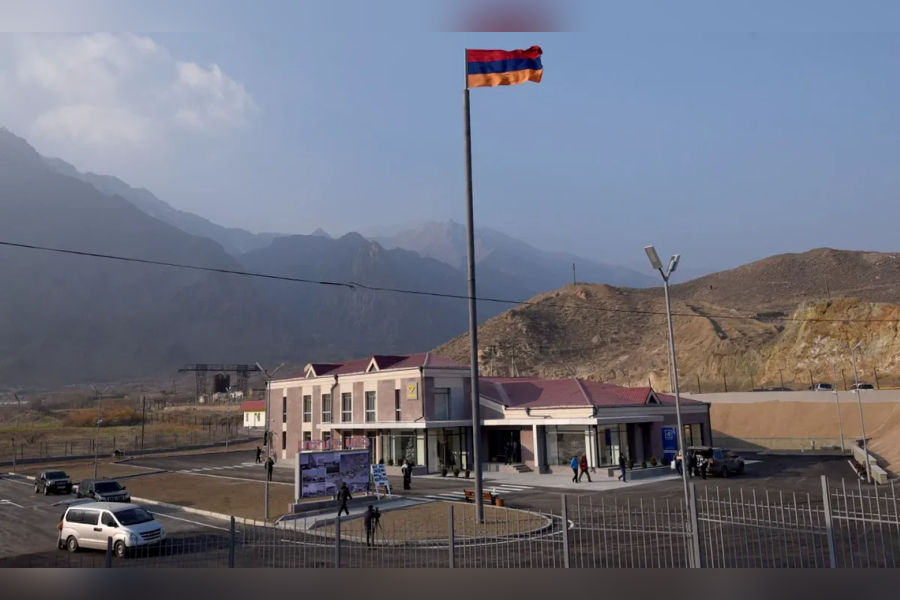
On April 8, Deputy Minister of Territorial Administration and Infrastructure Kristine Ghalechyan met with Khalil Shirgholami, Iran’s ambassador to Armenia, to discuss the importance of joint projects in infrastructure development and the construction of the Kajaran-Agarak road section near the Armenia-Iran border. Meanwhile, State Revenue Committee Chairman Eduard Hakobyan said that although transportation costs have increased due to the war in Iran, there is no substantial pressure on border or customs operations on the Armenian side.
However, the European Bank for Reconstruction and Development, recognizing the effects of the war in Iran on economies in the region, has decided to deploy 5 billion euros to directly affected countries — Iraq, Jordan, Lebanon, and the West Bank and Gaza Strip — as well as, to a lesser degree, affected countries — Egypt, Turkey, Armenia and Azerbaijan.

On April 9, following the Cabinet meeting, it was announced that a zero-percent customs tariff quota will be applied to certain goods imported from Iran, and the Ministry of Economy will be responsible for regulating this process, with a specific focus on agricultural goods.
A paper published by the Armenian Center for Socio-Economic Studies noted that continued disruptions to transport routes passing through Iran could negatively affect Armenia’s trade flows, given that 11% of Armenia’s total imports, worth $13 billion in 2025, and 6% of total exports, worth $8.4 billion, pass through the Armenia-Iran border via Meghri. Essential resources, such as 89.1% of iron bars, 88.4% of cement and 3,578 Chinese cars in 2025 alone, are also imported through the southern border. On April 11, Apa.az reported that 15 wagons totaling 887 tons of diesel fuel were sent from Azerbaijan to Armenia, adding to previously dispatched shipments totaling 6,312 tons of diesel, 979 tons of AI-92 gasoline and 2,955 tons of AI-95 gasoline.
Evacuations continue
On April 7, the Embassy of Russia in Armenia announced that another 175 Russian citizens, employees of the Bushehr Nuclear Power Plant, have left Iran and arrived in Armenia through the Nurduz-Agarak checkpoint. In total, the number of evacuated Russian citizens through Armenia has reached 509. The embassy added, “We express our deep gratitude to the authorities of the Republic of Armenia for their kind attitude and for the prompt organization of the entry of employees of the Rosatom state corporation.” Meanwhile, Minister of External Affairs of India Subrahmanyam Jaishankar thanked Armenia for its assistance in evacuating Indian nationals.
Black Wednesday and instability in Lebanon
On April 8, Lebanon faced one of its most difficult days as the Israeli Armed Forces carried out 160 strikes across multiple regions, targeting 100 locations in 10 minutes. This “Black Wednesday” caused at least 357 deaths and 1,223 wounded, while others remain missing or under the rubble, with many bodies still unidentified. Following the attack, the Lebanese government on April 9 declared a ban on nonstate weapons in Beirut; however, the likelihood of implementation and its mechanisms remain unclear. Naim Qassem, secretary-general of Hezbollah, urged the Lebanese government to refrain from making “free concessions” to Israel, rejecting any return to the status quo prior to the Iran war.
On April 10, hundreds of supporters of Hezbollah, the Amal Movement and the Syrian Social Nationalist Party staged a protest in Hamra, Beirut, against the decision of Lebanese authorities to engage in direct negotiations with Israel. As tensions rise domestically, Prime Minister Nawaf Salam canceled a scheduled trip to Washington, D.C., due to the unstable domestic situation, as Hezbollah supporters have begun referring to Salam as “the Zionist.”