
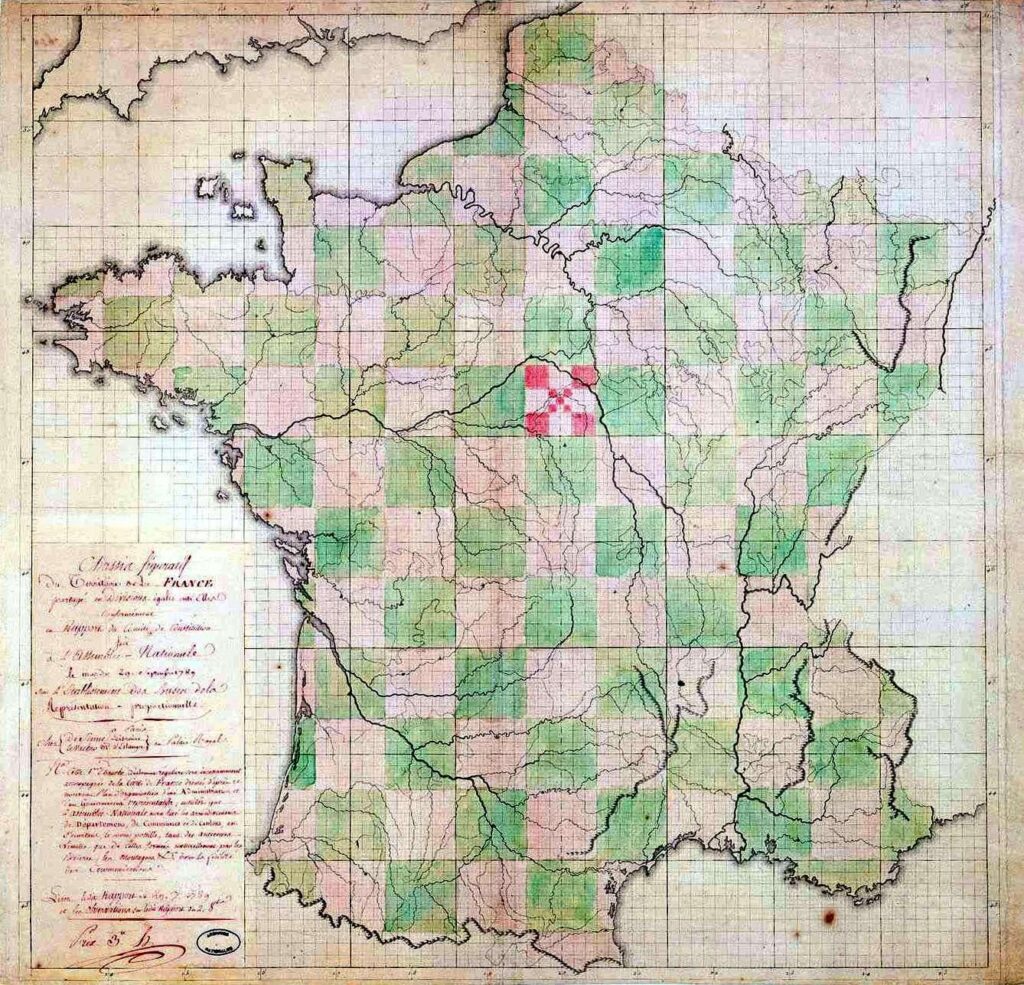
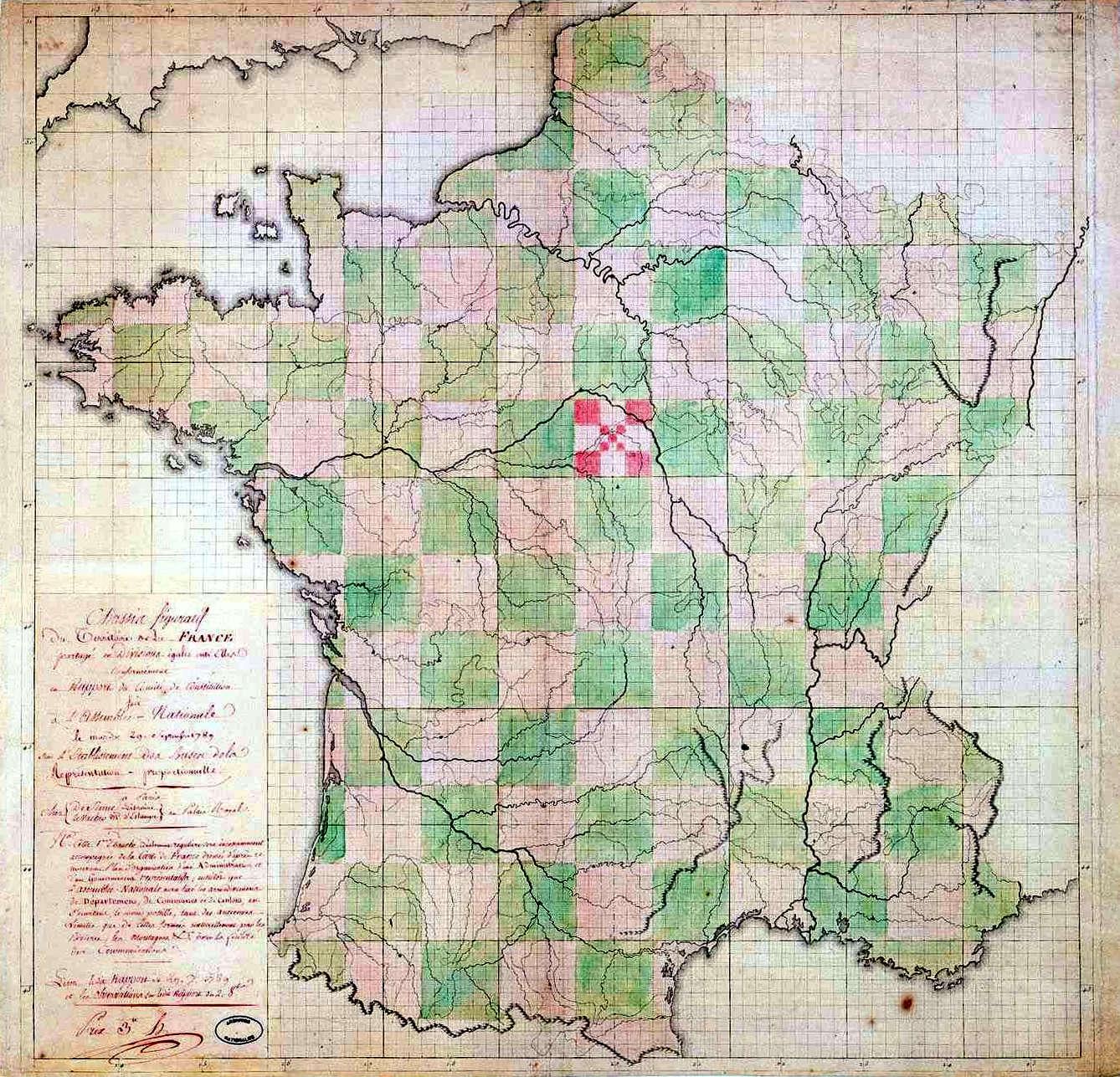
This proposed was made by Sieyès in 1790.
Revolutionaries were obsessed with standardization. Sometimes this went a tick too far.
France departments and region name were also changed during revolution from their historic names to being based more on geographic markers and random things to rid of nobility influence.
They also tried with a new calendar which was quickly abandoned.
Posted by Solid-Move-1411
33 Comments
as we all know the sun rises every 27.78 hours
I’d make a chess reference but then I’d sound like a monarchist
# Every 100 Seconds in France, a Minute Passes
Definition of over-cooking.
They were freestyling overthrowing an over 1000 year old world order so I’m willing to cut them some slack
What could possibly go *right?*
As a Croatian, that one square is rightfully ours. I demand it to be returned.
They later used the same method on Africa so I’m willing to argue they learned from this but in a bad way.
Metric time would be such a nice thing
“Decimal time was also introduced in France in 1793 with 100 seconds= 1 minute, 100 minutes=1 hour and 1 day=10 hour.”
Yet still, their 80 is 4*20. Right.
This is effectively how the US is subdivided below the state level.
This is also shortly before they created the Metric system.
the french revolution was basically just the enlightenment era version of “my source is that i made it up”… imagine trying to explain to a 1790s farmer that he now lives in square b4 and there are 100 minutes in an hour… no wonder they ended up with a guillotine… they were just tired of the math…
Ah yes, the autistic revolution
Let me guess, the calendar consisted of 10 day weeks, 10 week months and 10 month years?
also decimal weeks of ten days, three weeks a month, 360 days a year, 5 or 6 extra days for partying. also decimal angles instead of 360 based (which itself divisible by 12)
Finally a worthy opponent to the US borders
That’s quite understandable, at least the current system is a tad bit complicated.
France is a wet dream of the agrarian Bureaucracy.
Sometimes the right-wing agrarian bureaucrats rule, sometimes the left-wing agrarian bureaucrats, sometimes the centrist agrarian bureaucrats and sometimes even the military agrarian bureaucrats, but always the agrarian bureaucrats.
The amount of local government is absolutely incredible. Paris is divided into 20 arrondissements, which should not be confused with the 333 arrondissements into which the rest of France is divided. They are completely different things even though they have the same name. There are 13 provinces, 96 departments and 1996 cantons. Their responsibilities overlap with each other, and in some places something belongs to the department, in some places the same thing belongs to the arrondissement and in others it is the canton’s business.
In addition to these, there are of course 34,826 municipalities, each of which has its own local government, taxation and responsibilities, which of course overlap and cross over with the aforementioned parties. And to make things even easier, there are of course also 710 municipal associations in France. Most municipalities, but not all, also belong to associations of municipalities, of which there are 2585. These too all have their own local government.
In addition, Marseille is divided into 16 arrondissements and 8 sectors. These too, of course, all have their own local government.
Of course, the 15 overseas regions, but not Corsica, also have their own regional government, which may or may not be the same as in mainland France.
I don’t understand how the entire French population is enough for all those levels of government, including political representatives and civil servants.
They haven’t heard that hexagons are the bestagons.
I worked at a print shop where the time clock was on the 100 minute clock. At least what it put on your time card. The actual clock was not. One day someone put a hand written conversion so you could look at your time card and figure out easier what was 30 minutes later and what not. Owner ripped it down. He was friends with my dad through Rotary and said that it saved him money because people would clock out a few ‘minutes’ off and with rounding he saved a bit here or there. That he took that time and energy to figure it out and was gleeful sat wrong with my dad (and he felt it was against the rotarian creed). My dad made one up and printed it (this was the 90s) and made little wallet card laminated for me and my coworkers. Only rule was to keep it hidden from the boss.
Sometimes I still think about things like that and watch videos on the 60 minute hour and whatnot.
They should at least have gone with triangles.
The plan was actually carried out: departments were created on this base, but this map was just a working document. And the new calendar wasn’t abandoned so quickly: it’s only Napoleon that went back to the Gregorian calendar. (And the Republican calendar would actually be revived by the Paris Commune)
interestingly enough, a french second like this would be 0.864 normal seconds, very close
>100 seconds= 1 minute, 100 minutes=1 hour and 1 day=10 hour.

Isn’t the US a little bit like that?
Crazy how ambitious the revolution was and like a decade later they had a monarch again
Yup, this was the republican calendar, with 12 months of 30 days each.
(Vendémiaire – Brumaire – Frimaire for autumn)
(Nivôse – Pluviôse – Ventôse for Winter)
(Germinal – Floréal – Prairial for Spring)
(Messidor – Thermidor – Fructidor)
(5 “sansculottides” days or 6 on bissextile years to end the year)
Each month had 3 weeks (decades) of 10 days
Each day had 10 hours
Each hour had 100 minutes, and each monutes 100 seconds.
It was very square, and nice, but the 12-60 basis for day hours is far better.
In this calendar, we are today : “Quartidi 24 Germinal, year CCXXXIV (234)”
Chess
How else were you going to play Chess with a map of France?
My 11-year-old self’s first alternate map on MS Paint, but 219 years earlier.
This is why the Commune failed. Intellectual masturbation.
Those tiny departments right on the border in the alps and pyrenees having a combined population of 3
This was so war would better resemble chess matches.
“Infantry regiment to e4”
“Artillery to b7”