
It has been repeatedly shown through all kinds of studies that South Asia is one of the most vulnerable regions to climate change impacts. India, being the most populous and at a precarious low-medium human development stage, stands at the frontline of the climate crisis. We simultaneously face a multitude of climate change impacts – intensifying heatwaves, erratic monsoons, floods, droughts, and sea-level rise combined with more frequent and stronger cyclones. Yet, these impacts are not experienced equally. They intersect deeply with existing social inequalities and hierarchies — especially gender, caste, class, and geography —creating layered vulnerabilities.
In this context, gender justice is not merely a social concern; it is fundamental to achieving meaningful climate justice in India.
1. Gendered Climate Vulnerabilities in India :
In India, women are disproportionately dependent on direct access to natural resources for both their livelihoods and family care — whether through fetching drinking water, subsistence agriculture, maintaining livestock, low end fisheries, or collecting forest produce. According to multiple studies, a large share of rural women work in climate-sensitive sectors but lack ownership of land and tangible assets. This creates a paradox : high exposure to climate risk but low control over adaptation resources.
Heat Stress and Informal Labour :
India’s intensifying heatwaves —especially in regions like Rajasthan, Delhi, Telangana, and Odisha (now the entire Indi-Gangetic basic is seriously affected) — have severe implications for women in informal work. Women working in construction, brick kilns, domestic work, and agriculture often work longer hours in extreme heat, but
have limited access to cooling, hydration, or rest spaces.
They also face multiple health risks such as dehydration, heat exhaustion, and complications during pregnancy.
Unlike male workers, women’s heat exposure / stress is compounded by unpaid domestic labour — cooking, caregiving, and water collection — leading to a “double burden” of climate stress.
(b) Water Scarcity and Care Burdens
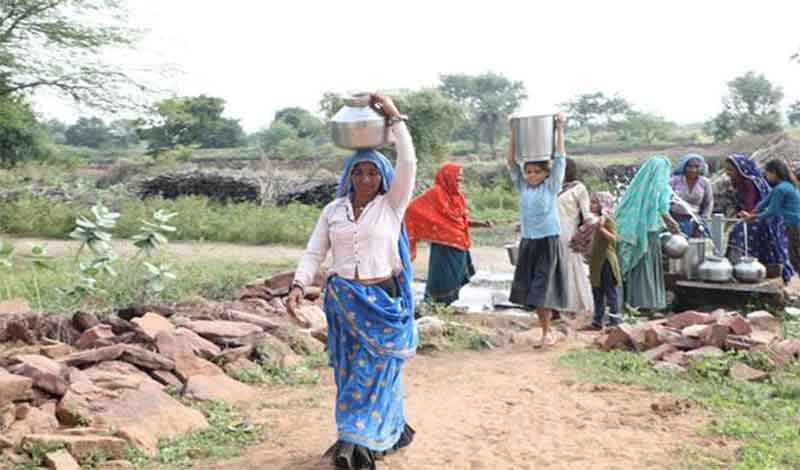
Water scarcity, intensified by erratic rainfall and groundwater depletion —disproportionately affects women and girls. Women also spend hours collecting water, sometimes walking long distances as nearby sources dry up.
Girls frequently drop out of school to assist with water and fuel wood collection.
Physical strain and safety risks increase, particularly in remote areas.
States like Maharashtra (Marathwada), Bundelkhand (UP–MP), and parts of Rajasthan regularly experience such gendered water crises.
(c) Floods, Disasters, and Displacement :
Floods in Assam and Bihar, cyclones in Odisha and West Bengal, and sea-level rise in the Sundarbans, Kerela, Odisha… have distinct gender impacts :
Women face greater risks in evacuation due to mobility restrictions and caregiving roles.
Relief camps often lack gender-sensitive facilities (sanitation, privacy, menstrual hygiene)….
Increased vulnerability to gender-based violence in temporary shelters is another widespread occurence.
In the Sundarbans, climate-induced migration has led to feminization of poverty, with men migrating out and women left to manage households under worsening ecological conditions.
2. Intersectionality: Gender, Caste, and Marginalisation :
In India, gender intersects strongly with caste and tribal identity : Dalit women often face exclusion from common water sources and relief distribution.
Adivasi women depend heavily on forests, which are increasingly degraded due to climate change and extractive development and State-sponsored corporate takeovers.
Urban poor women in informal settlements experience extreme heat due to urban heat island effects and lack of green spaces in their vicinities.
For example, in cities like Delhi and Ahmedabad, low-income women living in slums face both heat stress and lack of access to cooling infrastructure.
This layered inequality means climate policies must go beyond “women” as a category and address structural marginalisation.
3. Women as Leaders in Climate Action :
Despite constraints, women across India are at the forefront of climate resilience :
Self-Help Groups (SHGs), Women-led collectives have promoted the right kinds of self-controlled microfinance, have experimented with and adopted drought-resilient crops and seed sovereignty (Deccan Development Society, ….) , and livelihood diversification.
Community forestry : Women in states like Uttarakhand, Maharashtra (Mendha Lekha being a pioneer) and Odisha play key roles in forest conservation.
Water management : Local women’s groups manage traditional / community managed water harvesting structures and distribution in several States.
The legacy of grassroots movements like the Chipko Movement demonstrates how women have long been environmental defenders.
At the policy level, global institutions such as UN Women and the Intergovernmental Panel on Climate Change emphasize that women’s participation improves climate outcomes, though our country policies are yet to translate these into actionable plans. One of the contributing factors for this is that, in India, women remain underrepresented in formal climate governance and decision making positions.
4. Climate Change, Health, and Violence :
Climate change amplifies gendered health risks. Heatwaves increase risks for pregnant women and those in physically demanding labour.
Water scarcity leads to poor sanitation and disease burdens.
Almost country-wide (but more severe in cities) Air pollution— linked with climate change through fossil fuel burning — affects women’s respiratory health, especially those using biomass fuels.
Climate stress also correlates with rising gender-based violence.
Displacement and economic insecurity, increased domestic violence risks etc are another set of (indirect) impacts.
Unsafe public spaces during climate disruptions, heighten harassment risks.
These impacts remain underreported due to lack of gender-sensitive/ disaggregated data.
5. Policy Landscape in India : Progress and Gaps
India has made some progress in integrating gender into climate policy :
National Action Plan on Climate Change (NAPCC) acknowledges vulnerable groups.
Some State Action Plans (e.g., Kerala, Maharashtra) include gender considerations.
Programs like National Rural Livelihood Mission (NRLM) indirectly support women’s resilience.
However, major gaps persist : like the lack of gender-disaggregated climate data.
Limited funding for gender-responsive adaptation,
Tokenistic inclusion without structural change,
Poor integration of unpaid care work into economic and climate planning are major gap areas.
6. Why Gender Justice is Essential to Climate Justice in India (and the world) :
A. Addressing Structural Inequality :
Climate change magnifies pre-existing inequalities. Without tackling gender disparities in land rights, wages, and access to resources, adaptation efforts will remain unjust.
B. Enhancing Effectiveness of Climate Action :
Women’s local knowledge — on seeds, water, forests….. is critical for designing context-specific adaptation strategies.
C. Building Community Resilience :
Empowered women contribute to stronger households and communities, improving resilience to climate shocks.
D. Enabling Transformational Change :
Climate justice requires systemic change. Gender justice challenges patriarchal systems that drive both environmental degradation and social inequity.
Conclusion :
In India, the climate crisis is as much a social crisis as it is an environmental one. Gender shapes who is most affected, who adapts, and who decides. Women — especially those from marginalized communities, bear disproportionate burdens while also holding key knowledge and leadership potential.
A climate response that ignores gender will fail — not only ethically, but practically. Gender justice is therefore indispensable to climate justice. It ensures that climate action is equitable, inclusive, and transformative —capable of addressing both ecological sustainability and social justice.
Get the latest CounterCurrents updates delivered straight to your inbox.
Soumya Dutta is a climate activist associated with NACEJ/NAPM, MAUSAM.
Selected References :
Intergovernmental Panel on Climate Change (2022). AR6 Working Group II Report.
UN Women (2020). Gender, Climate Change and Disaster Risk Reduction.
Ministry of Environment, Forest and Climate Change (2014). National Action Plan on Climate Change.
World Bank (2021). Climate Change Gender Dimensions Report.
Agarwal, Bina (2010). Gender and Green Governance.
Krishnan, L., et al. (2020). Heat Stress and Women Workers in India.
SEWA reports on women and climate resilience.