
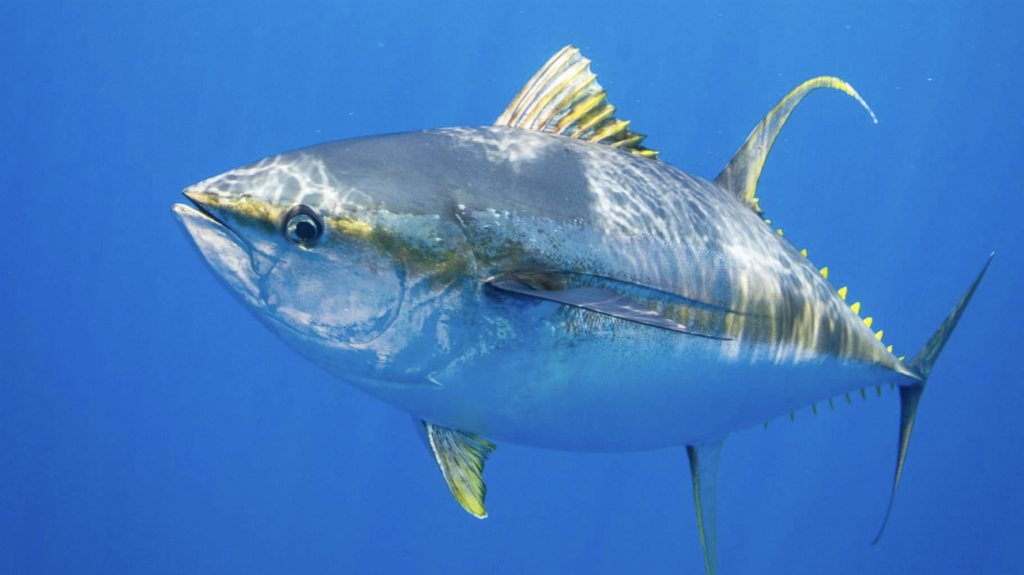
New research from scientists in China and the US has found that climate variability is a key driver of changes in yellowfin tuna productivity in the western and central Pacific Ocean, raising implications for one of the world’s most valuable fisheries.
The study, titled “Climate-driven variation in yellowfin tuna productivity in the western and central Pacific Ocean Inferred from a state-space model,” was led by Xiaodong Li, Zhe Geng, Jie Cao, Jizhang Zhu, and Jiangfeng Zhu from Shanghai Ocean University and collaborators at North Carolina State University.
The team used a state-space surplus production model to track how tuna populations and fishing pressure change over time, while allowing productivity to vary with environmental conditions.
They found that yellowfin tuna productivity shows clear changes over time and is closely linked to two key environmental factors: the Pacific decadal oscillation (PDO), a long-term climate pattern in the North Pacific, and mixed layer thickness, which reflects how the upper ocean is structured.
Both factors were positively associated with tuna productivity, suggesting that certain climate conditions support higher tuna growth and reproduction in the region.
The results suggest that tuna stocks in the Pacific are not driven solely by fishing, but also by large-scale climate patterns that shift ocean conditions over time.
The western and central Pacific tuna fishery is worth billions of dollars and supports major fishing fleets and coastal economies. The authors say that adding climate indicators, such as the PDO, to fisheries management could improve stock assessments and help set more accurate catch limits as ocean conditions change.