
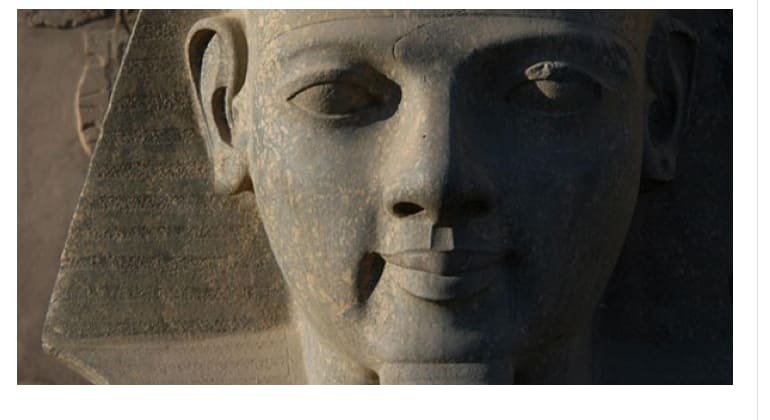
A 3,300-year-old cartouche containing the name of Pharaoh Ramses II has been discovered at Luxor, Egypt, by a group of South Korean scholars, making a significant historical discovery. The hieroglyphic writing, which was the first of its kind to be unearthed in this particular section of the ancient ruins, was discovered at the base of the first pylon of the Ramesseum Temple.
The discovery emphasises the expanding international cooperation in Egyptian archaeology and offers crucial new evidence for dating the mortuary temple’s construction phases. An excavation team from the Korea National University of Cultural Heritage, which is part of the Korea Heritage Service (KHS), made the discovery.
At the Ramesseum, a massive funerary temple constructed by Ramses II (reigned 1279–1213 BC) on the west bank of the Nile, the crew has been painstakingly surveying the northern portion of the collapsed first pylon since June 2025. The KHS claims that the cartouche, an oval frame with royal hieroglyphs that stand for eternal protection, was discovered engraved on the pylon’s foundation stones.
Initial Findings at the Pylon Gate
This latest discovery at the entrance gate is exceptional, even though a French archaeological team had previously found a Ramses II cartouche in the temple’s innermost sanctuary. “The shape of the cartouche and the pharaoh’s name are significant historical criteria for determining the exact era of the ruins, making this discovery historically valuable,” a KHS official said [2]. Additionally, the team discovered an architectural feature bearing an unidentified town name that may provide new information about Egypt’s territorial expansion during the lengthy and successful rule of Ramses II.
Reborn Temple: Repair and Instruction
In order to commemorate Ramses II’s accomplishments and provide a space for his posthumous worship, the Ramesseum was built. The enormous front pillar of the magnificent building collapsed centuries ago, leaving just fragments of it standing today.
The Korean team’s efforts are a component of a larger Official Development Assistance (ODA) project that was started following an agreement between South Korea and Egypt in 2022. For the first time at a conservation site in Egypt, the experts are erecting a temporary scaffold shelter over the site to help with the delicate repair work.
Korea’s Expanding Contribution to the Preservation of Global Heritage
In addition to restoring the fallen pylon, this initiative will teach Egyptian employees sophisticated archaeological methods including 3D scanning and architectural measurement. Since 2013, South Korea has carried out comparable ODA heritage projects at locations like Machu Picchu in Peru and Angkor Wat in Cambodia. Historians believe that the Ramesseum may provide even more details about the lives and times of one of the most influential monarchs of ancient Egypt as restoration work continues.
Ramesses II, Ramesses the Great: His Life and Death
Ramesses II, often known as Ramesses the Great, was undoubtedly one of the greatest and most famous pharaohs in ancient Egypt. After his father, Seti I, died in 1279 BC, Ramesses II, the third pharaoh of the 19th Dynasty, took the throne of Egypt in his late teens.
Although he is thought to have fathered more than 100 children, he is known to have ruled ancient Egypt for a total of 66 years, outliving many of his sons in the process. Ramesses II’s lengthy and wealthy reign allowed him to construct monuments to the gods and, of course, himself, as well as launch multiple military wars against adjacent territories.
The Battle of Kadesh was one of Ramesses II’s triumphs. The Hittites under Muwatalli and the Egyptians under Ramesses II engaged in combat for control of Syria. The Amurru’s defection from the Hittites to Egypt was the reason for the conflict, which occurred in the spring of Ramesses II’s fifth year.
The Hittites made an effort to reintegrate the Amurru into their area of influence as a result of this defection. Ramesses II chose to march his army north to defend his new vassal because he would have none of that.
Driving the Hittites, who have been causing problems for the Egyptians since the reign of Pharaoh Thutmose III, back outside their borders was another goal of the pharaoh’s battle against them.
According to the Egyptian narratives, Ramesses II had won a significant battle and they had vanquished the Hittites. The most well-known monument to this victory is located inside the Abu Simbel temple. The enormous pharaoh is depicted in this relief riding a chariot and defeating his Hittite adversaries.
In fact, this picture effectively captures the feeling of strength and victory that Ramesses II sought to attain. However, it appears from the Hittite narratives that Ramesses II overstated the Egyptian victory for propaganda purposes and that it was not so significant after all. Nonetheless, it is evident that following this conflict, power dynamics in the ancient Near East were drastically altered.
The Hittites were acknowledged as one of the superpowers in the area when they signed the first known peace pact with the Egyptians. Additionally, for the following seventy years or so, Egyptian-Hittite ties would be shaped by this contract.
Ramesses II had little influence over his bodily remains after his death, despite being one of the most powerful men on the planet during his lifetime. His mummified remains were first interred in tomb KV7 in the Valley of the Kings, but Egyptian priests moved it to a more secure location due to grave robbers’ theft.
The mummy of Ramesses II was saved from the robbers by these priests, but archaeologists now have it. Ramesses II’s mummy and the mummies of over fifty other kings and nobles were found in a hidden royal stash at Deir el-Bahri in 1881.
The hieroglyphics on the linen covering the pharaoh’s body, which described how the priests moved his mummy, were used to identify Ramesses II’s mummy. Ramesses II’s mummy began to deteriorate around a century after it was found, and archaeologists decided to airlift it to Paris for treatment of a fungal infection. It’s interesting to note that the pharaoh was given an Egyptian passport with the title “King (deceased)” on it. The famous pharaoh’s mummy is currently housed in Egypt’s Cairo Museum.